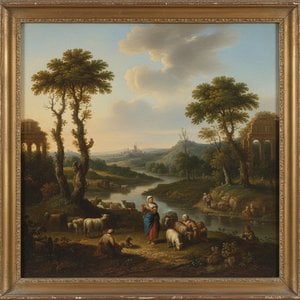
A Life Immersed in Light and Landscape
Karel Dujardin, a name resonating softly within the pantheon of Dutch Golden Age masters, was born in Amsterdam in 1626 – though some records suggest 1622. His life unfolded during a period of unprecedented artistic flourishing in the Netherlands, yet his path wasn’t one of immediate acclaim but rather a gradual unfolding of talent nurtured by careful study and extensive travel. Details surrounding his early years remain somewhat elusive, shrouded in the mists of time, however it is widely accepted that he received foundational training under Nicolaes Berchem, a painter celebrated for his idyllic landscapes populated with animals. This mentorship proved pivotal, instilling in Dujardin a deep appreciation for naturalism and a keen eye for capturing the subtle nuances of light and atmosphere. He diligently absorbed Berchem’s techniques—the masterful blending of colors, the precise rendering of textures—skills that would serve as bedrock for his own artistic endeavors.The Bentvueghels and Roman Influences
But Dujardin’s artistic journey wasn't confined to the studios of Amsterdam; he possessed an adventurous spirit that led him to Rome, where he became a member of the *Bentvueghels*, a society of predominantly Dutch and Flemish painters who embraced a bohemian lifestyle and often adopted satirical nicknames. In Rome, he was known as “Barba di Becco” or "Goat-Beard," a moniker likely referencing his distinctive facial hair, and it was here that his artistic voice truly began to mature. The Bentvueghels fostered an environment of intellectual curiosity and playful experimentation, encouraging members to challenge conventions and explore new perspectives. Dujardin’s Roman experiences profoundly impacted his artistic style; he wasn't merely replicating the landscapes he encountered; instead, he synthesized them with the Dutch tradition of genre painting, creating a unique blend that captivated audiences on both sides of the Alps. He skillfully captured the vibrant colors and dramatic lighting of Italian villas and gardens, blending these elements with meticulous depictions of rural scenes populated by animals—a hallmark of his oeuvre.Mastering Light and Detail: A Painter's Technique
Dujardin’s artistic technique was characterized by an unwavering commitment to realism and a remarkable ability to convey atmosphere. He achieved this through painstaking observation and meticulous layering of paint, employing glazing techniques—applying thin translucent washes over underlying layers—to build up depth and luminosity. This method allowed him to capture the ephemeral qualities of light with breathtaking accuracy, imbuing his canvases with warmth and vibrancy. Consider Woman Milking a Red Cow; the artist’s masterful rendering of sunlight filtering through foliage creates an illusion of palpable warmth, drawing the viewer into the scene. Similarly, in Farm Animals in the Shade of a Tree, Dujardin captures the tranquil stillness of a pastoral landscape with remarkable precision—every blade of grass, every ripple of water is rendered with painstaking detail.Notable Works and Legacy
Among his most celebrated paintings are *Rest at an Italian Inn*, which transports viewers to a picturesque Tuscan villa bathed in golden light, and The Regents of the Spinhuis and Nieuwe Werkhuis, Amsterdam—a monumental group portrait that exemplifies Dujardin’s skill in capturing individual likenesses within a larger composition. His self-portrait, completed in 1662, offers an intimate glimpse into his artistic vision and reveals a contemplative demeanor—a testament to his unwavering dedication to craft. Karel Dujardin's influence extends beyond his own lifetime; he remains a pivotal figure in the history of Dutch art, embodying the ideals of observation, craftsmanship, and the celebration of everyday existence. His works continue to inspire artists today, demonstrating the enduring power of beauty and realism—a legacy that secures his place among the giants of the Golden Age. He stands as an exemplar of artistic excellence, forever remembered for his luminous landscapes and captivating genre scenes.Perguntas e Respostas
De onde é Karel Du Jardin?
Karel Du Jardin nasceu em Países Baixos.
Posso visitar um museu virtual das obras de Karel Du Jardin?
É possível fazer uma visita virtual: a página Galeria 3D de Karel Du Jardin apresenta as obras do artista em uma galeria tridimensional.
Posso estudar o uso de cores de Karel Du Jardin em todas as suas obras?
O DNA da Paleta de Karel Du Jardin apresenta o perfil cromático da obra do artista.