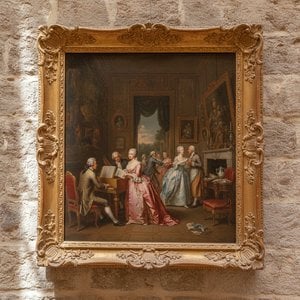
A Life Captured in the Biedermeier Spirit
Born in Vienna, Josef Franz Danhauser emerged as a prominent figure within the Austrian Empire, leaving behind a legacy that deeply reflects the Biedermeier period. The son of a sculptor and furniture manufacturer, Joseph Ulrich Danhauser, his early artistic inclinations were nurtured by his father's own hand. This foundation in craftsmanship and design likely informed the meticulous precision found in his later works. His journey through the halls of the Vienna Academy of Fine Arts allowed him to refine his skills under masters like Johann Peter Krafft, setting the stage for a career that would oscillate between the quiet intimacy of domestic scenes and the profound gravity of historical portraiture.
His life was not merely one of solitary creation but was also intertwined with the industrious spirit of his era. Following his father's passing, Danhauser found himself managing a family furniture factory alongside his brothers. This period of involvement in modern design served as a brief intermission in his painting career, yet it undoubtedly contributed to the aesthetic sensibility that would later define his genre works. His travels through Venice and Prague further enriched his visual vocabulary, allowing him to absorb the influence of Italian masters and integrate a broader European perspective into his Austrian roots.
Mastery of Genre and Emotion
Danhauser’s artistry is perhaps most celebrated for its ability to capture the subtle nuances of human existence. He specialized in genre works, often imbuing everyday scenes with moralizing undertones and a narrative depth reminiscent of William Hogarth. His paintings frequently invite the viewer into quiet, contemplative spaces—be it the intellectual sanctuary of The Scholars' Room or the serene, sun-drenched tranquility of Siesta (The Sleepers). In these works, he utilized soft palettes and masterful tonal shading to evoke a sense of warmth, companionship, and the gentle passage of time.
Beyond the domestic sphere, Danhauser possessed a remarkable ability to capture the essence of greatness. His portrait of Beethoven stands as a testament to his skill in Romantic Impressionism, moving beyond mere likeness to convey the psychological intensity and solemn dignity of the legendary composer. Through a careful use of light and shadow, he sculpted form and emotion, creating works that resonate with an aura of introspection. Whether depicting the musical transcendence of Liszt Fantasizing at the Piano or the somber reality of a deathbed, Danhauser’s brush captured the very pulse of 19th-century Romanticism.
Legacy and Artistic Significance
Though much of his work went largely unappreciated during his own lifetime, the historical significance of Josef Franz Danhauser lies in his role as a quintessential chronicler of his age. His contributions to the Biedermeier movement helped define an era characterized by understated elegance and a focus on the beauty of the everyday. His achievements, including receiving the Vienna Academy prize for Die Verstoßung der Hagar and serving as vice-rector of the Academy, underscore his standing within the artistic community of Vienna.
The enduring appeal of his oeuvre can be found in several key elements:
- Narrative Depth: His ability to weave moralizing themes into seemingly simple domestic scenes.
- Technical Versatility: A mastery ranging from the delicate pastel hues of his landscapes to the stark, dramatic chiaroscuro of his portraits.
- Cultural Connection: His unique position at the intersection of fine art, furniture design, and the burgeoning Romantic movement.
Perguntas e Respostas
Posso explorar as obras de Josef Franz Danhauser por tema?
A página Atlas de Temas mapeia as obras de Josef Franz Danhauser por tema.
What aliases or alternate names does Josef Franz Danhauser have?
Josef Franz Danhauser is also known as Josef Danhauser.
Como posso ver todas as obras criadas por Josef Franz Danhauser?
Todas as obras de Josef Franz Danhauser no este site podem ser visualizadas na página de Todas as Obras de Arte do artista.
Onde posso ver as obras de Josef Franz Danhauser em ordem cronológica?
A página de Linha do tempo das obras do artista apresenta as obras de Josef Franz Danhauser ordenadas por data, ano a ano.
Qual é o local e o ano de nascimento de Josef Franz Danhauser?
Josef Franz Danhauser nasceu em Viena, em 1805.
De onde é Josef Franz Danhauser?
Josef Franz Danhauser nasceu em Áustria.
Posso navegar pelas obras de Josef Franz Danhauser por movimento?
Os movimentos em que Josef Franz Danhauser trabalhou podem ser vistos na página de Todos os Movimentos do artista, que agrupa as obras por movimento.
Posso visitar um museu virtual das obras de Josef Franz Danhauser?
A Museu 3D de Josef Franz Danhauser é uma página que apresenta as obras do artista em uma galeria virtual tridimensional.