John Henry Lorimer: A Scottish Painter of Domestic Life and Architectural Legacy
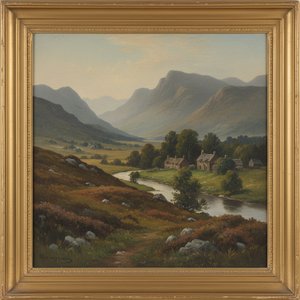
John Henry Lorimer (1856 – 1936) stands as a significant figure in Victorian Scottish art, renowned for his meticulous depictions of domestic interiors—particularly Kellie Castle—and for collaborating closely with his brother, Robert Lorimer, on the castle’s ambitious revitalization. Born in Edinburgh, Lorimer's upbringing fostered an intellectual environment shaped by his father’s professorship at Edinburgh University, instilling within him a deep appreciation for scholarly pursuits and artistic exploration. Educated at Edinburgh Academy and subsequently Edinburgh University, he honed his artistic skills through formal training at the Royal Scottish Academy, guided by masters like Frank McTaggart and William Chalmers—artists whose stylistic sensibilities profoundly impacted Lorimer’s own approach to painting. The formative years of Lorimer's artistic journey coincided with extensive travels across Europe between 1877 and 1891. These expeditions transported him to Spain, Italy, and Algeria, exposing him to diverse cultural traditions and artistic movements—experiences that undeniably enriched his visual understanding and broadened the scope of his creative inspiration. He sought to capture the essence of these places through landscapes imbued with atmospheric subtleties and vibrant colors, mirroring the Impressionistic techniques championed by artists like Claude Monet and Pierre-Auguste Renoir. This fascination with Impressionism would become a cornerstone of Lorimer’s artistic style—a stylistic choice that prioritized capturing fleeting moments of light and color over precise representation. Lorimer's brother, Robert Lorimer, was an architect whose visionary designs complemented John’s artistic endeavors. Together, they undertook the monumental task of transforming Kellie Castle from a crumbling ruin into a magnificent Victorian holiday home—a project that exemplifies not only familial collaboration but also a reciprocal influence on each other’s creative vision. Lorimer meticulously documented this transformation through paintings and sketches, capturing the grandeur of the castle's interior spaces and gardens—works that serve as tangible reminders of their shared ambition and artistic dedication. The meticulous attention to detail characteristic of Lorimer’s oeuvre is evident in his portraits of prominent figures such as Lyon Playfair, Joseph Lister, and Peter Hately Waddell – individuals whose likenesses he rendered with remarkable accuracy while subtly conveying their character traits. Lorimer's artistic output was consistently recognized by the Royal Scottish Academy and the Royal Academy in London, where he exhibited approximately 123 canvases at the former institution and 43 at the latter—a testament to his prolific artistic activity during his lifetime. His paintings frequently explored themes of domestic tranquility and familial harmony, reflecting a humanist sensibility rooted in Victorian values. Notably, “Paisagem 3” exemplifies Lorimer’s Impressionistic style, capturing the serene beauty of Scottish landscapes with soft hues and expressive brushstrokes. Sold at auction in 2000 for £32,900, this artwork remains a captivating glimpse into Victorian Scotland—a testament to Lorimer's enduring artistic legacy. Lorimer’s contribution extended beyond his paintings; he played an instrumental role in the preservation of Kellie Castle and its gardens, ensuring that it would continue to inspire future generations. His nephew, Hew Lorimer, followed in his family’s footsteps as a sculptor—a continuation of the Lorimer lineage's commitment to artistic excellence and creative innovation. John Henry Lorimer passed away peacefully at Gyles House, Pittenweem, Fife, on November 4th, 1936, leaving behind a remarkable body of work that solidified his place within the annals of Scottish art history—a legacy characterized by meticulous realism blended with lyrical sensitivity.Perguntas e Respostas
Onde estão as obras de John Henry Lorimer mapeadas por tema?
A página Atlas de Temas mapeia as obras de John Henry Lorimer por tema.
Posso ordenar as obras de John Henry Lorimer por cor?
O Índice Espectral de John Henry Lorimer é uma página que organiza as obras do artista por suas cores.
Quantas obras de John Henry Lorimer estão disponíveis para visualização?
Você pode explorar 57 obras de arte obras de John Henry Lorimer na página Todas as Obras de Arte.