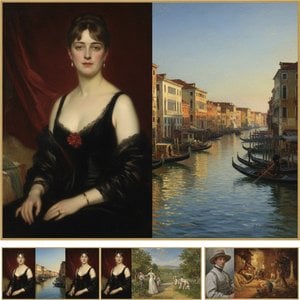
John Godwin Williams (c.1793–1863): Bridging East and West in Victorian Portraiture
John Godwin Williams, born around 1793 in Madras (now Chennai), India, was a British artist who achieved considerable renown during the Victorian era for his meticulously crafted portraits of prominent figures from both Britain and its colonial dominions. His artistic journey began at St John’s College, Cambridge, where he studied Classics alongside Fine Arts, fostering an intellectual curiosity that profoundly shaped his artistic vision. This dual engagement with scholarship and art would become a hallmark of his career, informing not only his subject matter but also the stylistic nuances of his paintings.
Williams' early training focused on watercolour painting, honing skills in capturing subtle tonal variations and atmospheric effects—techniques he would later adapt to oil paint. However, it was his relocation to Bombay (Mumbai) in 1823 that cemented his reputation as a portrait artist specializing in depictions of dignitaries and wealthy merchants. He quickly established himself as a sought-after painter, attracting commissions from influential families and individuals eager to commemorate their status and lineage. His portraits weren’t merely representations of likeness; they were carefully constructed narratives designed to convey prestige, character, and social standing.
A significant influence on Williams' artistic style was the Pre-Raphaelite Brotherhood, though he eschewed their overtly romantic aesthetic in favor of a more restrained approach rooted in classical ideals. Nevertheless, the Brotherhood’s emphasis on meticulous observation and idealized beauty—particularly concerning drapery and anatomy—can be discerned in his canvases. He meticulously studied antique sculptures and drawings to achieve anatomical accuracy and compositional balance, reflecting a commitment to artistic excellence that transcended stylistic trends.
Williams' oeuvre comprises approximately 150 paintings, predominantly portraits executed in oil on canvas. Among his most celebrated works are depictions of Lord Dalhousie, Governor General of India; Sir George Macartney, British Ambassador to China; and numerous members of the Bombay Merchant Elite. These portraits stand out for their remarkable detail—from the texture of fabrics to the subtle expressions conveyed by the subjects’ faces—demonstrating Williams' mastery of technique and his ability to capture the essence of his sitters. His paintings are housed in collections across Europe and North America, testifying to their enduring artistic merit and historical significance.
His contribution to Victorian art extends beyond individual portraits; he championed the revival of classical painting conventions within British artistic circles. By synthesizing influences from both Eastern and Western traditions—particularly through his Cambridge education—Williams produced a distinctive body of work that embodies the spirit of its time. He remains an artist whose legacy continues to inspire admiration for his technical skill, intellectual depth, and unwavering dedication to portraying human dignity with grace and precision.
Early Life & Education: Williams was born in Somerset, England, into a family of Puritan descent. His formative years were spent at Westminster School, where he excelled in Classics alongside Fine Arts—a foundation that would profoundly shape his artistic sensibilities.
Cambridge Training & Artistic Development: St John’s College, Cambridge, provided Williams with invaluable training in watercolour and oil painting, fostering a meticulous attention to detail and an understanding of tonal harmony. This academic rigor complemented his artistic pursuits, resulting in a uniquely informed visual vocabulary.
Bombay Period & Portrait Commissions: Moving to Bombay (Mumbai) in 1823 marked a pivotal moment in Williams’ career—establishing him as a leading portrait artist catering to the demands of India's elite. He secured commissions from influential families and merchants, crafting portraits that served as emblems of status and lineage.
Pre-Raphaelite Influence & Stylistic Considerations: Though eschewing the Brotherhood’s flamboyant romanticism, Williams absorbed their commitment to idealized beauty and anatomical accuracy—evident in his canvases—demonstrating a sophisticated grasp of artistic principles.
Notable Works & Legacy: Williams' prolific output encompassed approximately 150 paintings, primarily portraits rendered in oil on canvas. His masterpieces include depictions of prominent figures from Britain and India—testaments to his technical prowess and enduring artistic impact.
Williams’ meticulous observation and masterful technique ensured that his portraits transcended mere likeness; they conveyed profound narratives about character, social standing, and the complexities of Victorian society.
Pela Equipe Editorial de WahooArt.com
Teste de Conhecimentos Artísticos
Cada pergunta possui apenas uma resposta correta.
Questão 1:
Qual foi o principal movimento artístico que influenciou o estilo de John Godwin Williams?
Questão 2:
Em que cidade Williams estabeleceu sua carreira como pintor especializado em retratos?
Questão 3:
Qual característica marcante distingue os retratos de John Godwin Williams dos outros artistas da época?
Questão 4:
Williams estudou quais disciplinas em Cambridge?
Questão 5:
Em que coleção internacional estão presentes obras significativas de John Godwin Williams?
Descubra as 25 obras-primas de John Singer Sargent, o mestre do retrato e do impressionismo americano. Explore a história, técnica e beleza atemporal de seus quadros mais famosos. Encontre reproduções de arte exclusivas para decorar sua casa com elegância em WahooArt.com.
Descubra as 25 obras-primas de John Constable, o mestre da paisagem inglesa! Explore a arte romântica, cores vibrantes e histórias fascinantes por trás de 'Hay Wain' e outras pinturas icônicas. Encontre reproduções de alta qualidade para decorar sua casa com WahooArt.com.
Explore the captivating Orientalist paintings of John Frederick Lewis! Discover his mastery of detail, genre scenes & influence on 19th-century British art. Learn about his life, techniques & legacy at WahooArt.