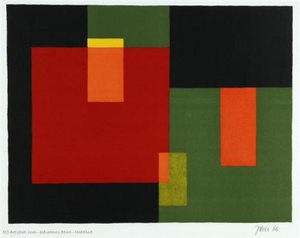
A Pioneer of Color and Form: The Life and Legacy of Johannes Itten
Johannes Itten, born in 1888 in the tranquil Swiss village of Südern-Linden, was more than just a painter; he was a visionary educator who fundamentally reshaped the landscape of modern art instruction. His journey began not within the hallowed halls of traditional art academies, but as an elementary school teacher—a formative experience that instilled in him a deep understanding of learning processes and the blossoming of creative potential. Itten’s early pedagogical explorations, inspired by Friedrich Fröbel's groundbreaking kindergarten concepts, emphasized intuitive development over rigid instruction, a philosophy he would carry throughout his career. Though briefly attempting formal training at Geneva’s École des Beaux-Arts, he found its methods stifling, returning to Bern where studies with Ernst Schneider proved pivotal. Schneider championed collective critique over individual assessment, nurturing creative impulses rather than suppressing them—a radical approach that became central to Itten's own teaching methodology. Influences from Eugène Gilliard, who explored abstract forms, and Adolf Hölzel, who utilized basic shapes as the foundation for artistic creation, further shaped his evolving aesthetic. He embraced Hölzel’s belief in lines, planes, circles, and spirals as essential starting points for visual exploration, laying the groundwork for his later theoretical work on color and form.The Bauhaus Revolution: The Vorkurs and Color Theory
Itten's arrival at Walter Gropius’ newly founded Bauhaus in Weimar in 1919 marked a turning point not only in his career but also in the history of art education. Appointed as a Master, alongside Lyonel Feininger and Gerhard Marcks, he was tasked with developing a foundational course—the *Vorkurs*, or preliminary course—that would become legendary. This wasn’t merely an introductory class; it was a complete reimagining of how artists were trained. Itten believed in stripping away preconceived notions and encouraging students to explore the fundamental properties of materials, composition, and, most importantly, color. He theorized seven distinct types of color contrast – hue, value, temperature, complements (neutralization), simultaneous contrast, saturation, and extension—and devised a series of exercises designed to unlock an intuitive understanding of these principles. His “color sphere,” encompassing twelve fundamental colors, became a cornerstone of Bauhaus curriculum. Itten insisted on fostering a holistic approach to learning, integrating gymnastic exercises alongside artistic pursuits, recognizing that physical relaxation was crucial for stimulating creativity and fostering self-expression. He championed experimentation and intuition over strict adherence to technique, creating an environment where students felt empowered to discover their own artistic voices. His work profoundly influenced artists like Josef Albers, Max Bill, and Bridget Riley, whose canvases embody the dynamism of his color theories.Departure, Spirituality, and Continued Innovation
Despite his profound impact on the Bauhaus, Itten’s tenure wasn't without conflict. Gropius prioritized industrial design and mass production—a vision that clashed with Itten’s unwavering commitment to individual expression and spiritual exploration. This divergence of philosophies ultimately led to his resignation in 1923. Undeterred, Itten established the “ontos weaving workshops” near Zurich in 1924, collaborating closely with Bauhaus weaver Gunta Stölzl—a partnership that solidified his belief in collaborative artistic endeavors. He continued to refine his pedagogical methods and explore new avenues for artistic innovation, fostering a generation of artists who embraced experimentation and challenged conventional boundaries. Itten’s exploration into Mazdaznan, Zoroastrian mysticism, deeply impacted his worldview and informed his artistic practice, demonstrating the importance of integrating spiritual contemplation alongside creative endeavors.A Lasting Influence on Art and Beyond
Johannes Itten's legacy extends far beyond the Bauhaus walls. His groundbreaking color theory continues to inspire artists today, particularly those involved in Op Art—a movement characterized by illusionistic visual effects that exploit perceptual phenomena. Furthermore, his meticulous study of color palettes has found application in diverse fields, including cosmetics, where it’s utilized to determine optimal shades for enhancing complexion and promoting aesthetic harmony. Itten's unwavering belief in the transformative power of art education cemented his place as a pioneer—a figure who championed holistic learning and encouraged artists to cultivate their inner vision. He remains an enduring symbol of artistic freedom and intellectual curiosity, reminding us that true creativity flourishes when nurtured by both observation and contemplation.Perguntas e Respostas
A qual período histórico pertence a obra de Johannes Itten?
Johannes Itten atuou no período Modernismo. Este período situa a atividade do artista na história.
Em que cidade e país Johannes Itten nasceu?
Johannes Itten nasceu em Suedern Linden, em Suíça.
Posso navegar pelas obras de Johannes Itten por técnica?
Para encontrar todas as obras de Johannes Itten por técnica, acesse a página de Por Técnica do artista.