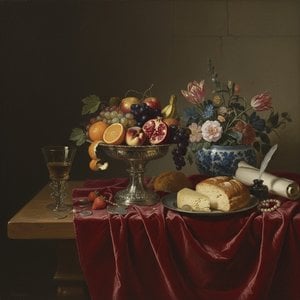
A Pioneer of French Still Life: The World of Jacques Linard
Jacques Linard, a name perhaps less instantly recognizable than some of his Baroque contemporaries, occupies a pivotal position in the development of still life painting in 17th-century France. Born in Troyes in 1597 and passing away in Paris in 1645, Linard wasn’t merely documenting objects; he was crafting poetic meditations on beauty, transience, and the burgeoning scientific curiosity of his age. His early life remains somewhat shrouded in mystery, though we know his father, Jehan Linard, was also a painter active in Troyes, suggesting an initial artistic grounding within the family workshop. Records place him in Paris by the 1620s, quickly establishing himself as a skilled artist and becoming part of the vibrant artistic community clustered around the Île de la Cité and later Saint-Nicolas-des-Champs. His marriage in 1626 to Marguerite Tréhoire, daughter of Parisian master painter Romain Tréhoire, further solidified his connections within the art world. By 1631, he had achieved the prestigious title of *Peintre et Valet de Chambre du Roi* under Louis XIII, a position that afforded him both recognition and financial stability.From Flemish Roots to French Elegance
Linard’s artistic development was deeply influenced by the Northern Realist tradition, particularly the exquisite still lifes of Jan Brueghel the Elder. The meticulous detail, vibrant colors, and careful arrangement of objects characteristic of Brueghel are clearly visible in Linard's early works. However, he wasn’t simply a copyist. He infused his paintings with a distinctly French sensibility—a refined elegance and clarity that set him apart from his Flemish predecessors. While the Dutch masters were simultaneously revolutionizing still life with their hyperrealism and symbolic depth, Linard carved out a unique niche by blending meticulous observation with a poetic grace. His compositions often feature a harmonious balance of light and shadow, creating an atmosphere of quiet contemplation. He was among the first in France to explore thematic arrangements centered around the “Five Senses” and the “Four Elements,” transforming commonplace objects into allegorical representations of human experience.The Language of Objects: Symbolism and Meaning
Linard’s still lifes are far from mere depictions of fruit, flowers, or shells. They are imbued with a rich layer of symbolism that reflects the intellectual currents of his time. Exotic fruits like peaches and grapes weren't just visually appealing; they represented abundance, prosperity, and even sensual pleasure. Shells, prized as *mirabilia*—rare and fascinating objects collected by connoisseurs—evoked luxury, travel, and the wonders of the natural world. Coral, with its resemblance to blood vessels, carried religious connotations, symbolizing Christ’s sacrifice and protection against evil. The inclusion of musical instruments or playing cards hinted at the fleeting nature of earthly delights. His paintings invite viewers not just to admire their beauty but also to contemplate deeper themes of mortality, spirituality, and the passage of time. This subtle yet profound symbolism distinguishes his work from purely decorative still lifes.A Lasting Legacy: Inspiring a Generation
Though only around fifty works are definitively attributed to Linard today, his influence on French painting was considerable. He is credited with pioneering the thematic still life in France and inspiring artists like Louise Moillon, who would become the most celebrated female still-life painter of her era. Linard’s ability to combine meticulous realism with poetic elegance established a new standard for the genre. His compositions often featured delicate brushwork and vibrant colors, creating an atmosphere of quiet contemplation that resonated with contemporary audiences. Works like “Basket of Flowers,” now housed in the Louvre, demonstrate his mastery of technique and his keen eye for detail. The poem inscribed on a cup within one painting—a verse by the famous Chinese poet Su Shi—reveals a broader cultural awareness and intellectual curiosity. His paintings weren’t simply about what they depicted; they were about how those depictions connected to a wider world of knowledge, beauty, and meaning. Linard's legacy lies not just in his beautiful creations but also in his role as a catalyst for the flourishing of still life painting in 17th-century France.Perguntas e Respostas
Onde e quando nasceu Jacques Linard?
Jacques Linard nasceu em Troyes, em 1597.
Onde as obras de Jacques Linard estão organizadas por cor?
A página Índice de Cores organiza as obras de Jacques Linard por cor.
De onde é Jacques Linard?
Jacques Linard nasceu em France.