Early Life and Training
Maris embarked on his artistic journey with lessons from J.A.B. Stroebel (1849-1852), establishing a crucial foundation for his future endeavors. He pursued formal studies at the Hague Academy of Art between 1850 and 1853, diligently refining his skills and nurturing an emerging artistic style—a style deeply rooted in observation and meticulous technique. A pivotal moment transpired when a discerning art dealer recognized Maris’s talent, orchestrating a collaboration with Hubertus van Hove, a figure who profoundly shaped his formative years as an artist. Furthermore, Matthijs Maris, benefiting from royal patronage, joined forces with Jacob, fostering a dynamic environment that propelled their artistic explorations forward.Artistic Career and Style
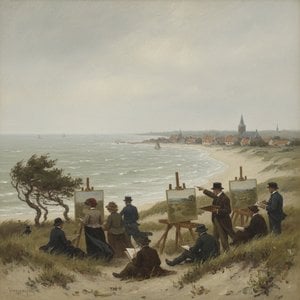
Maris's career flourished amidst considerable commercial success—sales to collectors in the United States and Scotland underscored his growing renown within the art world. His travels through Germany, Switzerland, and France during 1861 exposed him to a diverse tapestry of artistic styles, broadening his horizons and subtly influencing his own stylistic evolution. He swiftly gained recognition for capturing Dutch landscapes with breathtaking precision—particularly rivers, mills, towpaths, and serene beach scenes populated by fishing boats. This distinctive subject matter became synonymous with Maris’s oeuvre, reflecting an unwavering dedication to portraying the beauty of his homeland.- Key Characteristics of His Style:
- Broad and larger brushstrokes imparted texture and movement to his canvases, conveying a palpable sense of atmosphere.
- Subdued color palettes contributed significantly to the evocative quality of his landscapes, creating an immersive experience for the viewer.
- A pronounced emphasis on depicting clouds—and their transformative effects upon the surrounding environment—became a hallmark of Maris’s artistic vision.
- He applied paint thickly, building it up layer by layer and painstakingly adjusting hues to achieve harmonious compositions that resonated with profound beauty.
Major Works and Recognition
Maris achieved considerable acclaim for undertaking portraits of the Royal House of Orange in partnership with Matthijs Maris, demonstrating both his artistic prowess and his ability to convey dignity and grandeur. “Schip on the Scheveningen Beach” stands as a masterful exemplar of his talent—a scene rendered with remarkable atmospheric depth and meticulous detail that transports the viewer directly to the Dutch coast. He was inducted into Pulchri Studio in 1871, signifying his acceptance within the influential artistic community of his time. From 1885 onwards, Maris experienced widespread recognition throughout the Netherlands, cementing his position as a luminary of the Hague School—a movement he helped define through its distinctive aesthetic: realistic depictions of Dutch landscapes infused with an irresistible allure for capturing the sublime beauty of the natural world.Historical Significance and Legacy
Maris’s contribution to the Hague School is undeniable; he played a pivotal role in establishing its core principles—a focus on capturing the spirit of Dutch scenery through astute observation, masterful technique, and an unwavering artistic vision. His influence extended far beyond his lifetime, inspiring subsequent generations of artists with his singular style and approach to landscape painting. Today, Maris’s works reside within prestigious collections such as the Rijksmuseum—a lasting testament to their enduring artistic merit and profound historical importance. He succeeded in encapsulating the soul of the Dutch countryside—transforming it into timeless masterpieces that continue to captivate audiences worldwide.Perguntas e Respostas
Onde posso ver todas as obras de Jacob Maris?
Todas as obras de Jacob Maris no este site podem ser exploradas na página de Todas as obras do artista.
Posso navegar pelas obras de Jacob Maris por paleta de cores?
A página Por paleta de cores agrupa as obras de Jacob Maris por suas paletas de cores.
Onde as obras de Jacob Maris estão agrupadas por palavras-chave?
A página Por palavras-chave de Jacob Maris agrupa as obras do artista por palavras-chave.