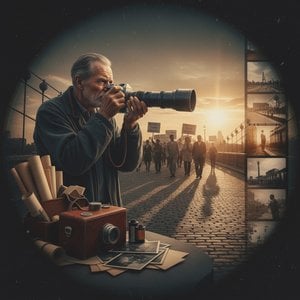
A Life Bridging Worlds: The Story of Jack Delano
Born Yakov Ovcharov in 1914, amidst the shifting landscapes of Podolie Governorate in what is now Ukraine, Jack Delano’s journey was one of remarkable transformation and artistic dedication. His early life, steeped in the traditions of a Jewish family, took an abrupt turn with emigration to Philadelphia in 1923. This relocation wasn't merely a change of geography; it was an immersion into a new culture that would profoundly shape his artistic vision. From a young age, Delano demonstrated a dual passion for visual and auditory expression, pursuing studies in both graphic arts/photography and music – viola and composition – at the Settlement Music School and later, the prestigious Pennsylvania Academy of the Fine Arts (PAFA). A Cresson Traveling Scholarship provided him with the opportunity to explore Europe, an experience that ignited his photographic eye and secured his first camera. This foundational period laid the groundwork for a career defined by its breadth and commitment to documenting the human condition.
Documenting America: From Coal Mines to Rural Lives
Delano’s artistic path began to crystallize with a focus on social realism. He initially turned his lens towards the harsh realities of coal-mining conditions in Pennsylvania, an undertaking that quickly caught the attention of Roy Stryker at the Farm Security Administration (FSA). This marked a pivotal moment, launching him into a role as one of the FSA’s dedicated photographers during the Great Depression and World War II. Unlike some contemporaries who focused solely on hardship, Delano possessed a unique ability to capture not just the struggles but also the dignity and resilience of working-class Americans. His photographs weren't simply records; they were empathetic portraits of individuals navigating extraordinary circumstances. He documented rural poverty, industrial landscapes, and the changing face of America with an honesty that resonated deeply. This period cemented his reputation as a master of documentary realism, a style characterized by its unvarnished portrayal of everyday life. Later, working with the Office of War Information (OWI), he continued to document the nation’s story, but it was his 1941 assignment in Puerto Rico that would irrevocably alter the course of his life and art.
Puerto Rico: A New Home, A New Muse
The initial FSA project in Puerto Rico proved transformative for Delano. What began as a temporary assignment blossomed into a lifelong commitment. He was captivated by the island’s vibrant culture, its complex social dynamics, and the warmth of its people. In 1946, he made the momentous decision to settle permanently in Puerto Rico with his wife, Irene. This move wasn't simply a geographical relocation; it was an artistic rebirth. Delano became deeply immersed in Puerto Rican life, not just as an observer but as a participant. He directed the seminal film "Los Peloteros," a poignant and beautifully observed story of impoverished rural children finding joy and camaraderie through baseball – a work that remains a cornerstone of Puerto Rican cinema. Furthermore, he played a crucial role in establishing WIPR, Puerto Rico’s first publicly funded educational television station, serving as producer, composer, and program director. His musical talents flourished, blending classical forms with the rich tapestry of Puerto Rican folk traditions. He composed orchestral pieces, ballets, chamber music, choral works, and solo vocal compositions, creating a unique sonic landscape that reflected his adopted homeland.
A Legacy of Interdisciplinary Artistry
Jack Delano’s artistic legacy is multifaceted and enduring. His contributions extend far beyond photography; he was a true polymath – a filmmaker, composer, illustrator, cartoonist, poet, professor, and even an architectural designer. He received a Guggenheim Fellowship in Photography in 1945 and an honorary doctorate from the University of the Sacred Heart in San Juan, Puerto Rico, in 1987, accolades that recognized his profound impact on both American and Puerto Rican culture. His FSA photographs remain invaluable historical documents, offering a glimpse into a pivotal era of social change. “Los Peloteros” continues to be celebrated for its authentic portrayal of Puerto Rican life and childhood experiences. And his musical compositions stand as testaments to his innovative spirit and his ability to bridge cultural divides. Delano’s work served as a vital cultural bridge between the United States and Puerto Rico, fostering understanding and appreciation across borders. He collaborated with poet Tomás Blanco on beloved children's books, including "The Child’s Gift," further extending his reach and influence. His lasting impact lies in his unwavering commitment to documenting social issues, celebrating human dignity, and embracing the power of artistic expression in all its forms.
A Lasting Impression
Jack Delano passed away in 1997, leaving behind a rich and diverse body of work that continues to inspire. His photographs are not merely historical artifacts; they are windows into the lives of ordinary people, imbued with empathy and understanding. His films capture the spirit of Puerto Rico with authenticity and grace. And his music resonates with a unique blend of classical sophistication and folk vibrancy. Delano’s legacy is one of artistic integrity, social consciousness, and a profound belief in the power of art to connect us all. He remains a vital figure in the history of documentary photography, Puerto Rican cinema, and American musical composition – a testament to a life lived with passion, purpose, and an unwavering commitment to capturing the beauty and complexity of the human experience.