A Dubliner’s Grace: The Life and Art of Hugh Douglas Hamilton
Hugh Douglas Hamilton, born in the vibrant heart of 18th-century Dublin around 1740, wasn't merely a painter; he was a conduit to an era. His life intertwined with the burgeoning artistic landscape of Ireland and Britain, bridging the delicate elegance of Rococo with the emerging clarity of Neoclassicism. The son of a peruke maker – a trade demanding precision and an appreciation for visual detail – young Hamilton’s path toward art wasn't predetermined but rather nurtured by his family’s inherent understanding of craftsmanship. He received his foundational training at the Dublin Society House, under the tutelage of Robert West and James Mannin, absorbing the techniques and principles that would shape his distinctive style. Even in these early years, a remarkable talent emerged, evidenced by the premiums he earned for drawings as early as 1756 – hints of the skill and sensitivity that would soon captivate both Irish and British society. Crucially, Hamilton cultivated a network of influential patrons, most notably the La Touche banking family, a connection that proved invaluable in securing commissions and establishing his reputation within the art world. These relationships weren’t simply transactional; they were gateways into the circles where artistic trends were born and nurtured.London’s Salons and Pastel Innovation
Driven by ambition and a desire to hone his craft, Hamilton journeyed to London in the early 1760s. It was here that he swiftly established himself as a prominent portrait painter, specializing in the fashionable medium of pastel. These weren't the grand, imposing portraits typically associated with royal courts; rather, they were lively, affordable representations that resonated deeply with the growing middle class eager to capture their likenesses and those of their loved ones. Hamilton’s talent was immediately recognized by London’s elite, culminating in a commission from Queen Charlotte in 1764 – a pivotal moment that solidified his reputation as one of the era's most sought-after portraitists. He exhibited regularly at both the Society of Artists and the Free Society of Artists, steadily building a loyal clientele and refining his technique. Around the mid-1770s, Hamilton embarked on an innovative experiment: the “fresco” pastel. By blending crayons and chalk, he achieved a richer texture and depth in his work, pushing beyond the limitations of traditional pastels and demonstrating a willingness to embrace new artistic possibilities. This groundbreaking technique marked a turning point in his career, showcasing his creative spirit and his commitment to exploring uncharted territory.Rome’s Influence: A Shift Towards Oil
In 1779, seeking inspiration and a deeper understanding of classical art, Hamilton traveled to Italy, spending the next twelve years primarily based in Rome. It was during this period that he encountered the intellectual currents of the time, engaging with artists like Antonio Canova and absorbing the principles of Neoclassicism. He began experimenting with oil painting, a medium traditionally associated with historical and grand narratives – a shift that reflected his evolving artistic sensibilities. This transition allowed him to explore larger canvases and create works imbued with greater dramatic intensity. His Italian years were marked by commissions from British tourists and members of the exiled Stuart family, capturing portraits of figures like Frederick Hervey, Bishop of Derry, and Charles Edward Stuart, the “Young Pretender.” These paintings demonstrate Hamilton’s ability to capture not only physical likeness but also the personalities and social standing of his subjects.Dublin Revisited: A Legacy in Pastel and Oil
Returning to Dublin in 1792, a year before his death in 1808, Hamilton continued to paint prolifically, establishing himself as the foremost portraitist in the city. His later works often combined elements of both pastel and oil painting, showcasing his versatility and mastery of various techniques. A particularly significant discovery occurred after his death: a sketchbook containing sixty-six drawings of Dublin street hawkers – a remarkable glimpse into the everyday lives of ordinary people during the 18th century. These sketches, meticulously rendered with an artist’s eye for detail and social observation, offer invaluable insights into the city's vibrant culture and its diverse population. Among his most notable portraits from this period is one of Lord Edward Fitzgerald, a poignant depiction of the Irish revolutionary leader that reflects both artistic skill and historical significance.A Painter of Character: Style and Significance
Hamilton’s distinctive style was characterized by an uncanny ability to capture not just physical likeness but also the character and social standing of his subjects. His portraits weren't merely representations; they were carefully constructed narratives, imbued with a sense of personality and atmosphere. He favored handmade cream or off-white paper for his pastels, creating a subtle warmth that enhanced the luminosity of the finished pieces. Remarkably efficient, many of his portraits were completed in a single sitting from life, testament to his keen observational skills and confident hand. His pastel process involved a meticulous layering: outlining with light tones, building features with carmine shades, blending delicately with his fingers, establishing broad backgrounds, and finally adding precise details using both pastel sticks and graphite. This careful approach allowed him to create portraits that were both realistic and flattering. Hugh Douglas Hamilton’s legacy extends beyond the individual portraits he created; it lies in his ability to capture a specific moment in Irish art history – a period of transition between Rococo elegance and Neoclassical clarity, reflecting the social and cultural shifts of an era. His work continues to be studied and admired for its beauty, insight, and historical significance.Perguntas e Respostas
Onde posso ver as obras de Hugh Douglas Hamilton organizadas por atmosfera?
As obras de Hugh Douglas Hamilton podem ser exploradas por humor na página Coleção por Humor, que organiza as artes de acordo com seus humores registrados.
Posso visitar um museu virtual das obras de Hugh Douglas Hamilton?
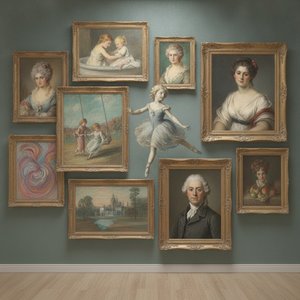
É possível fazer uma visita virtual: a página Galeria 3D de Hugh Douglas Hamilton apresenta as obras do artista em uma galeria tridimensional.
Onde posso ver todas as obras de Hugh Douglas Hamilton?
Todas as obras de Hugh Douglas Hamilton no este site podem ser exploradas na página de Todas as obras do artista.