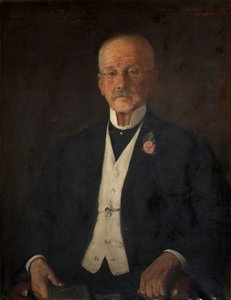
William Leach Lewis, Mayor of Margate (1888–1890 1905–1906)
Norman O'Neill (1875–1934)
Copyright status: Under copyright
Horace van Ruith: A Victorian Portraitist's Delicate Touch
Horace van Ruith (1847 – 1930) emerged as a prominent figure in the British art scene during the late Victorian era, renowned for his exquisitely detailed portraits capturing the essence of aristocratic families and distinguished individuals. Born in Rotterdam, Netherlands, Van Ruith’s artistic journey began with early training in drawing and painting under Willem van Hecke, honing skills that would become foundational to his distinctive style—a meticulous approach prioritizing accuracy and subtle tonal gradations.
Early Influences: Van Ruith's formative years coincided with the burgeoning Impressionist movement, though he steadfastly adhered to Academic traditions. However, he absorbed elements of Romanticism’s emotive landscapes and psychological depth, particularly evident in his preparatory sketches for larger canvases.
Formal Training & Recognition: He pursued formal studies at the Royal Academy of Arts in London, where he mastered techniques of oil painting and portraiture under luminaries like Frederic Leighton and Joseph Noel Paton. His dedication earned him accolades and membership into prestigious artistic societies.
Van Ruith’s oeuvre comprises over 300 portraits—a remarkable testament to his unwavering commitment to realism and psychological insight. He possessed an uncanny ability to convey not merely physical likeness but also the inner character of his subjects, capturing fleeting expressions and subtle gestures with breathtaking precision. His canvases are characterized by a masterful use of chiaroscuro – dramatic contrasts between light and dark – creating depth and dimensionality that draws viewers into the depicted scene. This technique allowed him to illuminate the subject’s personality and evoke an atmosphere of contemplative emotion.
Notable Subjects: Among his most celebrated commissions were portraits of members of the British aristocracy, including Earl Grey, Lord Salisbury, and Sir George Trevelyan. He also painted notable figures from the literary world, such as Robert Browning and Arthur Conan Doyle.
Technique & Style: Van Ruith’s brushstrokes are remarkably delicate, blending seamlessly to achieve velvety textures and subtle tonal variations. His meticulous attention to detail—from the folds of clothing to the glint in the eyes—elevates his portraits beyond mere likenesses into profound explorations of human psychology.
His paintings frequently depict serene landscapes infused with atmospheric perspective – a hallmark of Victorian artistic sensibilities. These scenes served as backdrops for his portraits, subtly enhancing their emotional impact and grounding them within the broader context of British culture and intellectual life. Landscapes like “Water Is Best” exemplify this approach, demonstrating Van Ruith’s ability to capture not just visual beauty but also intangible qualities of mood and emotion.
Legacy & Influence: Horace van Ruith's legacy extends beyond his impressive artistic output. He served as a professor at the Royal Academy for many years, nurturing generations of aspiring artists and shaping the stylistic conventions of British portraiture. His meticulous technique continues to inspire admiration among art historians and collectors alike.
Key Works: Some of his most enduring masterpieces include “Parsees at Prayer,” “Tattersall Wilkinson of Roggerham” and "Horace van Ruith" – each offering a captivating glimpse into Victorian society and demonstrating Van Ruith’s unparalleled mastery of artistic expression.
Despite the stylistic differences between Impressionism and Academic painting, Horace van Ruith's work stands as an enduring symbol of Victorian artistic excellence—a testament to his unwavering dedication to realism, psychological depth, and a profound appreciation for the beauty of the natural world. His portraits remain treasured artifacts of British cultural heritage, inviting viewers to contemplate the complexities of human experience with quiet contemplation.
Pela Equipe Editorial de WahooArt.com
Teste de Conhecimentos Artísticos
Cada pergunta possui apenas uma resposta correta.
Questão 1:
Horace van Ruith was primarily known for his artistic style.
Questão 2:
Van Ruith's paintings often depict:
Questão 3:
What was Horace van Ruith’s nationality?
Questão 4:
Which artistic movement influenced Van Ruith's technique?
Explore the profound psychological depth of emotional portraiture. From Expressionist masterpieces to custom oil commissions, discover how fine art captures the human soul through light, color, and masterful technique for discerning collectors.