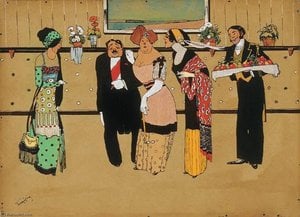
Geza Farago: A Hungarian Symbolist Visionary
Geza Farago (1877–1928) stands as one of the most prominent figures in early Hungarian poster art and a celebrated Symbolist painter. His artistic legacy transcends mere visual representation; it embodies a profound engagement with philosophical ideas and emotional depth, characteristics that define his distinctive style and enduring influence on Hungarian cultural heritage. Born in Budapest, Hungary, Farago’s formative years were marked by exposure to the burgeoning artistic milieu of Prague and Vienna – cities renowned for their avant-garde movements and intellectual ferment.
His formal education commenced at Ferenc Újházy's studio, where he honed his drawing skills before embarking on a journey to Paris in 1898. This pivotal relocation proved instrumental in shaping his artistic trajectory, as he enrolled at Colarossi’s evening classes and studied under Alphonse Mucha’s tutelage – an encounter that irrevocably cemented his connection with the Symbolist aesthetic. Mucha's influence permeated Farago’s oeuvre, fostering a preoccupation with idealized female figures and employing decorative techniques reminiscent of Japanese woodcuts, mirroring the stylistic currents prevalent in Europe at the time.
Farago’s artistic output extended beyond painting into diverse mediums—poster design, caricature illustration, and theatrical costume design—demonstrating his versatility as an artist and his keen understanding of contemporary cultural trends. He achieved considerable acclaim during World War I, diligently crafting propaganda posters that effectively communicated messages of patriotism and resilience. Simultaneously, he captivated audiences with his humorous caricatures and masterful stage designs, solidifying his reputation as a multifaceted creative talent. Notably, he served as scenic designer for the King’s Theatre for fifteen years and later at the Budapest Operetta Theatre, leaving an indelible mark on Hungarian theatrical history.
Farago's artistic style is characterized by bold contours, vibrant colors, and ornamental patterns—elements that align seamlessly with the principles of Art Nouveau. Like Mucha, he favored depictions of graceful women, capturing their beauty and elegance with meticulous detail. His posters are imbued with a playful spirit and infused with humor, reflecting his astute observation of societal dynamics. Furthermore, Farago’s fascination with Japanese woodcuts profoundly impacted his artistic vision, influencing his compositional choices and decorative motifs.
His paintings, particularly “Paradise Lost,” exemplify the Symbolist preoccupation with exploring psychological states and conveying profound emotions through evocative imagery—a hallmark of his artistic approach. His works are housed in the Hungarian National Gallery, ensuring that his contribution to Hungarian art history continues to inspire future generations. Farago’s enduring legacy resides not merely in his visual creations but also in his embodiment of the spirit of Symbolism – a movement dedicated to capturing the essence of human experience and delving into realms beyond mere surface appearances.