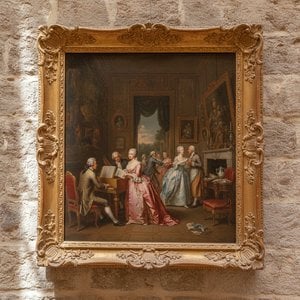
The Soul of Trentino: The Life and Legacy of Eugenio Prati
Eugenio Prati, born in the serene landscape of Caldonazzo on January 27th, 1842, stands as a pivotal figure in Italian genre painting—a movement dedicated to portraying the everyday realities and struggles of rural life. His artistic legacy resides not merely in his canvases but in capturing the spirit of Trentino’s landscape and its inhabitants during the late nineteenth century. Prati's journey began with formal training at the Venice Academy of Fine Arts, where he absorbed the stylistic precepts of masters like Francesco Hayez, shaping his foundational understanding of composition and color theory. Subsequently, he honed his skills further in Florence under the patronage of Baron Giuseppe Turco Turcato Lazzari, fostering a connection to aristocratic circles that would influence his artistic vision.
Prati’s childhood was imbued with an innate fascination for art—a passion fueled by familial encouragement and nurtured by exposure to artistic traditions prevalent in the Veneto region. Recognizing his talent early on, he embarked upon a rigorous academic program designed to cultivate technical proficiency alongside aesthetic sensibility. This dedication culminated in his enrollment at the Venice Academy of Fine Arts, where he diligently studied under luminaries who championed realism and emotional depth—principles that would become hallmarks of Prati’s oeuvre. The Florentine Baron’s patronage provided invaluable resources for continued artistic exploration, allowing him to immerse himself in the vibrant cultural milieu of Tuscany.
A Master of Rural Narratives and Costume Genre
Prati's distinctive artistic style is characterized by a masterful blend of observation and expressive technique. He eschewed idealized representations, opting instead for detailed depictions of rural scenes—laborious fields, humble dwellings, and intimate domestic moments—that resonated with the sensibilities of his time. His palette was deeply connected to the earthiness of the Valsugana region, where he settled in 1879. While he is most celebrated for his genre subjects, Prati also demonstrated a remarkable versatility, venturing into sacred and historic themes, as well as intricate costume genre paintings that captured the traditional attire of the era.
His ability to weave narrative into a single frame allowed him to achieve international recognition. The strength of his storytelling was evident in works such as:
- Ancora un momento and Ritorno da Massaua, which garnered acclaim at the 1887 Esposizione Nazionale di Venezia.
- Primi fiori, a piece that traveled far beyond Italian borders, finding audiences in prestigious exhibitions across Genoa, Chicago, Berlin, and St. Petersburg.
- Nozze in Val di Tesino and Si espetta lo sposo, which exemplify his talent for capturing the tender, often poignant, moments of communal and familial life.
Historical Significance and Artistic Endurance
The historical significance of Eugenio Prati lies in his role as a visual chronicler of a vanishing way of life. At a time when the world was rapidly industrializing, Prati turned his gaze toward the enduring traditions of the Trentino region, preserving the dignity of the peasantry and the quiet beauty of the Alpine foothills. His work serves as a bridge between the academic rigor of the nineteenth century and the burgeoning interest in realism that would define much of modern European art.
Through his meticulous attention to detail—from the texture of a peasant's garment to the soft light filtering through a mountain pass—Prati created a body of work that transcends mere documentation. He imbued his subjects with a profound humanity, ensuring that the spirit of the Valsugana would remain etched in the annals of art history long after the era of the Austrian Empire had passed. Today, his paintings remain cherished not only as technical triumphs but as emotional windows into the heart of Italy's rural past.
Perguntas e Respostas
De onde é Eugenio Prati?
Eugenio Prati nasceu em Italy.
Posso visitar um museu virtual das obras de Eugenio Prati?
As obras de Eugenio Prati podem ser visualizadas em uma galeria 3D na página Galeria 3D do artista.
Onde e quando nasceu Eugenio Prati?
Eugenio Prati nasceu em Caldonazzo, em 1842.