Elena Popea: A Romanian Modernist Pioneer
Elena Popea (15 April 1879, Brașov – 19 June 1941, Bucharest) stands as a remarkable figure in Romanian art history—a woman artist who defied societal expectations and carved out a distinctive artistic legacy amidst the turbulent currents of the early 20th century. Born into an intellectual family, her father was a secondary school teacher and her uncle Bishop Nicolae Popea, fostering an environment that nurtured her passion for learning and creativity from a young age. This formative influence propelled her pursuit of philology in Leipzig and painting in Berlin—disciplines that would shape the trajectory of her artistic journey.
Early Training & Influences
Her artistic education began around 1900 with Angelo Jank, Jordan Jakob, and Caroline Kempter, immersing herself in German Impressionism. This exposure to European avant-garde movements would prove pivotal in informing her stylistic choices. The meticulous observation of light and color—characteristic of Impressionist painters like Claude Monet—became a cornerstone of Popea’s artistic approach. Furthermore, she absorbed the expressive dynamism of Expressionist artists, channeling emotion into her canvases with bold brushstrokes and vibrant hues. Finally, she experimented with Cubist techniques—analyzing forms and reconstructing them in fragmented planes—adding complexity and intellectual depth to her compositions.
A Debut at Sibiu & Parisian Recognition
Elena Popea’s artistic career gained momentum in 1905 with her participation in the “Expoziția națională” organized by ASTRA in Sibiu—a landmark event showcasing Romanian art and culture. This debut garnered considerable acclaim, establishing her presence within Bucharest’s artistic circles and securing invitations to prestigious salons like the Salon des indépendants in Paris during World War I. Her Parisian sojourn allowed her to engage with influential artists and expand her creative horizons. The Salon des indépendants—a bastion of avant-garde experimentation—provided Popea with invaluable exposure and fostered collaborations that enriched her artistic vision.
Parisian Artistic Engagement
She studied with Lucien Simon at his academy in Montparnasse, continuing her artistic exploration amidst the vibrant intellectual landscape of the era. Her Parisian summers were dedicated to capturing inspiration from diverse landscapes—Scandinavia, Scotland, Spain and the Middle East—resulting in a prolific output of canvases reflecting her keen observation of nature. Simon’s guidance instilled in Popea a disciplined approach to technique—emphasizing precision and tonal harmony—which would become hallmarks of her oeuvre.
Style & Subject Matter: Landscapes & Floral Still Lifes
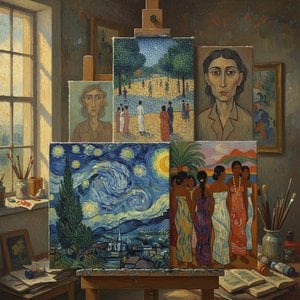
Popea’s artistic style blended Impressionism, Expressionism, and Cubism—resulting in works characterized by textured paint—applied with meticulous consistency—that faithfully reproduced the essence of her subjects. Primarily focused on landscapes and floral still lifes, she sought to convey emotion and atmosphere through subtle color palettes and expressive brushstrokes. Recurring motifs included birch trees—often depicted against stormy skies—symbolizing resilience and vulnerability—a testament to her profound connection with Romanian rural life. Her canvases frequently featured delicate floral arrangements—rendered with painstaking detail—capturing the ephemeral beauty of blossoms and foliage. The influence of Cubist principles—particularly in analyzing forms and reconstructing them in fragmented planes—added intellectual depth and complexity to her compositions.
Notable Works & Legacy
“Peasant Woman with Wooden Pail” exemplifies Popea’s dedication to portraying everyday scenes with sensitivity and detail, capturing the dignity and simplicity of rural Romanian life. Similarly, “The Old Bridge”—a monumental canvas depicting a historic edifice—demonstrates her masterful command of perspective and tonal gradation—creating an immersive experience for the viewer. Her paintings continue to resonate today, offering glimpses into a bygone era while celebrating the enduring power of artistic expression. Elena Popea’s contribution to Romanian art is undeniable. Her unwavering commitment to capturing the beauty and spirit of the Romanian countryside, coupled with her masterful blending of artistic styles, cemented her place as a pioneer—a woman artist who challenged conventions and enriched the cultural heritage of Romania.