Early Life and Artistic Beginnings
Daniel Maclise, a name synonymous with the grandeur of Victorian history painting, was born on January 25th, 1806, in Cork, Ireland – a city steeped in both artistic tradition and the rugged beauty of the countryside. His father, Alexander McLish, was a tanner and shoemaker, providing a practical grounding for a young boy who instinctively sought to capture the world through art. From an early age, Daniel displayed a remarkable talent for drawing, a gift nurtured by his mother, Rebecca McLeish, who recognized and encouraged his burgeoning artistic inclinations. He received his initial education in Cork, where he honed his skills at the local School of Art, focusing intently on the fundamentals of drawing and anatomy – essential building blocks for any aspiring artist. It was during this formative period that Maclise’s passion solidified, a deep-seated desire to translate historical narratives and human experiences onto canvas with meticulous detail and dramatic flair.London Calling: Training and Early Recognition
Driven by his ambition and the need for more advanced training, Daniel embarked on a significant journey in 1827, relocating to London – the vibrant heart of British art and culture. This move was largely self-funded, demonstrating his unwavering commitment to his artistic pursuits. He enrolled at the Royal Academy Schools, an institution renowned for its rigorous curriculum and esteemed faculty. Here, he immersed himself in the study of classical techniques, mastering the principles of perspective, composition, and color theory. Maclise quickly distinguished himself, excelling particularly in life drawing and, crucially, history painting – a genre that would define his career. His early successes were marked by a series of captivating portraits, notably depicting figures like Charles Kean, the celebrated actor, and Niccolò Paganini, the legendary violinist. These works garnered immediate attention, establishing Maclise’s reputation as a skilled portraitist with a keen eye for capturing personality and character.The Shadowy Figure of “Alfred Croquis”
Adding another layer to his artistic identity, Maclise adopted the pseudonym "Alfred Croquis" while contributing illustrations to *Fraser's Magazine* in the 1830s. This clever disguise allowed him to create a series of character portraits – often humorous and satirical – that resonated deeply with readers and further cemented his popularity. “Alfred Croquis” became known for his ability to capture the essence of Victorian society, portraying its figures with wit, charm, and subtle social commentary. The success achieved under this pseudonym significantly boosted Maclise’s profile and demonstrated his versatility as an artist.Monumental Achievements: Westminster Palaces and Literary Collaborations
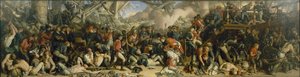
Maclise's career reached its zenith during the mid-19th century, marked by a succession of monumental commissions that solidified his place in British art history. He was elected an Associate of the Royal Academy in 1835 and, ultimately, a full member in 1840 – a prestigious recognition of his artistic merit. Perhaps his most enduring legacy lies in his magnificent murals adorning Westminster Palace. The *Meeting of Wellington and Blücher after the Battle of Waterloo*, depicting this pivotal moment in European history with breathtaking realism and dramatic intensity, remains a centerpiece of the building’s grand interior. Equally impressive is *The Death of Nelson*, a colossal fresco that vividly portrays the heroic demise of the British admiral – a testament to Maclise's mastery of scale and narrative composition. Beyond these monumental works, Maclise also lent his artistic talents to the illustration of Charles Dickens’ beloved Christmas books, bringing the author’s stories to life with evocative imagery and meticulous detail.A Style Defined by Detail and Narrative
Maclise’s artistic style was characterized by a remarkable blend of historical narrative, realism, and portraiture. He possessed an exceptional eye for detail, meticulously rendering fabrics, costumes, and facial expressions with astonishing accuracy. Influenced by both French Neoclassicism and classical art – particularly after his visit to Paris in 1830 – Maclise’s work often drew inspiration from historical events, literary works (most notably Shakespeare), and mythological tales. He skillfully combined these diverse sources into cohesive compositions that were both visually stunning and intellectually engaging. His ability to capture the essence of human emotion and create compelling narratives cemented his reputation as one of the foremost history painters of his era.Later Years and Lasting Legacy
Despite his immense success, Maclise’s dedication to his art took a significant toll on his health. In 1865, he declined the presidency of the Royal Academy, recognizing that his declining physical condition would hinder his ability to fulfill the responsibilities of the role. He died in Chelsea, London, on April 25th, 1870, leaving behind a vast and influential body of work. His memoir, published by William Justin O’Driscoll in 1871, offered valuable insights into his life and artistic philosophy. Today, Maclise's murals at Westminster Palace remain among the most celebrated examples of Victorian-era art, continuing to inspire awe and admiration for their scale, beauty, and historical significance. His illustrations for Dickens continue to delight readers, ensuring that his legacy endures as a vital contributor to both literature and visual culture. Daniel Maclise’s work stands as a powerful testament to the enduring power of art to capture history, evoke emotion, and illuminate the human experience.Perguntas e Respostas
Onde as obras de Daniel Maclise estão agrupadas por palavras-chave?
As obras de Daniel Maclise podem ser exploradas por palavra-chave na página de Por palavras-chave do artista. Cada palavra-chave agrupa as obras relacionadas.
Onde posso explorar as obras de Daniel Maclise mapeadas por tema?
A página Atlas de Temas mapeia as obras de Daniel Maclise por tema.
Qual é o nível de popularidade das obras de Daniel Maclise?
Existe uma página de Estatísticas para Daniel Maclise, apresentando estatísticas sobre as obras do artista no este site.