A Pioneer of American Abstraction: The Life and Art of Carl Holty
Carl Robert Holty (1900–1973) was a German-born American abstract painter who bridged European modernist ideas with the American context, described by Andrew Stevens as “a figure of our art history,” known for his masterful command of color, shape, and form. He stands as one of the earliest prominent voices in American abstraction, marking a crucial juncture between traditional artistic styles and the burgeoning exploration of non-representational visual language.
Early Life and Artistic Beginnings
Born in Freiburg im Breisgau, Germany, in 1900, Holty’s formative years were steeped in both German heritage and the transatlantic currents shaping his family's trajectory. His parents, American citizens residing temporarily in Germany while his father completed medical studies, instilled a dual cultural perspective that would profoundly influence his artistic sensibilities. Shortly after his birth, they returned to Milwaukee, Wisconsin—a city brimming with a vibrant German-American community—where Holty’s grandfather nurtured his nascent passion for art by introducing him to local galleries and fostering early lessons with a German painter. Even as a teenager, Holty demonstrated exceptional talent, filling sketchbooks with cartoons and experimenting with poster design—signs of an inquisitive creative spirit eager to communicate visually through innovative mediums. His rapid academic progression culminated in graduating high school within two and a half years at Milwaukee University School before briefly attending Marquette University and subsequently serving in the Reserve Officers' Training Corps during World War I. These experiences broadened his horizons, grounding him in military discipline alongside exposure to diverse cultural landscapes.
European Influences and The Hofmann Breakthrough
Returning to Milwaukee in 1923, Holty established himself as a portrait painter—a profession that allowed him to hone his observational skills—but the siren call of European artistic innovation proved irresistible. Recognizing the transformative potential of encountering groundbreaking ideas beyond his immediate surroundings, he embarked on a decade-long sojourn that irrevocably shaped his aesthetic vision. Initially settling in Munich, Holty pursued formal studies at the Royal Academy, though his plans were disrupted by an encounter with Vaclav Vytlacil—a pivotal connection who steered him toward the studio of Hans Hofmann. This proved to be a watershed moment; Hofmann’s emphasis on conceptual drawing—understanding form not merely as representation but as a tactile and intellectual construct—opened up entirely new vistas for Holty. Hofmann championed the notion that “form” could transcend mere imitation, urging artists to delve into the underlying principles governing visual perception. Holty eloquently recounted Hofmann's influence, stating that he "opened up" a world of profound understanding regarding space, color, and shape—insights that would become foundational to his artistic practice for decades to come.
Synthesis Cubism and Biomorphic Exploration
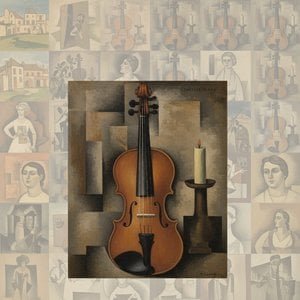
Following the tragic loss of his wife in 1930, Holty relocated to Paris—a city renowned as the epicenter of avant-garde creativity—immersing himself in the intellectual ferment of Surrealism alongside movements like Cubism and Neo-Plasticism. His Parisian canvases drew comparisons to those of Juan Gris and Pablo Picasso, reflecting a deep engagement with Synthetic Cubism’s fragmented forms and spatial explorations—techniques that Holty skillfully adopted to convey complex ideas through visual abstraction. Simultaneously, he began incorporating biomorphic shapes—inspired by Surrealist imagery—introducing organic contours into his compositions and subtly hinting at the influence of subconscious processes on artistic expression.
American Abstract Art and Pedagogical Legacy
In 1935 Holty returned to New York City, reconnecting with Hofmann and Vytlacil, as well as Stuart Davis—key figures in the burgeoning American art scene—solidifying his position within a movement dedicated to redefining artistic boundaries. He swiftly became an integral part of this transformative era, co-founding the American Abstract Artists (AAA) group in 1936 and serving as its chairman from 1938 to 1944—a role that championed abstract art’s acceptance within a nation accustomed primarily to representational styles. During this period Holty refined his artistic style, moving away from strict Cubist adherence while retaining Hofmann's core principles. He developed innovative techniques—such as taping to achieve precise edges and layering paint through overpainting—adding further depth and complexity to his canvases. Beyond his prolific artistic output, Holty dedicated himself to education, holding teaching positions at Brooklyn College from 1950 until 1970—where he earned the title of professor emeritus—sharing his expertise as a visiting instructor at institutions like the Art Students League, Washington University in St. Louis, and the University of Louisville—leaving behind an enduring legacy as an inspirational mentor who nurtured countless aspiring artists.
### Notable Achievements and Artistic Recognition
Holty’s unwavering commitment to experimentation and artistic discourse cemented his place as a pivotal figure in American art history. His paintings—characterized by rhythmic arrangements of color and shape—became celebrated for their evocative power and intellectual rigor, earning him widespread acclaim from critics and fellow artists alike. Furthermore, his collaborative project with Romare Bearden on *The Painter’s Mind*—a testament to his intellectual curiosity and dedication to artistic dialogue—underscored his belief in the importance of fostering interdisciplinary conversations within the art world. Carl Holty passed away peacefully in New York City in 1973, leaving behind a rich body of work that continues to inspire admiration for its beauty and innovation—a legacy that transcends time and reaffirms Holty’s enduring contribution to the advancement of American abstract art.