Doğançay’s artistic journey began with foundational training from his father, Adil Doğançay, and Arif Kaptan, both respected Turkish painters.
He demonstrated athletic ability as a youth, playing on the Gençlerbirliği football team.
Education: He earned a law degree from the University of Ankara in 1950 and later a doctorate in economics from the University of Paris (1950-1955), while also attending art courses at the Académie de la Grande Chaumière.
Early Career & Transition to New York
Upon returning to Turkey, Doğançay participated in numerous exhibitions, including joint shows with his father.
A brief stint in the diplomatic service brought him to New York City in 1962.
Turning Point: In 1964, he made the pivotal decision to dedicate himself entirely to art and establish New York as his permanent home.
Initially struggling with financial viability as an artist, he was encouraged by Thomas M. Messer, director of the Solomon R. Guggenheim Museum, to persevere in the challenging New York art scene.
Artistic Development and ‘Walls of the World’
Early Work: Doğançay began exploring the streets of New York for inspiration, utilizing found materials in his collages and assemblages.
The Walls Project (1970s): He embarked on his monumental ‘Walls of the World’ photographic documentary project, traveling extensively to capture urban walls across the globe.
Concept: Doğançay viewed these walls as barometers of society – reflecting time, emotions, and the human condition through layers of posters, graffiti, and weathering.
His approach was encyclopedic, focusing on the marks left by people and the environment, revealing hidden beauty in decay.
Style and Influences
Artistic Style: Doğançay’s work blends elements of Abstract Expressionism and Collage, often appearing abstract at first glance but rooted in real-world observations.
Influences: He drew inspiration from the *Nouveau Réalistes* movement, particularly their use of found objects and deconstruction techniques.
His work suggests that appearances can be deceiving, elevating everyday surfaces to artistic significance.
Major Achievements & Recognition
‘Trojan Horse’ (2006): This painting was gifted by the Turkish government to the OECD in Paris, symbolizing international collaboration and artistic exchange.
His ‘Walls of the World’ project became a significant cultural document, showcasing urban landscapes and societal narratives.
Later Years: Doğançay divided his time between studios in New York and Turgutreis, Turkey, continuing to create until his death.
Legacy and Historical Significance
Death: Burhan Doğançay passed away in January 2013 at the age of 83.
He left behind a vast body of work that challenges conventional notions of beauty and artistic subject matter.
Impact: His focus on urban walls elevated an overlooked element of city life to high art, prompting viewers to reconsider their surroundings and the stories embedded within them.
Doğançay’s work continues to resonate with audiences worldwide, offering a unique perspective on globalization, cultural identity, and the enduring power of human expression.
Pela Equipe Editorial de WahooArt.com
Teste de Conhecimentos Artísticos
Cada pergunta possui apenas uma resposta correta.
Questão 1:
Burhan Doğançay is best known for his long-term artistic project documenting what?
Questão 2:
Before dedicating himself fully to art, Doğançay initially pursued a career in what field?
Questão 3:
Who significantly encouraged Burhan Doğançay to remain in New York and pursue his art career?
Questão 4:
What did Doğançay consider urban walls to be a reflection of?
Questão 5:
In 2006, which organization received a painting titled 'Trojan Horse' as a gift from the Turkish government?
Elevate your hospitality projects with our expert trend forecast on luxury murals. From biophilic botanical jungles to opulent gold leaf geometry, discover how bespoke large-scale wall art and custom frescoes can transform hotel interiors into unforgettable architectural statements.
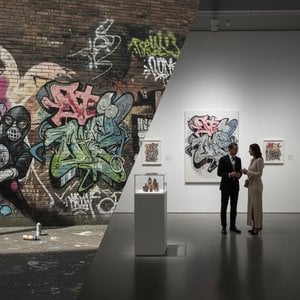
Explore the captivating journey of street art from urban walls to prestigious galleries. Discover how contemporary graffiti has evolved into a high-end collectible movement, redefining modern interior design and global art culture.