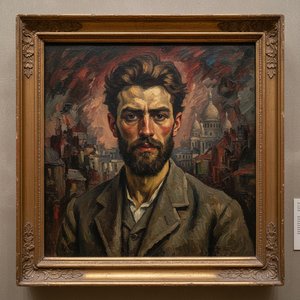
LeRoy Neiman: A Chronicler of the American Spirit
LeRoy Neiman, born in Saint Paul, Minnesota, on June 8, 1921, into a family profoundly shaped by hardship and resilience, emerged as one of the most distinctive portraitists of his era. His early life, marked by his father’s abandonment and subsequent adoption of the surname Neiman, instilled within him a keen observational eye and an enduring fascination with the lives of ordinary people—particularly those engaged in pursuits of pleasure, power, and passion. Growing up in Frog Town, a working-class neighborhood known for its gritty authenticity, provided him with a rich tapestry of subjects and a deep understanding of the American spirit, qualities he would later translate onto canvas with remarkable skill and evocative immediacy. His early artistic endeavors—selling posters for local merchants and tattooing schoolmates – demonstrated an innate talent and a willingness to engage directly with his audience, foreshadowing his lifelong commitment to capturing authentic moments in time.
Neiman’s formal training at the Saint Paul School of Art and the prestigious School of The Art Institute of Chicago (SAIC) exposed him to diverse artistic influences, including Robert Clark (later Indiana) and Leon Golub. At SAIC, he honed his technical abilities while simultaneously absorbing the burgeoning abstract expressionist movement, a shift that would subtly inform his later work, particularly in its emphasis on capturing dynamic energy and fleeting expressions. A pivotal moment arrived during his time at Carson Pirie Scott, where he met Hugh Hefner and became involved with *Playboy*, a venture that profoundly shaped his career trajectory. The creation of the Femlin logo—a mischievous sprite embodying both allure and rebellion—became an iconic symbol of the magazine’s provocative spirit and cemented Neiman's reputation as a visual storyteller adept at capturing the essence of celebrity and glamour.
The 1950s and 60s witnessed Neiman’s rapid ascent to prominence, fueled by a relentless touring schedule that took him from Parisian salons to the opulent playgrounds of Monaco and the vibrant energy of the American South. He documented the lives of captains of industry, political figures, and sporting heroes—Muhammad Ali became a lifelong friend and frequent subject—with an unparalleled ability to convey not just likeness but also character, emotion, and the sheer thrill of the moment. His paintings weren’t simply representations; they were vibrant snapshots of experience, imbued with a palpable sense of joie de vivre. His work during this period was characterized by bold brushstrokes, rich colors, and a masterful use of light and shadow, creating an illusion of movement and immediacy that drew viewers into the scene. He famously stated, “*Playboy *made the good life a reality for me and made it the subject matter of my paintings—not affluence and luxury, as such, but joie de vivre itself.”—LeRoy Neiman, VIP Magazine, July 1962.
The Art of Observation: Technique and Style
Neiman’s distinctive style was rooted in a rigorous approach to observation and an intuitive understanding of human psychology. He rarely worked from photographs, preferring instead to sketch directly on location, capturing the nuances of expression and gesture with remarkable speed and accuracy. His technique involved layering thin washes of color—a process he referred to as “wet-on-wet”—to create luminous effects and a sense of atmospheric depth. He employed a loose, gestural brushstroke that prioritized capturing the essence of a subject over meticulous detail, resulting in paintings that felt both spontaneous and carefully considered. The influence of his time at SAIC is evident in his attention to form and composition, but he ultimately developed a highly personal style characterized by its dynamism, color, and emotional intensity. His ability to distill complex narratives into single, arresting images was a hallmark of his work, solidifying his place as one of the most celebrated portraitists of the 20th century.
A Legacy of Portraits: Major Subjects and Themes
Neiman’s subject matter spanned a remarkably diverse range, reflecting his travels and encounters with influential figures across various fields. He painted presidents and prime ministers, athletes in the heat of competition (particularly boxing), musicians, artists, and socialites—all rendered with an equal degree of skill and attention to detail. However, at the heart of his work lay a fascination with the “man at his leisure”—a theme that became central to his *Playboy* column and informed countless paintings depicting individuals engaged in pursuits of pleasure, relaxation, and camaraderie. His portraits weren’t merely depictions of outward appearances; they were explorations of character, personality, and the human condition. He captured not just what people looked like but how they felt—the confidence of a champion boxer, the charm of a socialite, the quiet contemplation of an aging statesman.
Critical Reception and Enduring Influence
Throughout his career, Neiman’s work received widespread critical acclaim and was exhibited in prestigious museums around the world, including the Corcoran Gallery of Art, the Art Institute of Chicago, and the Carnegie International Exhibition. His paintings have been collected by numerous private and public institutions, and continue to be admired for their technical brilliance, emotional resonance, and historical significance. While some critics initially questioned his artistic merit, arguing that his work was overly commercial or lacking in intellectual depth, Neiman’s popularity with a broad audience—and his enduring presence in the art world—testifies to the power of his unique vision. His legacy extends beyond the realm of fine art, as his paintings have become iconic representations of American culture and the spirit of the mid-20th century. LeRoy Neiman died on June 8, 2012, at the age of 91, leaving behind a vast body of work that continues to captivate and inspire viewers today.