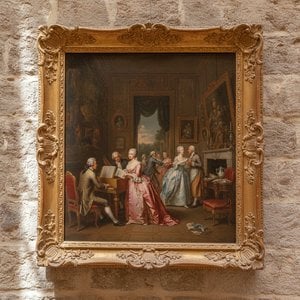
Anthony Oberman: A Dutch Portraitist Bridging Classical Tradition and Romantic Impression
Anthony Oberman (1781 – 1845) occupies a prominent place in the annals of Dutch art history, primarily celebrated for his exquisitely rendered portraits and genre scenes that eloquently captured the essence of his time. Born in Amsterdam amidst an era brimming with artistic dynamism and societal evolution—a period witnessing significant shifts towards Romantic ideals—Oberman’s formative years were deeply rooted in the enduring legacy of Haarlem Baroque painting. This heritage he assimilated with remarkable skill, shaping a distinctive artistic style characterized by meticulous detail and profound sensitivity. His education at the Stadstekenacademie furnished him with invaluable foundational competencies, propelling him toward a vocation devoted to portraying individuals and daily life with unparalleled accuracy and nuance. Oberman’s artistic trajectory unfolded concurrently with the burgeoning fervor surrounding Romanticism; however, he steadfastly maintained allegiance to classical principles of composition—specifically disegno—the Italian term for drawing—demonstrating an exceptional aptitude for harmoniously blending contrasting stylistic currents. This commitment is powerfully substantiated in “The Artist at His Studio” (1820), a masterpiece residing within the esteemed Rijksmuseum’s collection. The painting depicts a solitary artist immersed in his workspace, illuminated by natural light and surrounded by sketches and pigments—a scene laden with symbolic depth that speaks to the pursuit of artistic perfection and the contemplation of creative genesis. Considered one of Oberman's crowning achievements, it exemplifies his mastery of tonal gradation and anatomical precision, mirroring techniques championed by luminaries like Jean-Auguste Dominique Ingres. Beyond “The Artist at His Studio,” Oberman cultivated a substantial oeuvre encompassing genre paintings depicting quintessential aspects of Dutch domestic life—often portraying idyllic meadows populated by children’s laughter or intimate familial gatherings brimming with warmth and affection. These works reveal an astute observation of human psychology and emotion, underpinned by meticulous attention to textural subtleties and nuanced color palettes. Notably, his depictions of Adriaan van der Hoop’s Trotter ‘De Vlugge’ (The Fast One) and ‘De Rot’ at the Coach House offer compelling glimpses into Dutch equestrian culture during the Romantic period—a testament to Oberman's ability to capture both grandeur and intimacy within a single frame. His technique—characterized by delicate brushstrokes and masterful manipulation of color—reflects broader stylistic innovations prevalent across Europe, signaling his engagement with influential artistic dialogues. Furthermore, Oberman’s influence extended beyond his immediate contemporaries; he served as a respected teacher and mentor at the Haarlem Academy, fostering a fervent dedication to artistic rigor amongst aspiring artists—a tradition that endured for decades after his passing. His unwavering commitment to classical draughtsmanship inspired subsequent generations of Dutch painters, ensuring that Oberman's legacy transcends individual artworks and embodies enduring values of humanist observation and intellectual curiosity. Anthony Oberman’s contribution to the artistic landscape of 19th-century Holland remains undeniable—a testament to his artistry and a beacon for those who strive to honor the traditions of classical excellence while embracing the expressive potential of Romantic innovation.Perguntas e Respostas
Como posso encontrar todas as obras de Anthony Oberman por técnica?
A página Por Técnica agrupa as obras de Anthony Oberman por técnica.
Em quais movimentos Anthony Oberman atuou?
A página Todos os Movimentos agrupa as obras de Anthony Oberman por movimento artístico.
Como posso encontrar obras de Anthony Oberman sobre um tema específico?
A página Por palavras-chave de Anthony Oberman agrupa as obras do artista por palavras-chave.