The situation
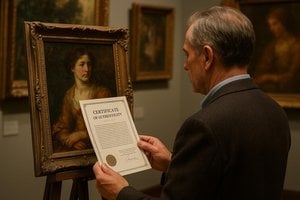
You've read the listing carefully, the words check out, you're satisfied the object is being described honestly. Then a second document shows up, usually right before you pay: a certificate of authenticity. It sits there on the screen looking like the verdict of the whole transaction — a signature, sometimes a little seal, a paragraph naming the artist and the work. For most buyers, this is where the checking stops. The certificate feels like the finish line, the way a diploma feels like proof you learned something.
Here's what a certificate of authenticity actually is, in law and in plain English, before you decide how much weight it can carry: it's a written statement by a seller, attesting to authorship. That's it. Nobody neutral issues it as a matter of course — not a court, not a museum. It's written by the person with the most direct financial stake in you believing it. That doesn't make certificates worthless. It makes them exactly as trustworthy as the person who wrote them, which is a very different animal from self-evidently true.
The problem the certificate alone cannot solve
The trouble with a certificate of authenticity is a production-cost problem, and it's an ugly one. A museum wall label is expensive to fake — you'd have to deceive curators, conservators, and a public paper trail all at once. A certificate of authenticity requires a printer and an embossing stamp, both cheap, both sitting on a shelf at any office-supply store. So the single most official-looking document in the whole transaction is, mechanically, the easiest thing in it to fabricate. A buyer who stops at "there is a certificate" has confirmed that a piece of paper exists. Nothing more.
Several US states solved this exact problem decades before online selling existed, because print dealers had been running the same trick for years in mail-order and gallery sales of multiples — prints and photographs made in more than one copy. California's Fine Prints Act and New York's Arts and Cultural Affairs Law both took the same route: instead of banning vague certificates outright, they wrote down, by statute, exactly what a certificate for a print or photograph has to contain, and attached a real financial penalty to skipping it.
Two certificates, side by side
Picture two certificates arriving with the same kind of print.
Certificate A reads, in full: "This artwork is certified authentic. A beautiful addition to any collection." Heavy card stock, serif type, gold border, the whole costume of officialdom. Nowhere does it say who wrote it, how they know what they claim to know, or how you'd ever reach them again.
Certificate B is plainer — ordinary paper, no border, nothing to look at — but it states: "Issued by [named dealer, registered business, address, phone]. Title: [specific]. Artist: [named]. Medium: giclée print, pigment ink on cotton rag. Edition: 45 of an edition of 150; three artist's proofs exist in addition to the numbered edition. Signed in pencil, lower left margin. This certificate is based on the dealer's direct commission of the edition from the artist in 2023."
Certificate A is, materially, decorated cardboard. It could sit next to any print by anyone and nothing on it would need to change. Certificate B says exactly what it knows, exactly how it knows it, and exactly who's answerable if it's wrong. Notice what actually did the work in Certificate B: not the paper, not the gold border, but an identifiable issuer and a specific, checkable claim. Strip the ornament off both, and Certificate A has nothing left standing. Certificate B has everything that matters, still standing, no costume required.
The solution worked out by statute, and what it costs to apply
California's Fine Prints Act spells out, plainly, what a certificate for a print must disclose: the title and the artist's name; whether the artist signed it, and how — a pencil signature is a completely different fact from a signature baked into the printing plate itself; whether it's offered as a limited edition; whether other editions of the same image exist elsewhere; how many copies exist in each edition; and a description of the process and materials. New York's equivalent statute requires the same written disclosure for prints and photographs sold above a modest price threshold, and adds a detail worth remembering on its own: when a dealer hands you a certificate, the law treats every fact on it as a warranty — a promise the dealer can be held to, not a mere description they can shrug off later.
Applying this costs you nothing but attention. Read any certificate you're offered and ask, item by item, whether it answers those questions: who is the issuer, and can they actually be reached; what exactly is the medium; what exactly is the edition; how is it signed; and — the single most revealing line, when it's there — what is the basis for the claim. A certificate that explains how the issuer came to know what they're asserting ("commissioned directly from the artist," "compared against the catalogue raisonné entry") is doing real work. One that only asserts is doing nothing at all, dressed up to look like something.
The remedy isn't symbolic, either. Under California law, a dealer who sells a print without the required certificate, or with false information on it, owes the buyer their money back with interest — and if the violation was deliberate, three times that amount, plus legal costs. That's real teeth, a genuine incentive for a legitimate dealer to get the certificate right. It's also precisely the incentive an anonymous seller of Certificate A has dodged completely, by making sure nobody can ever be identified as the issuer in the first place.
The new problem this creates: a good certificate still only proves what the issuer says
Suppose a certificate passes every test above — named issuer, specific claims, a clear statement of its own basis. It has now proven that a real, identifiable business is willing to put its name behind a specific claim, and can be sued if that claim is false. Genuinely valuable. But look at what it has not proven: it hasn't proven the artist named on it exists as anything more than a name the dealer typed. A well-constructed certificate about a well-constructed fiction is still a fiction, just a legally exposed one. Verifying the paperwork and verifying the person it describes are two completely different jobs, and the second one doesn't get skipped just because the first one passed.
Checking the artist against a record the seller does not control
For an artist claimed to be historical, or already established, verify their provenance somewhere entirely outside the seller's own website — the same instinct that makes you check a restaurant review site instead of trusting the menu's own claim to be "world famous." A general art encyclopedia is the easiest starting point — one such reference, WikiOO, documents several hundred thousand artworks and tens of thousands of artist biographies, free to search, organized so both the artist and the specific composition can be checked independently. Beyond that sits a small set of specialist authority files that museums, libraries, and auction houses themselves rely on to disambiguate names — the Getty's Union List of Artist Names chief among them, cross-linked through Wikidata to library and national-collection records. An artist absent from all of these, where the claimed period and reputation would normally guarantee inclusion, is either genuinely obscure in a way worth asking the seller to explain, or is not who the listing says they are.
For a living artist, no database helps, because databases exist for accumulated reputations and a living artist may not have earned one yet, honestly, through no fault of their own. What substitutes for it is continuity that would be tedious to fabricate: years of posted work, including the ordinary pieces and the abandoned ones alongside the polished, not just the highlight reel; photographs and video of work in progress, in a studio recognizable across many posts by the same easel, the same floor, the same light; an exhibition history at venues you can actually telephone and have confirmed. A portfolio that looks complete and professional overnight isn't, by itself, suspicious — but it's also not yet the kind of evidence that years of ordinary, unglamorous documentation provides.
The pattern worth recognising on sight
There's a specific, now common version of this problem worth naming directly, because recognizing its shape defuses it fast: an account is built by copying a real artist's portfolio and biography, with a username altered from the original by a character or two — a doubled letter, a numeral standing in for a word. This account then contacts a buyer directly, rather than waiting to be found, the way a scammer cold-calls instead of waiting for you to dial in. A sense of urgency follows fast — a piece "on hold," a discount expiring within the hour, the oldest trick in the book wearing new clothes. And the request, sooner or later, is to move payment away from wherever the conversation started, onto a channel that can't be reversed.
Two things defeat this pattern reliably. The first: refuse to complete any part of the transaction inside the conversation that started it — close it, find the artist's own site or verified account independently, and start again from there. If both routes genuinely lead to the same seller, you've lost nothing but two minutes. The second belongs to the next stage of the transaction entirely, because it concerns not the artist but the money, and that's a different conversation for a different day.
Provenance, and the register no certificate can substitute for
One more question belongs in this same paperwork stage, especially for anything with age or a documented ownership history behind it: where has the object been since it left the artist's hands, and what supports each step of that journey? "From a private collection," offered with no date and no document, isn't provenance — it's the absence of provenance, worded to sound like its presence, the way "seasoned to taste" sounds like a recipe but tells you nothing. A credible answer names prior owners, or at minimum dates and invoices, even where a current owner's name is withheld for privacy.
For anything of real value, this question has a free, public backstop worth using regardless of how convincing the seller's story is: a stolen-art register. INTERPOL maintains a public database, searchable through a free app, of tens of thousands of items recorded as stolen by police worldwide. It exists because the alternative — buying in good faith something that turns out to be stolen — can mean surrendering it later to its rightful owner, without compensation, no matter what the seller told you. A few minutes against that register is cheap insurance against the single worst outcome available in this entire process.
Where this leaves the reader
A certificate that names its issuer and states its basis, an artist confirmed outside the seller's own site, a provenance story that survives being asked for dates, and a clean result against the stolen-art registers — together, those answer the question this article set out to answer: is the paperwork, and the person behind it, real? They don't answer a separate, entirely practical question, which is what happens to the money already sent if any of this turns out to be wrong after all — and what payment method, chosen before any of it was known, decides whether that money can still be clawed back.
Related on OriginalUniqueArt.com
- Curious what a real one looks like? Our own Certificate of Authenticity, explained line by line — issuer named, basis stated, nothing decorative.
- Deciphering Authenticity: A Guide to Art Verification & Provenance Research — the long version of everything this article just walked you through.
- The Provenance Puzzle — how experts actually trace an artwork's ownership trail, for when "private collection" isn't good enough.
- Navigating the Digital Canvas — the wider playbook for buying art online without getting burned.
- Wondering what happens after the paperwork checks out? Our return policy — the answer to the question this article deliberately leaves open.
Sources
- Certificates of Authenticity: A Complete How-To Guide — Format
- California Civil Code § 1745 — Remedies and Penalties, Sale of Fine Prints (Justia)
- California Civil Code §§ 1742–1744.9 — Full Disclosure in the Sale of Fine Prints (Justia)
- New York ACA § 15.01 — Full Disclosure in the Sale of Visual Art Objects Produced in Multiples (Justia)
- Art Law on Consumer Protections for Purchasers of Prints and Multiples — Artnet News
- Union List of Artist Names (ULAN) — Getty, via Collections Trust
- Union List of Artist Names ID (P245) — Wikidata
- About — WikiOO, The Encyclopedia of Fine Arts
- Art Provenance: What It Is and How to Verify It — ArtBusiness.com
- INTERPOL Stolen Works of Art Database
- INTERPOL ID-Art mobile app
- How do blockchain certificates work — Verisart Help Center
- Don't fall for this Instagram art scam — Fox News