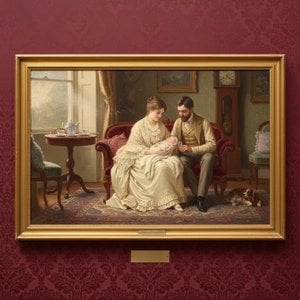
Early Life & Transatlantic Influences: A Foundation in Philadelphia
 Wikipedia: Charles Robert Leslie
Charles Robert Leslie (19 October 1794 – 5 May 1859) was an American genre painter. == Biography == Leslie was born in London to American parents. When he was five years of age he returned with them to the United States, where they settled in Phil...
Charles Robert Leslie’s story is one of transatlantic currents, a life shaped by the burgeoning artistic sensibilities of both America and England. Born in London in 1794 to American parents, Robert and Lydia Leslie, his early years were steeped in the cultural atmosphere of the Old World before a pivotal return to the United States at the tender age of five. Settling in Philadelphia, a city rapidly evolving into a hub of intellectual and artistic activity, young Charles found himself immersed in a distinctly different environment. While formally educated, it was the burgeoning world of performance that first captured his imagination. His early attempts to capture the charismatic actor George Frederick Cooke on canvas – portraits rendered from memory alone – reveal an innate talent and a passion for representing human character. This initial spark, however, proved insufficient for the limited opportunities available in Philadelphia at the time. A fund was raised, a testament to the recognition of his potential, enabling him to embark on a journey that would define his artistic trajectory: a voyage to Europe and immersion within the established art world of London.
From High Art Aspirations to Genre Painting: Finding Leslie’s Niche
Arriving in London in 1811, Leslie was immediately enveloped by the influential circles of British artistry. Introductions from his family secured him access to figures like Benjamin West, Martin Archer Shee, and Washington Irving, and admission as a student to the prestigious Royal Academy. Initially drawn towards “high art” – ambitious historical and mythological subjects – he encountered challenges in achieving distinction within this competitive field. His early work, *Saul and the Witch of Endor*, while demonstrating technical skill, lacked the distinctive voice that would come to characterize his mature style. It was a gradual but decisive shift toward genre painting that unlocked Leslie’s true potential. He abandoned grand narratives for intimate scenes drawn from literature, a realm where he could deftly blend narrative charm with meticulous observation. This wasn't merely a change in subject matter; it represented a fundamental understanding of his strengths – an ability to capture the nuances of everyday life and imbue them with a romantic sensibility.
Royal Academy Ties & the Pursuit of Narrative: Shaping a Victorian Aesthetic
Leslie’s election as an Associate, and later full Royal Academician in 1826, marked his acceptance into the heart of the British art establishment. The Royal Academy, under the enduring influence of Joshua Reynolds' principles of idealized beauty and noble representation, had long dominated the artistic landscape. However, a new generation was emerging, seeking greater realism and emotional resonance. Leslie’s work occupied an intriguing space within this evolving context. While he didn’t entirely abandon the pursuit of aesthetic refinement, his paintings increasingly focused on capturing moments of genuine human interaction and emotion. His scenes weren't simply decorative; they were carefully constructed narratives, often imbued with a gentle humor and subtle moral undertones. This approach resonated with a Victorian audience eager for art that both entertained and edified, reflecting their own rapidly changing social values.
Literary Subjects and Portraiture: Capturing Character and Romance
 Amy Robsart (1532–1560)
Admire Charles Robert Leslie’s ‘Amy Robsart,’ a captivating Neoclassical portrait of aristocratic beauty. Rich colors & dramatic lighting evoke romance. Explore this 1836 masterpiece!
Leslie’s enduring fame rests on his ability to translate the beloved characters of literature onto canvas. He didn't merely illustrate stories; he *embodied* them. Works like *Sir Roger de Coverley going to Church* (1819) and *Londoners Gypsying* (1820) are not simply depictions of scenes from Addison’s essays, but rather evocative interpretations that capture the spirit of those narratives. His portraits, too, were imbued with a similar narrative quality. Amy Robsart (1836), for example, is more than just an aristocratic likeness; it's a captivating study in Neoclassical beauty and romantic intrigue, rich colors and dramatic lighting evoking a sense of mystery and allure. He excelled at portraying the psychological depth of his sitters, revealing their inner lives through subtle gestures and expressions. This talent extended to works inspired by Cervantes’ *Don Quixote*, Shakespeare, and other literary giants, establishing him as a master of narrative painting.
Constable's Friend & Biographer: Preserving a Legacy Through Words
Beyond his own artistic achievements, Leslie is perhaps best remembered for his profound friendship with John Constable and his seminal biography, *Memoirs of the Life of John Constable* (1843). This work, considered a cornerstone of artistic biography, offered an intimate and insightful portrait of the landscape painter’s life, struggles, and creative process. Leslie's meticulous research and deep understanding of Constable’s personality allowed him to paint a vivid picture of the artist as both a man and a visionary. The *Memoirs* not only secured Constable’s place in art history but also revealed Leslie’s own literary talent and his commitment to preserving the legacy of his peers. It stands as a testament to the power of friendship and the importance of documenting artistic lives for future generations, offering invaluable insights into the creative spirit of 19th-century England.
Leslie’s Enduring Influence: Bridging Romanticism and Academic Art
Charles Robert Leslie's career represents a fascinating intersection of Romantic sensibility and academic tradition. He wasn’t a revolutionary figure challenging established norms, but rather a skilled mediator who successfully blended the emotional depth of Romanticism with the technical precision of Victorian art. His paintings continue to captivate viewers with their charm, narrative richness, and meticulous attention to detail. While his work may have fallen out of favor during periods dominated by more radical artistic movements, it has experienced a renewed appreciation in recent years as scholars and collectors recognize its unique contribution to British art history. At WahooArt.com, we celebrate Leslie’s enduring legacy, offering high-quality reproductions of his most beloved works – allowing you to bring the captivating world of 19th-century England into your own home.