A Glimpse of Eternity: Paul Cézanne’s Mont Sainte-Victoire
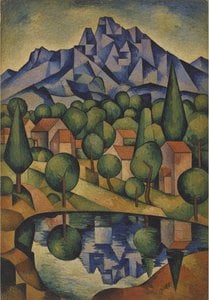
Paul Cézanne’s “Mont Sainte-Victoire Seen from Les Lauves,” painted in 1904, isn't merely a depiction of a mountain; it’s an invitation into the very heart of artistic perception. Housed within the Pushkin State Museum in Moscow, this oil on canvas transcends the boundaries of landscape painting, becoming a profound meditation on seeing itself – how we perceive depth, form, and ultimately, the essence of reality. More than just a representation of the iconic mountain range overlooking Aix-en-Provence, it’s a testament to Cézanne's revolutionary approach to art, bridging the gap between the fleeting impressions of Impressionism and the nascent geometric explorations that would define Cubism. This work stands as a pivotal moment in art history, a visual manifesto for a new way of seeing, and now beautifully rendered in exquisite hand-painted reproductions available at WahooArt.
Cézanne’s genius lay not in replicating the mountain with photographic accuracy, but rather in distilling its core. He achieved this through an extraordinary technique – a deliberate fragmentation of form and color, a process he relentlessly pursued throughout his career. Observe the repetitive, exploratory brushstrokes, each meticulously placed to build up complex fields of color that suggest volume and depth. These aren’t smooth, blended washes; they are individual marks, carefully considered and strategically arranged. The painting isn't about accurately depicting the mountain; it’s about conveying *its* presence – its solidity, its weight, its relationship to the surrounding landscape. The two prominent mountains, rendered with a subtle yet insistent geometry, seem to emerge from the hazy atmosphere, their forms simplified and abstracted, echoing Cézanne’s lifelong fascination with structure and form. Scattered trees, painted with similar deliberate strokes, add layers of texture and contribute to the overall sense of spatial ambiguity – an effect that draws the viewer into the scene, inviting them to actively participate in its construction.
The Pursuit of Structure: A Revolutionary Technique
Cézanne’s style was revolutionary not just in its subject matter but also in its execution. He moved away from the Impressionist focus on capturing fleeting moments of light and atmosphere, instead prioritizing the underlying structure of objects. This is evident in “Mont Sainte-Victoire Seen from Les Lauves,” where he breaks down forms into their essential geometric components – planes, lines, and angles – and rearranges them to create a new visual language. His use of color is equally innovative; he employs flattened planes of color rather than blending hues together, creating a sense of solidity and depth that defies traditional perspective. This technique, often described as “primitivism,” harkens back to Cézanne’s early studies of Japanese prints, which profoundly influenced his understanding of composition and form. He wasn't interested in capturing the *illusion* of depth; he was striving for a more fundamental representation of space – one based on solid shapes and interlocking planes.
The painting’s creation occurred during a period of intense artistic experimentation for Cézanne. He was driven by a desire to move beyond the limitations of traditional landscape painting, rejecting the emphasis on capturing fleeting moments of light and color in favor of a more enduring representation of form. This pursuit led him to repeatedly revisit Mont Sainte-Victoire, transforming it into a series of paintings that explored different perspectives and compositional arrangements. The choice of Les Lauves as the vantage point – a location offering a unique view of the mountain – reflects this methodical approach, demonstrating Cézanne’s commitment to understanding his subject on a deeply personal level. He wasn't simply painting what he saw; he was actively *constructing* an image based on his own observations and artistic vision.
A Mountain as Symbol: The Enduring Legacy
Mont Sainte-Victoire held a particularly profound significance for Cézanne, becoming something of a personal obsession. He painted it dozens of times over several decades, each iteration revealing a slightly different facet of the mountain’s character and his evolving artistic approach. The mountain itself is steeped in symbolism – representing permanence, stability, and the enduring power of nature. For Cézanne, it was more than just a geological formation; it was a visual challenge, a canvas for exploring the fundamental principles of art. The repetition of this subject throughout his career demonstrates not only his dedication but also his belief that through sustained observation and experimentation, one could unlock deeper truths about both the mountain and the act of seeing itself.
Cézanne’s innovative approach to art profoundly influenced the development of modern art. His emphasis on structure, form, and color paved the way for Cubism, while his exploration of spatial ambiguity anticipated many of the techniques used by later abstract artists. Artists like Henri Matisse and Pablo Picasso were deeply inspired by Cézanne's work, adopting his use of flattened planes of color and simplified forms in their own paintings. Cézanne’s legacy extends far beyond the immediate artistic circles of his time; he fundamentally changed the way we perceive and represent the world around us. The painting “Mont Sainte-Victoire Seen from Les Lauves” remains a powerful testament to this enduring influence, inviting viewers to contemplate the beauty and complexity of both art and nature.
Reproductions Available at WahooArt: Bringing Cézanne Home
For those seeking to experience the beauty and influence of “Mont Sainte-Victoire Seen from Les Lauves” firsthand, WahooArt offers meticulously crafted hand-painted reproductions that capture the essence of Cézanne’s original masterpiece. These reproductions are not mere copies; they are artistic interpretations created by skilled artisans who have painstakingly studied Cézanne's technique and color palette. Each reproduction faithfully recreates the painting’s distinctive brushstrokes, atmospheric depth, and emotional resonance, allowing art enthusiasts to bring a piece of this iconic artwork into their own homes.
Beyond “Mont Sainte-Victoire Seen from Les Lauves,” WahooArt offers a curated selection of reproductions by Paul Cézanne, including "Seated Woman in Blue" and other notable works. Explore our collection today and discover the timeless beauty of Cézanne’s art – a legacy that continues to inspire and captivate audiences around the world. View this reproduction here.
Other Notable Works by Paul Cézanne



 Visualizar na parede
 Alternar para Impressão
 Compartilhar
 Compartilhar
 Detalhes

 Baixar imagem
 Semelhantes
 Raio X
 Slideshow
 Estatísticas


 Ler mais






































 A opção de vidro está disponível apenas para tamanhos inferiores a 110 cm