A Window into the Soul: Rembrandt’s “Self Portrait, Metropolitan Museum of Art, N”
Rembrandt van Rijn's "Self Portrait, Metropolitan Museum of Art, N," painted in 1660, isn’t merely a depiction of an aging artist; it’s a profound meditation on time, mortality, and the very nature of artistic creation. This iconic work, currently residing within the hallowed halls of the Metropolitan Museum of Art in New York City, offers a remarkably intimate glimpse into the mind of one of history’s greatest masters – a man wrestling with both his legacy and the inevitable passage of years. The painting immediately commands attention not through ostentatious grandeur, but through a quiet intensity, a palpable sense of introspection that draws the viewer into a deeply personal dialogue.
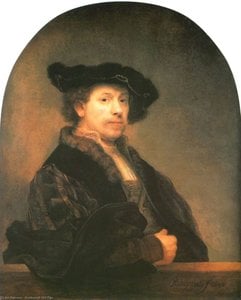
The composition itself is deceptively simple. Rembrandt, now considerably older than in earlier self-portraits, sits before a dark, undefined background – a deliberate choice that forces our focus entirely onto his face and hands. He wears a black velvet cap with a prominent white lace trim, a detail suggesting both formality and a touch of melancholy. His gaze is direct, unwavering, meeting the viewer’s eye with an almost unsettling honesty. It's not a boastful or triumphant look; rather, it’s one of quiet contemplation, tinged with a hint of weariness – a reflection, perhaps, of the burdens carried by a man who had spent his life attempting to capture the essence of human experience on canvas. The subtle wrinkles around his eyes and mouth speak volumes about the years etched upon his face, each line telling a silent story of triumphs and sorrows.
Rembrandt’s masterful use of *chiaroscuro* – the dramatic interplay of light and shadow – is central to the painting’s power. He employs this technique with exquisite precision, sculpting the form of his face and hands with carefully placed highlights and deep shadows. The light seems to emanate from an unseen source, illuminating only portions of his being while leaving the rest shrouded in darkness. This creates a sense of depth and volume, lending a remarkable three-dimensionality to the portrait. More importantly, it serves to heighten the emotional impact, emphasizing the areas of concern – the furrowed brow, the downturned mouth – and intensifying the overall mood of introspection and perhaps even melancholy. The shadows aren’t simply absences of light; they are active participants in the narrative, suggesting hidden depths and unspoken anxieties.
The historical context surrounding this particular self-portrait is crucial to understanding its significance. 1660 was a challenging period for Rembrandt. While he had enjoyed immense success earlier in his career, financial difficulties were mounting, and his reputation faced criticism. He was battling personal struggles as well, including the loss of several children and a strained relationship with his household. This painting, therefore, can be interpreted as a poignant reflection on these challenges – a moment of quiet self-assessment amidst a period of uncertainty. It’s not a celebration of artistic achievement but rather an honest portrayal of a man confronting his own vulnerabilities. The choice to depict himself in this state, vulnerable and perhaps weary, is profoundly revealing, demonstrating Rembrandt’s willingness to expose his own humanity within his art.
The painting’s enduring appeal lies in its ability to connect with viewers on a deeply emotional level. It transcends the boundaries of time and circumstance, offering a timeless meditation on the human condition. Rembrandt doesn’t simply paint a likeness; he paints an *experience* – a feeling of shared vulnerability and quiet contemplation. The image invites us to consider our own mortality, our own struggles, and our own attempts to make sense of the world around us. It’s a reminder that even in the face of adversity, there is beauty to be found in honesty and introspection. It remains a testament to Rembrandt’s genius – a powerful and enduring symbol of artistic integrity and human resilience.
Rembrandt’s Innovative Style: Light, Shadow, and the Human Spirit
Rembrandt van Rijn's revolutionary approach to painting was inextricably linked to his masterful manipulation of light and shadow, a technique he termed *chiaroscuro*. This wasn’t merely an aesthetic choice; it was a fundamental tool for conveying emotion and revealing the inner life of his subjects. In "Self Portrait, Metropolitan Museum of Art, N," this is evident in every brushstroke. He doesn’t simply depict light; he sculpts it, using it to define form, create drama, and evoke specific moods. The stark contrast between the illuminated areas and the deep shadows isn’t random; it’s carefully orchestrated to draw attention to key features – the eyes, the mouth, the hands – and to amplify their emotional impact.
Consider, for instance, the way Rembrandt renders the texture of his velvet cap. It's not painted with smooth, even strokes but rather with a series of short, broken lines that create a sense of depth and volume. Similarly, the folds in his clothing are suggested through subtle shifts in shadow, conveying both their physical form and their underlying weight. This meticulous attention to detail is characteristic of Rembrandt’s style – a commitment to capturing not just the outward appearance of his subjects but also their inner essence.
Furthermore, Rembrandt's use of *chiaroscuro* wasn’t limited to simply creating dramatic contrasts. He employed subtle gradations of light and shadow to create a sense of atmosphere and mood. The darkness surrounding his figure isn’t oppressive; it’s suggestive, hinting at hidden depths and unspoken emotions. It creates a feeling of intimacy, as if we are privy to a private moment of reflection. This masterful control over light and shadow is what distinguishes Rembrandt’s work from that of many of his contemporaries – it’s what gives his paintings such a profound sense of realism and emotional resonance.
The influence of Caravaggio, a contemporary Italian painter known for his dramatic use of *chiaroscuro*, can be seen in Rembrandt’s approach. However, Rembrandt took this technique to new heights, imbuing it with his own unique sensibility. He didn’t simply imitate Caravaggio; he transformed the technique into something entirely his own – a powerful tool for exploring the complexities of human emotion and experience. His ability to use light and shadow to reveal not just the physical appearance but also the inner state of his subjects is what makes "Self Portrait, Metropolitan Museum of Art, N" such a compelling and enduring work of art.
## The Metropolitan Museum of Art: A Sanctuary for Artistic Treasures
The Metropolitan Museum of Art in New York City stands as one of the world’s preeminent cultural institutions, housing an unparalleled collection spanning millennia and continents. Its vast holdings encompass virtually every artistic discipline imaginable – painting, sculpture, decorative arts, costumes, music, and more. The museum’s commitment to preserving and showcasing art from diverse cultures and historical periods is truly remarkable, offering visitors a unique opportunity to engage with the full spectrum of human creativity.
The inclusion of Rembrandt’s "Self Portrait, Metropolitan Museum of Art, N" within the Met’s collection underscores its dedication to representing the greatest achievements of Western art. The painting’s placement alongside other masterpieces – from ancient Egyptian artifacts to Renaissance sculptures – highlights the museum’s ambition to provide a comprehensive and engaging experience for all visitors. The Met’s meticulous care and conservation efforts ensure that this iconic work, and countless others, will be available for generations to come.
Visiting the Metropolitan Museum of Art is more than simply viewing art; it’s embarking on a journey through time and culture. The museum’s thoughtfully designed galleries, informative displays, and expert curatorial staff create an immersive environment that stimulates the mind and nourishes the soul. The "Self Portrait, Metropolitan Museum of Art, N" itself is a testament to the Met’s commitment to preserving artistic excellence – a poignant reminder of Rembrandt’s genius and a captivating window into the human spirit.



 Visualizar na parede
 Comprar impressão
 Compartilhar
 Compartilhar
 Detalhes

 Baixar imagem
 Semelhantes
 Raio X
 Slideshow

 Ler mais






































 A opção de vidro está disponível apenas para tamanhos inferiores a 110 cm







![A Aula de Anatomia do Dr. Nicolaes Tulp [1632]](/media/artworks/images-thumb/e5/fc/e5fcb33447eac6b24ab049b22effa1a3.jpg)





