
Cubist Portrait
Rostro is a work by Pablo Picasso (1881–1973). It belongs to the Cubist Portrait movement. It is made in Acrylic On Canvas.

Pablo Picasso's “Rostro,” a deceptively simple graphite drawing executed around 1920, transcends its minimalist aesthetic to deliver a profound meditation on human emotion and artistic exploration. This piece exemplifies Picasso’s mastery of dry media—specifically charcoal—and represents a pivotal moment in his oeuvre, marking a shift towards greater introspection and stylistic refinement following the initial burst of Cubist experimentation.
While seemingly devoid of overt narrative content, “Rostro” resonates with symbolic significance rooted in Picasso’s broader artistic concerns. The monochromatic palette—primarily shades of gray—reflects a preoccupation with psychological states and the exploration of inner landscapes. Furthermore, the intense gaze captured in the eye suggests contemplation and perhaps vulnerability, inviting viewers to consider themes of solitude and self-awareness.
Picasso’s technique in “Rostro” demonstrates an unparalleled command of graphite rendering. He achieves remarkable tonal gradation through the strategic application of hatching and cross-hatching, creating a rich surface texture that contrasts sharply with subtle highlights. This meticulous attention to detail underscores Picasso's dedication to capturing not merely likeness but also feeling—a feat accomplished with unwavering precision.
“Rostro” remains a compelling exemplar of Picasso’s artistic genius—a testament to his ability to transform simple materials into expressions of profound human emotion and intellectual contemplation.
Pablo Picasso, Rostro.
Reproduções pintadas à mão de "Rostro", de Pablo Picasso podem ser adquiridas no este site: uma reprodução a óleo pintada à mão sobre tela de linho, através da sua página de encomendas Reprodução Pintada à Mão.
Os temas presentes em "Rostro", de Pablo Picasso incluem profile portrait, monochromatic drawing, facial detail, cubist style, texture study, shadow play, human figure. Juntos, eles sintetizam o assunto da obra.
O formato de "Rostro" é Portrait. Esta informação é útil ao planejar onde uma reprodução será colocada.
No catálogo, "Rostro", de Pablo Picasso está registrado como WallArt. A categoria ajuda a encontrar obras semelhantes.
A emoção Melancholic de "Rostro" acompanha seu estilo Cubist Portrait.
"Rostro" possui uma prévia em realidade aumentada: a página de Prévia em RA da obra permite visualizá-la no seu próprio espaço através de um dispositivo compatível.
"Rostro" apresenta profile portrait, monochromatic drawing, facial detail, cubist style, texture study, shadow play, human figure, e o seu estado de espírito registrado é Calm.
"Rostro", de Pablo Picasso possui uma luminância Bright Balance. A luminância descreve quanta luz as cores parecem refletir.

1881–1973, Espanha
Infância, Família e Formação Na cidade de Málaga, Espanha, um menino chamado Pablo Picasso chegou ao mundo em 25 de outubro de 1881. Ele era filho de María Picasso y López e José Ruiz Blasco, um homem que compreendia o peso de um pincel e a disciplina de uma tela. Desde os seus primeiros anos, a criança demonstrava uma inclinação inquieta pelo desenho, um talento que parecia manifestar-se em suas primeiras tentativas de fala. Seu pai, também pintor, reconheceu a centelha em seu filho e assumiu a missão de cultivar essa habilidade emergente.
 The Alchemy of Carbon: Mastering Precision, Depth, and Texture in the Art of GraphiteDiscover the sophisticated world of graphite drawing. Explore the technical mastery of light, texture, and depth through an art-history len…
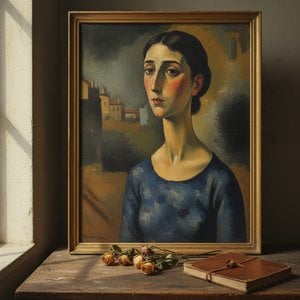 Capturing the Soul: An Exploration of Modigliani's Iconic Portraits and the Melancholy of ModernismDelve into the haunting beauty of Amedeo Modigliani's portraits. Explore the intersection of Expressionism and Modernism through an expert …
 Decoding Impasto: The Emotional Power and Texture of Van Gogh's BrushstrokesExplore the profound emotional depth of Van Gogh's impasto technique. Discover how his sculptural brushstrokes and textured oil layers defi…
 Visualizar na parede

 Impressão
 Compartilhar
 Compartilhar
 Guia


 Baixar imagem
 Semelhantes
 Raio X
 Ver diaporama
 Perguntas e Respostas

 Estatísticas
 Guernica1937
 As Jovens de Avignon1907
 Weeping Woman1937
 O Velho Guitarrista