A vida de Leonor Fini
A Life Unbound: The World of Leonor Fini
Born in Buenos Aires in 1907, and raised amidst the shifting landscapes of Trieste, Italy, Leonor Fini was an artist whose life itself felt like a perpetual act of transformation. Her early years were marked by instability—frequent relocations dictated by her parents’ tumultuous custody battles—a circumstance that instilled within her a profound sense of self-reliance and a fascination with disguise, themes that would become central to her artistic vision. This nomadic upbringing, coupled with a lack of formal training, fostered an intensely personal approach to artmaking, one rooted in observation, intuition, and a deep engagement with the Old Masters she encountered through books and museum visits. She absorbed the traditions of Renaissance and Mannerist styles, laying a foundation for the unique visual language that would define her career. Fini’s childhood wasn't conventional; it was an immersion into a world of shifting identities and concealed truths, experiences that profoundly shaped her artistic sensibility.
Parisian Encounters and the Embrace of Surrealism
The pivotal moment in Fini’s journey arrived with her move to Paris in the early 1930s. The city pulsed with creative energy, a magnet for artists and intellectuals from across Europe and beyond. It was here that she encountered figures who would profoundly influence her artistic development: Carlo Carrà and Giorgio de Chirico, whose metaphysical paintings resonated with her own burgeoning interest in dreamlike imagery and psychological depth. She quickly became immersed in the vibrant Surrealist scene, forging friendships with Paul Éluard, Max Ernst (with whom she had a significant romantic relationship), Georges Bataille, Henri Cartier-Bresson, Picasso, André Pieyre de Mandiargues, and Salvador Dalí. While embracing the spirit of artistic experimentation that characterized the movement, Fini resisted strict categorization as a Surrealist, preferring to forge her own path, incorporating elements of Gothic art, Romanticism, and Symbolism into her work. A striking moment illustrating her presence within this circle was being photographed nude by Cartier-Bresson while traveling with Mandiargues—an image that later achieved considerable recognition and value, highlighting both Fini’s artistic allure and Cartier-Bresson's photographic genius. Her early Parisian years were a period of intense exploration, marked by experimentation with various mediums and styles, laying the groundwork for her distinctive visual language.
A Language of Masks and Powerful Women
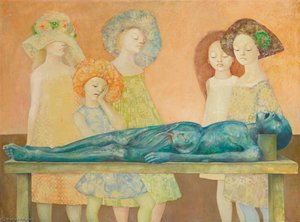
Fini’s art is immediately recognizable for its distinctive style and recurring motifs. Her paintings are populated by strong, enigmatic women—often depicted with animalistic features or masked faces—who embody themes of female power, sexuality, and independence. La bout du monde, exemplifies this fascination, portraying a submerged female figure surrounded by skulls, a haunting image that speaks to both vulnerability and resilience. Eroticism is a pervasive element in her work, explored not through explicit representation but through symbolic imagery and dreamlike scenarios. Masks, in particular, serve as potent symbols of transformation, concealment, and the multifaceted nature of identity. Her canvases are filled with shifting forms, ambiguous spaces, and a sense of psychological tension that draws the viewer into a world both alluring and unsettling. She wasn’t merely depicting women; she was exploring the complexities of female experience, challenging conventional representations and celebrating feminine agency. The influence of artists like Botticelli and the Pre-Raphaelites is evident in her use of color, composition, and subject matter, creating a unique synthesis of classical and modern aesthetics.
Beyond Painting: A Multifaceted Creative Force
Leonor Fini's creative talents extended far beyond the realm of painting. In 1949, she conceptualized and designed *Le rêve de Leonor* (“Leonor’s Dream”), a ballet choreographed by Frederick Ashton with music by Benjamin Britten—a testament to her ability to translate her artistic vision into another medium. Her collaborations with Elsa Schiaparelli, designing the iconic bottle for the perfume “Shocking,” demonstrated her flair for design and her understanding of the power of visual imagery. She further expanded her creative horizons through costume and set designs for theatre, ballet, opera, and film productions, including Renato Castellani’s Romeo and Juliet (1954) and John Huston’s *A Walk with Love and Death* (1968). In the 1970s, she turned to writing, publishing three novels—Rogomelec, Moumour, Contes pour enfants velu, and Oneiropompe—and illustrating works by literary giants such as Edgar Allan Poe, Charles Baudelaire, and Shakespeare. This diverse body of work underscores her remarkable versatility and her unwavering commitment to artistic exploration. Her designs for the Paris Opera were particularly notable, showcasing a blend of classical elegance and surrealist imagination.
Legacy and Enduring Influence
Leonor Fini’s legacy extends beyond her impressive oeuvre; she is increasingly recognized as a significant figure in the feminist movement due to her depictions of empowered women who challenged traditional gender roles. She outlived many of her contemporaries, maintaining an active career well into her later years, culminating in a retrospective exhibition at the Musée du Luxembourg in Paris (1986) that drew massive crowds. Her work is now included in major surveys of Surrealism and featured in exhibitions exploring women artists and self-representation, solidifying her place in art history. Notably, Madonna famously drew inspiration from Fini’s imagery for her music video “Bedtime Story” (1994), demonstrating the enduring impact of her artistic vision on popular culture. Leonor Fini's unique artistic voice—a blend of personal experience, intellectual curiosity, and unwavering independence—continues to captivate and inspire audiences today, ensuring that her work will resonate for generations to come.




 Metropolitan Museum of Art