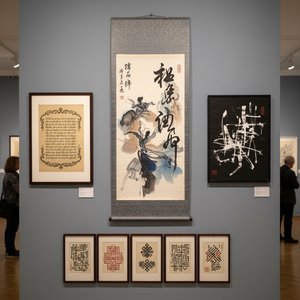
Xu Bing – A Disruptor of Language: The Life and Art of Xu Bing
Xu Bing, born in Chongqing, China, in 1955, stands as a monumental figure within contemporary art—a provocateur who relentlessly interrogated the role of language and its impact on perception. His artistic trajectory is inextricably linked to the turbulent currents of twentieth-century Chinese history, specifically the formative influence of the Cultural Revolution (1966–1976), where he experienced firsthand the imposition of ideological dogma and the suppression of intellectual freedom—a crucible that instilled within him a profound awareness of language as both instrument of control and potential vehicle for liberation. This conviction would become the bedrock upon which his groundbreaking artistic practice was built. Growing up in Beijing, amidst the burgeoning intellectual atmosphere of Peking University—where his father served as professor—Xu’s early life nurtured a spirit of inquiry and fostered an appreciation for cultural heritage. However, it was the forced relocation to the countryside for re-education between 1975 and 1977 that irrevocably shaped his worldview, etching into his consciousness the chilling realization that words could be wielded as weapons—a lesson he would revisit throughout his artistic career. Returning to Beijing after graduation in 1987, Xu formally enrolled at the Central Academy of Fine Arts (CAFA), dedicating himself to mastering printmaking and drawing techniques—skills honed with meticulous discipline and underpinned by a deep understanding of Chinese calligraphy traditions. This foundational training provided him with the technical arsenal he would later repurpose in ways that defied convention and challenged established artistic paradigms.Deconstructing Communication: Key Works and Artistic Development
Xu Bing’s initial output demonstrated an impressive command of Socialist Realism aesthetics—a stylistic choice reflecting the prevailing artistic climate of his time—yet it was his decisive break from this tradition that truly cemented his position as a visionary artist. Pieces like “Shattered Jade” (1977) and “Bustling Village on the Water” (1980–81), while technically proficient, served as crucial stepping stones toward a more conceptually driven artistic vision—one characterized by an unwavering commitment to questioning accepted truths and dismantling ingrained assumptions. The pivotal moment arrived with *Book from the Sky* (1987–1991)—a monumental installation that instantly catapulted Xu Bing to international acclaim. This ambitious project involved painstakingly carving thousands of woodblocks depicting invented Chinese characters—symbols devoid of phonetic sound—and printing them onto scrolls filled with these nonsensical glyphs. The sheer scale and painstaking execution demanded respect, simultaneously provoking profound contemplation about the nature of language, cultural understanding, and the illusion of knowledge. It wasn’t merely an aesthetic exercise; it was a deliberate provocation aimed at destabilizing viewers’ cognitive frameworks. Continuing his exploration of linguistic complexities, Xu Bing tackled *Ghosts Pounding the Wall* (1990)—another installation that interrogated perceptions of communication and representation—employing a striking juxtaposition of Western and Eastern artistic traditions. He further pushed boundaries with *Square Word Calligraphy* (1994–ongoing), transforming English words into visually recognizable Chinese characters—a playful experiment that underscored the inherent similarities between disparate linguistic systems while simultaneously highlighting their fundamental differences. Subsequent works, including *Background Story* (2004–ongoing)—created from dust collected after September 11—and *Where Does the Dust Collect Itself?* (2004)—presented a poignant meditation on memory, authenticity, and cultural identity—demonstrating Xu Bing’s unwavering dedication to confronting pressing social issues through artistic expression.Influences and Philosophical Underpinnings
Xu Bing's artistic worldview is profoundly shaped by his personal experiences within the Cultural Revolution and informed by Western Conceptual Art movements—a synthesis that prioritizes ideas over formal conventions. He draws inspiration from Chinese calligraphy traditions, recognizing their capacity to convey profound meaning through subtle gestures and understated elegance—not merely as stylistic models but as tools for dismantling ingrained assumptions about visual representation. Simultaneously, Xu’s work resonates with the spirit of inquiry championed by Conceptual Art artists who questioned the role of art in society and challenged viewers to engage in critical self-reflection. Philosophically, he grapples with questions surrounding perception, cultural identity, and the constructed nature of reality—arguing that meaning is not inherent in objects or images but emerges from interaction between observer and environment.Recognition and Lasting Legacy
Xu Bing’s contributions to contemporary art have garnered widespread acclaim through numerous prestigious awards and exhibitions—most notably a MacArthur Fellowship (1999), recognizing his originality and transformative artistic vision; the Fukuoka Prize (2003); and the Artes Mundi Prize (2004)—specifically for *Where Does the Dust Collect Itself?*. In 2015, he received the U.S. Department of State Medal of Arts—a testament to his enduring influence on the global art landscape. His work has been showcased in solo exhibitions at major museums worldwide, including The Museum of Modern Art and The Metropolitan Museum of Art in New York; the British Museum; and numerous galleries across Europe and North America. He served as Vice President of CAFA from 2008 to 2014—a role that solidified his position as a leading figure in Chinese art education—and continues to inspire artists and scholars alike, ensuring his place as one of the most significant voices shaping our understanding of art’s capacity to provoke thought and foster dialogue.Pytania i odpowiedzi
Gdzie i w którym roku urodził(a) się Xu Bing?
Xu Bing urodził się w Чунцин w 1955 roku.
Jak znaleźć dzieła Xu Bing o konkretnej tematyce?
Strona Według słów kluczowych artysty Xu Bing grupuje jego dzieła według słów kluczowych.
Czy istnieje zestawienie wszystkich tematów, które malował Xu Bing?
Strona Atlas tematów prezentuje dzieła Xu Bing pogrupowane według tematów.