William Shackleton, 1872 – 1933

Obrazy: 57 najsłynniejszych dzieł artysty William Shackleton, zestawienie

Najsłynniejszym obrazem William Shackleton jest Phryne at Eleusis (1907), znajdujący się w Touchstones Rochdale w Rochdale. Wraz z Autumn in Parham Park, West Sussex (1904) i The Eternal Dream (1924) tworzy to zestaw trzech dzieł, które zna każdy. Nasz katalog zawiera 57 dzieł autorstwa William Shackleton; poniższych 57 to te, na które świat patrzy najczęściej – każde z podaniem roku powstania, muzeum, w którym się znajduje, oraz uzasadnieniem jego znaczenia.

Ranking oparty na naszym wskaźniku popularności, który łączy liczbę wyszukiwań, wizyt oraz zamówień dla każdego dzieła. Aktualizacja: Listopad 2026. Każde arcydzieło na tej stronie można zamówić jako ręcznie malowaną reprodukcję olejną o jakości muzealnej lub jako wysokiej jakości wydruk artystyczny, w wybranym przez Ciebie rozmiarze.

Portret William Shackleton
William Shackleton · 1872 – 1933
Urodzony · zmarł
1872 – 1933, Bradford
Nurt
Impressionism
Dzieła w naszym katalogu
57
Najsłynniejsze
Phryne at Eleusis (1907)
Najwięcej dzieł w
Nottingham Castle Museum And Art Gallery

10 najsłynniejszych obrazów artysty William Shackleton

Phryne at Eleusis (1907) autorstwa William Shackleton
1

Phryne at Eleusis

1907 · Oil On Canvas · Touchstones Rochdale, Rochdale

The sun hangs low over the Aegean, casting a bruised light across the water. Phryne stands at the edge of the world, her arms outstretched toward the horizon. She is a pale figure against the deepening orange of the sky, a singular point of grace amidst a gathering of shadows. The ocean breathes behind her, its surface catching the final, dying glimmers of the day. People move in the foreground…

Ręcznie malowana reprodukcja olejowa od $181 34 × 29 cm Rozmiar zgodny z oryginałem $581 141 × 101 cm Zamów w oryginalnym rozmiarze →
The Eternal Dream (1924) autorstwa William Shackleton
3

The Eternal Dream

1924 · Oil On Canvas · Doncaster Museum And Art Gallery, Doncaster

A winged figure hangs suspended in a sea of clouds. It is an angel or perhaps a fairy, caught in a moment of stillness. The wings are spread wide, claiming the space between the heavens and the earth. Yellow and blue dominate the canvas, casting a warmth that feels like a sudden sunbeam through a heavy mist. The oil on canvas gives the light a physical weight, a thickness that…

Ręcznie malowana reprodukcja olejowa od $181 27 × 37 cm Rozmiar zgodny z oryginałem $403 79 × 105 cm Zamów w oryginalnym rozmiarze →
Winter Sunrise, Malham, Yorkshire (1924) autorstwa William Shackleton
4

Winter Sunrise, Malham, Yorkshire

1924 · Oil On Canvas · Usher Gallery, Lincoln

The landscape of Malham is rendered through a palette of blue, purple, and gray, capturing the specific chill of a winter morning. Light breaks through a heavy cloud layer, casting a pale, golden promise across the terrain. A small village sits nestled near the base of the mountains, providing a sense of human scale against the expansive sky. Trees are scattered throughout the composition, their forms providing depth and grounding…

Ręcznie malowana reprodukcja olejowa od $181 39 × 26 cm
The Golden Hour (1893) autorstwa William Shackleton
5

The Golden Hour

1893 · Oil On Canvas · Cecil French Bequest, London

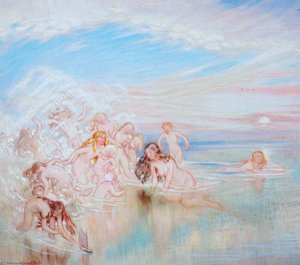
A hazy, dreamlike scene unfolds as nude figures emerge from and interact with water under a pervasive golden light. The composition is loosely organized, centering on a group of figures reaching upward toward a primary light source, while others remain partially submerged. In the distance, a single ship provides a subtle narrative anchor to the aquatic setting. The palette is dominated by shades of yellow and gold, creating an atmosphere…

Ręcznie malowana reprodukcja olejowa od $281 30 × 33 cm Rozmiar zgodny z oryginałem $285 32 × 35 cm Zamów w oryginalnym rozmiarze →
The City of the Golden Gates (1922) autorstwa William Shackleton
6

The City of the Golden Gates

1922 · Oil On Canvas · Harris Museum - Art Gallery, Preston

In this 1922 oil on canvas, William Shackleton presents a sprawling urban panorama that captures a specific moment of civic energy. The composition centers on a gathering of figures clustered around an imposing statue, creating a focal point of shared human experience amidst the vastness of the city. As your eyes move across the canvas, you encounter a sense of rhythmic movement; people drift through the streets like notes in…

Ręcznie malowana reprodukcja olejowa od $181 30 × 33 cm Rozmiar zgodny z oryginałem $611 120 × 127 cm Zamów w oryginalnym rozmiarze →
Highland Raiders Goredale Scar (1917) autorstwa William Shackleton
7

Highland Raiders Goredale Scar

1917 · Oil On Canvas

The landscape of Goredale Scar is a fractured thing. Under an overcast sky, the earth seems to be in the process of unmaking itself, leaving behind crumbling stone and debris. Cattle and a dog move through this chaos, their bodies clustered in a way that suggests a sudden, urgent necessity. The light is diffused, filtered through heavy clouds to cast soft, muted shadows across the terrain. There is a sense…

Ręcznie malowana reprodukcja olejowa od $181 35 × 28 cm Rozmiar zgodny z oryginałem $199 44 × 36 cm Zamów w oryginalnym rozmiarze →

William Shackleton, obrazy od 11 do 57

Children and Fairies (1924) autorstwa William Shackleton
#30

Children and Fairies

1924 · The Hepworth Wakefield

In the delicate brushstrokes of William Shackleton’s 1924 masterpiece, Children and Fairies, we are invited to step through a veil separating the mundane from the magical. This enchanting…

Zabierz ją do domu od $181 →
Highland Raiders (1918) autorstwa William Shackleton
#40

Highland Raiders

1918 · Nottingham Castle Museum And Art Gallery

In the evocative masterpiece Highland Raiders, painted in 1918 by the British master William Shackleton, we are transported to a world that feels simultaneously grounded in historical reality…

Zamów ręcznie malowaną kopię od $181 →
A Love Lyric autorstwa William Shackleton

The Cartwright Hall Art Gallery in the United Kingdom is home to a plethora of stunning artworks, including William Shackleton's captivating piece, A Love Lyric. This beautiful oil…

Zabierz ją do domu od $181 →

Tematy, które najczęściej malował William Shackleton

Cztery tematy najczęściej powracające w tych arcydziełach, wraz z najdoskonalszym przykładem każdego z nich.

Gdzie można zobaczyć obrazy William Shackleton

8 muzeów, w których znajduje się najwięcej obrazów z tej strony.

Muzea Miasto Dzieła artysty William Shackleton Obrazy z tej listy
Nottingham Castle Museum And Art Gallery, NottinghamNottingham Castle Museum And Art Gallery Nottingham 6 Study for 'The Harvesters', Highland Raiders, Study of a Man Holding a Cock for 'Highland Raiders'
Laing Art Gallery, Newcastle upon TyneLaing Art Gallery Newcastle upon Tyne 3 Amberley, Putney Bridge, Study for 'The Mussel Gatherers'
Touchstones Rochdale, RochdaleTouchstones Rochdale Rochdale 2 Phryne at Eleusis, Christ at Jerusalem
Doncaster Museum And Art Gallery, DoncasterDoncaster Museum And Art Gallery Doncaster 2 The Eternal Dream, Study for 'The Eternal Dream'
Cecil French Bequest, LondonCecil French Bequest London 2 The Golden Hour, Silver Seas
Towneley Hall Art Gallery - Museum, BurnleyTowneley Hall Art Gallery - Museum Burnley 2 Study for 'Japanese Festival', The Nymph of Malham Cove
Usher Gallery, LincolnUsher Gallery Lincoln 1 Winter Sunrise, Malham, Yorkshire
Harris Museum - Art Gallery, PrestonHarris Museum - Art Gallery Preston 1 The City of the Golden Gates

Najsłynniejsze obrazy William Shackleton z każdej dekady

  1. 1890s
    The Golden Hour (1893) autorstwa William Shackleton
    Nr 5 z 57

    The Golden Hour

    Wiek 18 – 27 · Cecil French Bequest

    A hazy, dreamlike scene unfolds as nude figures emerge from and interact with water under a pervasive golden light. The composition is loosely organized, centering on a group…

  2. 1900s
    Phryne at Eleusis (1907) autorstwa William Shackleton
    Nr 1 z 57

    Phryne at Eleusis

    Wiek 28 – 37 · Touchstones Rochdale

    The sun hangs low over the Aegean, casting a bruised light across the water. Phryne stands at the edge of the world, her arms outstretched toward the horizon.…

  3. 1910s
    Highland Raiders Goredale Scar (1917) autorstwa William Shackleton
    Nr 7 z 57

    Highland Raiders Goredale Scar

    Wiek 38 – 47

    The landscape of Goredale Scar is a fractured thing. Under an overcast sky, the earth seems to be in the process of unmaking itself, leaving behind crumbling stone…

  4. 1920s
    The Eternal Dream (1924) autorstwa William Shackleton
    Miejsce 3 / 57

    The Eternal Dream

    Wiek 48 – 57 · Doncaster Museum And Art Gallery

    A winged figure hangs suspended in a sea of clouds. It is an angel or perhaps a fairy, caught in a moment of stillness. The wings are spread…

  5. 1930s

Pytania o obrazy William Shackleton

Jakie jest najsłynniejsze dzieło William Shackleton?Pokaż odpowiedź

Phryne at Eleusis (1907), Touchstones Rochdale, Rochdale. Następnie pojawiają się Autumn in Parham Park, West Sussex (1904) oraz The Eternal Dream (1924).

Ile lat miał William Shackleton, gdy namalowano Phryne at Eleusis?Pokaż odpowiedź

35 lat: Phryne at Eleusis pochodzi z 1907, a William Shackleton urodził(a) się w 1872.

Jakie są 10 najlepszych obrazów autorstwa William Shackleton?Pokaż odpowiedź

Phryne at Eleusis, Autumn in Parham Park, West Sussex, The Eternal Dream, Winter Sunrise, Malham, Yorkshire, The Golden Hour, The City of the Golden Gates, Highland Raiders Goredale Scar, Silver Seas, Self Portrait at the Age of 23 i Amberley. Powyższy ranking zawiera rok oraz muzeum dla każdego z nich.

Ile obrazów stworzył/a William Shackleton?Pokaż odpowiedź

Nasz katalog obejmuje 57 dzieł autorstwa William Shackleton, datowanych od 1891 do 1933.

Gdzie znajdują się najsłynniejsze obrazy William Shackleton?Pokaż odpowiedź

Większość z nich znajduje się w Nottingham Castle Museum And Art Gallery (Nottingham), Laing Art Gallery (Newcastle upon Tyne) i Touchstones Rochdale (Rochdale). Powyższa tabela zawiera listę muzeów po kolei.

Kiedy William Shackleton namalował swoje najsłynniejsze dzieła?Pokaż odpowiedź

W okresie 1920s: 15 z 57 dzieł na tej stronie pochodzi z tego czasu, w tym The Eternal Dream.

Jakie są najwcześniejsze i najpóźniejsze słynne obrazy William Shackleton?Pokaż odpowiedź

Najwcześniejszy na tej stronie to Silver Seas (1891), najpóźniejszy Grass of Parnassus (1933).

Co najczęściej malował William Shackleton?Pokaż odpowiedź

Landscape (4), People (3) i Trees (2), spośród 57 dzieł na tej stronie.

Jakiej techniki najczęściej używał/a William Shackleton?Pokaż odpowiedź

Oil On Canvas: 8 z 57 dzieł na tej stronie.

Do jakiego nurtu artystycznego należy William Shackleton?Pokaż odpowiedź

Impressionism i British aesthetic movement, co pokazują obrazy na tej stronie.

Które obrazy William Shackleton można zobaczyć w Nottingham Castle Museum And Art Gallery?Pokaż odpowiedź

Study for 'The Harvesters', Highland Raiders i Study of a Man Holding a Cock for 'Highland Raiders' to jedne z 6 dzieł na tej stronie znajdujących się w zbiorach Nottingham Castle Museum And Art Gallery, Nottingham.

Czy mogę kupić reprodukcję obrazu William Shackleton?Pokaż odpowiedź

Tak. Każdy obraz na tej stronie można zamówić jako ręcznie malowaną reprodukcję olejną o jakości muzealnej lub jako wysokiej jakości wydruk artystyczny w wybranym przez Ciebie rozmiarze, bezpośrednio ze strony danego dzieła.

O William Shackleton

The Soul of the British Landscape: The Life and Art of William Shackleton

In the tapestry of early 20th-century British art, few threads are as delicately woven as those left by William Shackleton. Born in 1872 in the industrial heart of Wednesfield, Staffordshire, Shackleton emerged from a period of profound transition in the art world. His journey was one of constant refinement, moving between the rigorous academic traditions of his training and a deeply personal, atmospheric approach to the natural world. As a painter who mastered both the expansive grandeur of the Yorkshire Moors and the quiet, intimate beauty of a single bloom, Shackleton captured a sense of time and place that remains profoundly moving to the modern observer.

Shackleton’s artistic foundation was built upon the prestigious halls of the Beckenham School of Art and the Royal Academy. It was during these formative years that he began to synthesize the classical precision of his instructors with the burgeoning influences of the British Aesthetic Movement. He found inspiration in the works of masters like Walter Sickert and Frederic Leighton, learning to balance a realistic depiction of form with an expressive, almost poetic use of light and brushwork. This duality allowed him to navigate seamlessly between different genres, finding equal depth in a sprawling vista and a quiet domestic scene.

A Mastery of Light and Atmosphere

The true heart of Shackleton’s oeuvre lies in his ability to translate the ephemeral qualities of the British atmosphere onto canvas. He possessed an uncanny knack for capturing the "sublime"—that specific, breathtaking moment when light breaks through a heavy cloud or when the morning frost clings to the heather. His depictions of the Yorkshire landscape, particularly around Haworth Moor and Malham, are not merely topographical records but emotional landscapes. In works such as "Winter Sunrise, Malham, Yorkshire," one can almost feel the biting chill of the air and the silent, golden promise of a new day.

This mastery extended far beyond the rugged highlands. Shackleton’s sensitivity to nature was equally evident in his more delicate studies. His "Study of Roses" demonstrates a profound ability to find the infinite within the small, using soft textures and subtle color gradations to celebrate the fleeting beauty of life. Whether he was painting the vast, windswept plains or the intricate petals of a flower, his technique remained rooted in an appreciation for the organic rhythms of the natural world.

Portraiture and the Human Connection

While landscapes provided him with a stage for grandeur, portraiture offered Shackleton a medium for psychological intimacy. He moved away from the stiff, formal traditions of Victorian portraiture to explore the nuanced expressions of his subjects. His portraits often utilized soft, diffused light—reminiscent of the interior scenes favored by the Impressionists—to create an atmosphere of quiet contemplation. By placing his subjects within domestic settings, he invited the viewer into a private world, capturing not just a likeness, but a sense of character and soul.

The legacy of William Shackleton is defined by this versatility and his enduring contribution to the British tradition. He remains a significant figure for those who seek art that speaks to the senses and the spirit. His work serves as a bridge between the romanticism of the previous century and the more experimental approaches of the modern era, leaving behind a collection of works that continue to resonate with their profound respect for the beauty found in both the monumental and the minute.