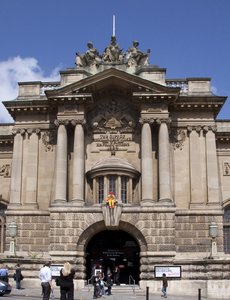
William Menzies Coldstream, 1908 – 1987

Obrazy: 19 najsłynniejszych dzieł artysty William Menzies Coldstream, zestawienie

Najsłynniejszym obrazem William Menzies Coldstream jest Helen Darbishire, Principal (1931–1945) (1939), znajdujący się w Somerville College w Oxford. Wraz z Cripplegate (1946) i London Bombed Site 1946 (St Nicholas Coln Abbey and Bow Church) (1946) tworzy to zestaw trzech dzieł, które zna każdy. Nasz katalog zawiera 21 dzieł autorstwa William Menzies Coldstream; poniższych 19 to te, na które świat patrzy najczęściej – każde z podaniem roku powstania, muzeum, w którym się znajduje, oraz uzasadnieniem jego znaczenia.

Ranking oparty na naszym wskaźniku popularności, który łączy liczbę wyszukiwań, wizyt oraz zamówień dla każdego dzieła. Aktualizacja: Listopad 2026.

Portret William Menzies Coldstream
William Menzies Coldstream · 1908 – 1987
Urodzony · zmarł
1908 – 1987, Belford
Nurt
Contemporary realism
Dzieła w naszym katalogu
21
Najsłynniejsze
Helen Darbishire, Principal (1931–1945) (1939)
Najwięcej dzieł w
Government Art Collection

10 najsłynniejszych obrazów artysty William Menzies Coldstream

Helen Darbishire, Principal (1931–1945) (1939) autorstwa William Menzies Coldstream
1

Helen Darbishire, Principal (1931–1945)

1939 · Oil On Canvas · Somerville College, Oxford

William Menzies Coldstream's 1939 portrait of Helen Darbishire is more than simply a likeness; it’s a carefully constructed meditation on age, authority, and the quiet strength of intellect. Painted during a period of profound social and political upheaval – the shadow of impending war hung heavy over Europe – the work offers a remarkable study in restrained realism, a testament to Coldstream's meticulous observation and his deliberate rejection of flamboyant…

Cripplegate (1946) autorstwa William Menzies Coldstream
2

Cripplegate

1946 · Acrylic On Canvas · Arts Council Collection, Londyn

William Menzies Coldstream’s “Cripplegate” isn’t merely a depiction of a London cityscape; it’s a meticulously observed study of urban life, imbued with the quiet dignity and analytical precision that defined the artist’s entire oeuvre. Painted in 1946, during a period of profound social and artistic transformation in Britain, this oil on canvas offers a rare glimpse into a specific moment within the city's historical fabric – a snapshot of a…

London Bombed Site 1946 (St Nicholas Coln Abbey and Bow Church) (1946) autorstwa William Menzies Coldstream
3

London Bombed Site 1946 (St Nicholas Coln Abbey and Bow Church)

1946 · Acrylic On Canvas · Brytyjska Kolekcja Councilu, Londyn

London Bombed Site 1946 (St Nicholas Coln Abbey and Bow Church) – A Reflection on Resilience William Menzies Coldstream’s “London Bombed Site 1946” isn't merely a depiction of devastation; it’s a profound meditation on memory, faith, and the enduring spirit of London itself. Painted in 1946, shortly after the Blitz—the relentless aerial bombardment campaign that scarred Britain during World War II—this monumental canvas transcends mere documentation to become an emblem…

The Table (1932) autorstwa William Menzies Coldstream
4

The Table

1932 · Oil On Canvas · Bristol Museum - Art Gallery, Bristol

Completed in 1932, The Table is an oil on canvas by William Menzies Coldstream. Measuring 91 x 71 cm, the work presents a quiet domestic interior through a focused arrangement of objects. The composition centers on a tabletop holding a vase with blossoms, a cup, a bottle, and two books. A chair is positioned near the table, contributing to the sense of a lived-in space.

William Menzies Coldstream, obrazy od 11 do 19

Rimini, Opera Narodowa (1945) autorstwa William Menzies Coldstream
#12

Rimini, Opera Narodowa

1945 · Government Art Collection

A Snapshot of Resilience: William Menzies Coldstream’s Rimini, the Opera House Sir William Menzies Coldstream (1908–1987) wasn't merely a painter; he was a fervent believer in observation—a conviction…

Sleeping Cat (1938) autorstwa William Menzies Coldstream
#13

Sleeping Cat

1938 · Ashmolean Museum of Art and Archaeology

Completed in 1938, Sleeping Cat by William Coldstream presents a quiet study of Helen Darbishire. As the Principal of Somerville College, Oxford, Darbishire is captured in a moment…

Freesias with a Skull (1940) autorstwa William Menzies Coldstream
#14

Freesias with a Skull

1940 · Ashmolean Museum of Art and Archaeology

Freesias with a Skull is an oil on canvas painting by the artist William Coldstream. The work was completed in 1940. This still life measures 51.0 x 61.0…

Tematy, które najczęściej malował William Menzies Coldstream

Cztery tematy najczęściej powracające w tych arcydziełach, wraz z najdoskonalszym przykładem każdego z nich.

Gdzie można zobaczyć obrazy William Menzies Coldstream

8 muzeów, w których znajduje się najwięcej obrazów z tej strony.

Muzea Miasto Dzieła artysty William Menzies Coldstream Obrazy z tej listy
Government Art Collection, LondynGovernment Art Collection Londyn 2 Capua Cathedral from the Bishop's Palace, Rimini, Opera Narodowa
Ashmolean Museum of Art and Archaeology, OksfordAshmolean Museum of Art and Archaeology Oksford 2 Sleeping Cat, Freesias with a Skull
st Cross College, Oxfordst Cross College Oxford 2 W. E. van Heyningen, Orange Tree
Somerville College, OxfordSomerville College Oxford 1 Helen Darbishire, Principal (1931–1945)
Arts Council Collection, LondynArts Council Collection Londyn 1 Cripplegate
Brytyjska Kolekcja Councilu, LondynBrytyjska Kolekcja Councilu Londyn 1 London Bombed Site 1946 (St Nicholas Coln Abbey and Bow Church)
Bristol Museum - Art Gallery, BristolBristol Museum - Art Gallery Bristol 1 The Table
Magdalen College, Oxford, OxfordMagdalen College, Oxford Oxford 1 George Stuart Gordon (1881–1942), President (1928–1942)

Najsłynniejsze obrazy artysty William Menzies Coldstream, rok po roku

Od 1932 do 1946, kariera artysty William Menzies Coldstream obejmuje 15 lat, czyli nieco ponad dekadę: oto zestawienie rok po roku, wraz z najsłynniejszymi obrazami z każdego z nich.

  1. 1932
    The Table (1932) autorstwa William Menzies Coldstream
    Miejsce 4 / 19

    The Table

    Wiek: 24 · Bristol Museum - Art Gallery

    Completed in 1932, The Table is an oil on canvas by William Menzies Coldstream. Measuring 91 x 71 cm, the work presents a quiet domestic interior through a…

  2. 1932
  3. 1937
  4. 1937
  5. 1937
  6. 1938
    Sleeping Cat (1938) autorstwa William Menzies Coldstream
    13 z 19

    Sleeping Cat

    Wiek: 30 · Ashmolean Museum of Art and Archaeology

    Completed in 1938, Sleeping Cat by William Coldstream presents a quiet study of Helen Darbishire. As the Principal of Somerville College, Oxford, Darbishire is captured in a moment…

  7. 1939
    Helen Darbishire, Principal (1931–1945) (1939) autorstwa William Menzies Coldstream
    Miejsce 1 / 19

    Helen Darbishire, Principal (1931–1945)

    Wiek: 31 · Somerville College

    William Menzies Coldstream's 1939 portrait of Helen Darbishire is more than simply a likeness; it’s a carefully constructed meditation on age, authority, and the quiet strength of intellect.…

  8. 1940
  9. 1940
    Freesias with a Skull (1940) autorstwa William Menzies Coldstream
    Nr 14 z 19

    Freesias with a Skull

    Wiek: 32 · Ashmolean Museum of Art and Archaeology

    Freesias with a Skull is an oil on canvas painting by the artist William Coldstream. The work was completed in 1940. This still life measures 51.0 x 61.0…

  10. 1943
  11. 1944
  12. 1945
    Rimini, Opera Narodowa (1945) autorstwa William Menzies Coldstream
    Miejsce 12 / 19

    Rimini, Opera Narodowa

    Wiek: 37 · Government Art Collection

    A Snapshot of Resilience: William Menzies Coldstream’s Rimini, the Opera House Sir William Menzies Coldstream (1908–1987) wasn't merely a painter; he was a fervent believer in observation—a conviction…

  13. 1946
    Cripplegate (1946) autorstwa William Menzies Coldstream
    Nr 2 z 19

    Cripplegate

    Wiek: 38 · Arts Council Collection

    William Menzies Coldstream’s “Cripplegate” isn’t merely a depiction of a London cityscape; it’s a meticulously observed study of urban life, imbued with the quiet dignity and analytical precision…

  14. 1946

Pytania o obrazy William Menzies Coldstream

Jakie jest najsłynniejsze dzieło William Menzies Coldstream?Pokaż odpowiedź

Helen Darbishire, Principal (1931–1945) (1939), Somerville College, Oxford. Następnie pojawiają się Cripplegate (1946) oraz London Bombed Site 1946 (St Nicholas Coln Abbey and Bow Church) (1946).

Ile lat miał William Menzies Coldstream, gdy namalowano Helen Darbishire, Principal (1931–1945)?Pokaż odpowiedź

31 lat: Helen Darbishire, Principal (1931–1945) pochodzi z 1939, a William Menzies Coldstream urodził(a) się w 1908.

Jakie są 10 najlepszych obrazów autorstwa William Menzies Coldstream?Pokaż odpowiedź

Helen Darbishire, Principal (1931–1945), Cripplegate, London Bombed Site 1946 (St Nicholas Coln Abbey and Bow Church), The Table, Studio Interior, Winifred Burger, On the Map, Inez Spender, Portrait of a Soldier i Havildar Ajmer Singh. Powyższy ranking zawiera rok oraz muzeum dla każdego z nich.

Ile obrazów stworzył/a William Menzies Coldstream?Pokaż odpowiedź

Nasz katalog obejmuje 21 dzieł autorstwa William Menzies Coldstream, datowanych od 1932 do 1946.

Gdzie znajdują się najsłynniejsze obrazy William Menzies Coldstream?Pokaż odpowiedź

Większość z nich znajduje się w Government Art Collection (Londyn), Ashmolean Museum of Art and Archaeology (Oksford) i st Cross College (Oxford). Powyższa tabela zawiera listę muzeów po kolei.

Kiedy William Menzies Coldstream namalował swoje najsłynniejsze dzieła?Pokaż odpowiedź

W okresie 1937: 3 z 19 dzieł na tej stronie pochodzi z tego czasu, w tym Winifred Burger.

Jakie są najwcześniejsze i najpóźniejsze słynne obrazy William Menzies Coldstream?Pokaż odpowiedź

Najwcześniejszy na tej stronie to The Table (1932), najpóźniejszy Cripplegate (1946).

Co najczęściej malował William Menzies Coldstream?Pokaż odpowiedź

Observation (5), British art (4) i Architecture (3), spośród 19 dzieł na tej stronie.

Jakiej techniki najczęściej używał/a William Menzies Coldstream?Pokaż odpowiedź

Oil On Canvas: 4 z 19 dzieł na tej stronie.

Do jakiego nurtu artystycznego należy William Menzies Coldstream?Pokaż odpowiedź

Contemporary realism, co pokazują obrazy na tej stronie.

Które obrazy William Menzies Coldstream można zobaczyć w Government Art Collection?Pokaż odpowiedź

Capua Cathedral from the Bishop's Palace i Rimini, Opera Narodowa to jedne z 2 dzieł na tej stronie znajdujących się w zbiorach Government Art Collection, Londyn.

O William Menzies Coldstream

A Life Dedicated to Observation: The World of William Menzies Coldstream

Sir William Menzies Coldstream, a pivotal figure in 20th-century British art, wasn’t merely a painter; he was an advocate for seeing—for a rigorous, analytical approach to representing the world around us. Born in the quiet Northumberland village of Belford in 1908, his early life shifted towards the bustling energy of London, where he received a private education before embarking on formal artistic training at the Slade School of Fine Art from 1926 to 1929. This foundational period instilled within him not just technical skill, but a commitment to direct observation that would define his entire career. Coldstream’s path wasn't confined to the easel; it was interwoven with documentary filmmaking, progressive social movements, wartime service, and ultimately, a profound influence on art education in Britain. He embodied a rare combination of artistic dedication and institutional leadership, leaving an indelible mark on the landscape of British art.

Early Years and Artistic Foundations

William Menzies Coldstream was born on February 28th, 1908, to Dr. George Probyn Coldstream, a physician, and Susan Jane Lilian Tod, daughter of Major Robert Mercer-Tod. The family moved to West Hampstead, London in 1910, providing William with access to the vibrant artistic circles of the city. He received a private education before attending the Slade School of Fine Art from 1926 to 1929, where he studied under Professor Tonks and other influential figures. It was at the Slade that Coldstream encountered artists like Claude Rogers and Rodrigo Moynihan, forming friendships that would shape his artistic outlook. His initial struggles with medical school led him to pursue art as a more fulfilling path, demonstrating an early inclination towards creative expression. He began experimenting with various styles, influenced by the Impressionists and Post-Impressionists, particularly Cezanne and Sickert – artists whose emphasis on form and structure resonated deeply with his developing aesthetic sensibilities. This period laid the groundwork for his later commitment to analytical realism, a style characterized by meticulous observation and precise representation.

From GPO Film Unit to the Euston Road School

In 1934, Coldstream’s interest in social issues and financial difficulties prompted him to join the GPO Film Unit under John Grierson, where he collaborated with luminaries like W.H. Auden, Benjamin Britten, and Barnett Freedman. This experience exposed him to the power of visual storytelling and broadened his understanding of the cultural landscape. He continued to paint during this time, supported by a stipend from Kenneth Clark, reflecting his dedication to both artistic pursuits and social engagement. However, it was in 1937 that Coldstream’s most significant contribution to British art emerged: the co-founding of the Euston Road School with Graham Bell, Victor Pasmore, and Claude Rogers. Situated on Fitzroy Street, this school represented a deliberate departure from the prevailing abstract trends dominating the art world at the time. The Euston Road School championed a return to realism—a commitment to painting directly from life, rejecting the dominance of abstraction. This approach was rooted in a belief that art should engage with and represent the everyday realities of British society. The school’s curriculum emphasized direct observation, meticulous measurement, and a rigorous understanding of form and space – principles that would become hallmarks of Coldstream's own artistic practice.

Wartime Service and Artistic Transformation

The outbreak of World War II dramatically altered Coldstream’s trajectory. He enlisted in the Royal Artillery before transferring to the Royal Engineers, finding himself employed as a camouflage officer from 1940-1943. This seemingly disparate role proved surprisingly relevant to his artistic practice. The need for precise observation and representation of form—skills honed through years of dedicated study—were directly applicable to the task of deceiving the enemy. During this period, Coldstream’s methodical approach was further refined; he began to meticulously record details of landscapes and architectural subjects, developing a keen eye for spatial relationships and visual accuracy. In 1943, he accepted a full-time commission from the War Artists' Advisory Committee (WAAC), taking him to Cairo and Italy. There, he produced portraits of individuals within an Indian transport unit and documented damaged buildings in Capua and Rimini, demonstrating his ability to translate wartime experiences into compelling visual narratives. Despite producing only nine paintings during this period, each work reflected a profound shift in his artistic perspective—a synthesis of analytical observation and emotional engagement.

Legacy in Art Education and Beyond

Following the war, Coldstream transitioned into a prominent role in art education, becoming a transformative force in shaping future generations of artists. He served as a visiting teacher at Camberwell School of Arts and Crafts before ascending to the position of Professor there, and then, in 1949, he became Principal and Professor of Fine Art at the Slade School—the very institution that had nurtured his own talent decades earlier. His leadership was marked by an unwavering belief in the importance of direct observation and rigorous training. Perhaps his most significant contribution to art education came as Chairman of the National Advisory Council on Art Education (1958-1971), where he spearheaded the creation of the “Coldstream Report” (1960). This landmark document outlined requirements for a new Diploma in Art and Design (Dip.A.D.), leading to increased recognition and degree status for art school courses—a pivotal moment in elevating the standing of artistic education within Britain. Beyond this, he held significant administrative positions, including Vice Chairman of the Arts Council, director of the Royal Opera House, Covent Garden, and trustee of the National Gallery, further solidifying his influence on the cultural landscape. William Menzies Coldstream’s legacy rests not only on his own body of work but also on his profound influence as an educator and administrator. He championed a method of seeing—a way of engaging with the world through careful observation and precise rendering—that continues to resonate with artists today. He remains an essential figure for understanding the evolution of both realist painting and art pedagogy in Britain, a testament to the enduring power of dedication, discipline, and a commitment to truthfulness in art.