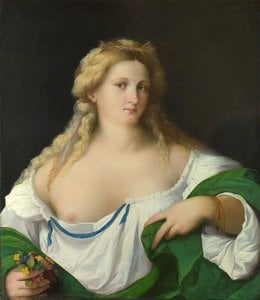
Palma Vecchio, 1480 – 1528

100 najsłynniejszych obrazów autorstwa Palma Vecchio

Obrazem, który przyniósł sławę Palma Vecchio, jest Madonna and Child (1515); znajduje się on w Ermitaż, Sankt Petersburg. Portrait of a Man (1512) oraz Judith (1525) podążają za nimi w sercach kolekcjonerów i odwiedzających muzea. Z 107 dzieł Palma Vecchio w naszym katalogu, tych 100 jest najbardziej podziwianych – każde z nich zostało przedstawione wraz z datą powstania, muzeum oraz cechami wyróżniającymi.

Ranking oparty na naszym wskaźniku popularności, który łączy liczbę wyszukiwań, wizyt oraz zamówień dla każdego dzieła. Aktualizacja: Październik 2026. Każde arcydzieło na tej stronie można zamówić jako ręcznie malowaną reprodukcję olejną o jakości muzealnej lub jako wysokiej jakości wydruk artystyczny, w wybranym przez Ciebie rozmiarze.

Portret Palma Vecchio
Palma Vecchio · 1480 – 1528
Urodzony · zmarł
1480 – 1528, Serina
Nurt
High renaissance
Dzieła w naszym katalogu
107
Najsłynniejsze
Madonna and Child (1515)
Najwięcej dzieł w
Kunsthistorisches Museum

Palma Vecchio: dziesięć arcydzieł

Madonna and Child (1515) autorstwa Palma Vecchio
1

Madonna and Child

1515 · Oil On Canvas · Ermitaż, Sankt Petersburg

To stand before this depiction of the Madonna and Child is to be drawn into a moment suspended outside the rush of time—a sanctuary painted by the masterful hand of Palma Vecchio. This work, dating from 1515, transcends mere portraiture; it is an eloquent meditation on maternal love, divine connection, and the profound mystery of creation. The composition centers on the Virgin Mary, portrayed with a tender intimacy as she…

The Adoration of the Shepherds with a Donor autorstwa Palma Vecchio
4

The Adoration of the Shepherds with a Donor

Oil On Canvas

The air in the painting feels heavy with the scent of damp earth and hay. In a rural landscape of rolling hills and distant, pale buildings, a small light gathers around the Holy Family. Mary holds the infant Jesus close, her form a soft curve against the shadows. Beside them, Joseph stands as a steady presence. A shepherd boy kneels in the dirt, his posture a study in humility before…

Lucretia (1520) autorstwa Palma Vecchio
5

Lucretia

1520 · Oil · Kunsthistorisches Museum, Wiedeń

The air feels heavy, thick with the scent of velvet and the silent weight of an impending end. Lucretia sits before us, her pale skin luminous against a backdrop of deep, swallowing shadows. A sharp, diagonal line of a dagger presses against her chest, creating a point of tension that vibrates through the stillness. Her reddish-blonde hair flows in soft, organic waves, framing a face caught in a moment of…

Portrait of a Gentleman (1520) autorstwa Palma Vecchio
6

Portrait of a Gentleman

1520 · Oil On Panel · Philadelphia Museum of Art, Filadelfia

In this 1520 portrait, we are met with a man whose steady gaze bridges the distance between his era and our own. He is positioned slightly off-center, a choice that lends a sense of naturalism to his posture, as if he has just paused in thought to acknowledge our presence. The composition is a medium close-up, focusing our attention on the quiet dignity of his features. His long, flowing brown…

John the Baptist (1527) autorstwa Palma Vecchio
7

John the Baptist

1527 · Oil On Panel · Kunsthistorisches Museum, Wiedeń

A single light source enters from the upper left, carving a face out of the heavy darkness. This is the world of Palma Vecchio, where deep browns and muted greens emerge from a nearly black background. The man, identified as John the Baptist, looks directly at the viewer with a piercing, steady gaze. His reddish-brown hair falls in soft, organic waves around a face marked by contemplation. A thin, dark…

John the Evangelist (1528) autorstwa Palma Vecchio
8

John the Evangelist

1528 · Oil On Canvas · Kunsthistorisches Museum, Wiedeń

An elderly man sits within a heavy shadow. His face, etched by time, turns toward an unseen light from the upper left. A thick, white beard flows over a deep green tunic. Over one shoulder, a red cloak rests with the weight of heavy wool. The skin of his hands and brow catches the glow, pulling him out from the dark, atmospheric background.

The Holy Family with St Mary Magdalen (1514) autorstwa Palma Vecchio
9

The Holy Family with St Mary Magdalen

1514 · Oil On Panel · Ashmolean Museum of Art and Archaeology, Oksford

In this 1514 oil on panel, we find ourselves drawn into a private, outdoor moment of the Holy Family. The composition is intimate, centered on a man holding a child while a woman stands nearby, her hands resting upon a vase. This arrangement creates a sense of domesticity within a sacred context. The background, filled with the soft presence of trees, suggests a natural setting that allows the figures to…

Young Woman in Profile (1512) autorstwa Palma Vecchio
10

Young Woman in Profile

1512 · Oil · Kunsthistorisches Museum, Wiedeń

The portrait presents a young woman in a strict profile view, her head and shoulders occupying the majority of the frame. She is positioned against a dark, circular backdrop that creates a halo-like effect around her silhouette. The subject's skin is rendered in warm, fleshy tones, transitioning through soft shadows that define the structure of her face and neck. This technique, known as sfumato, allows for a gradual blending of…

Więcej arcydzieł artysty Palma Vecchio, od 11 do 100

John the Baptist (1528) autorstwa Palma Vecchio
#12

John the Baptist

1528 · Kunsthistorisches Museum

The figure of John the Baptist emerges from the shadows of history in this religious painting by Palma Vecchio. He stands alone, a solitary presence caught in a…

Zabierz ją do domu →
Saint Sebastian (1527) autorstwa Palma Vecchio
#13

Saint Sebastian

1527 · Kunsthistorisches Museum

This religious work, titled Saint Sebastian, was executed by the Venetian painter Palma Vecchio around 1527. The painting focuses on the Roman martyr, a figure venerated for his…

Zamów reprodukcję →
The Raising of Lazarus (1514) autorstwa Palma Vecchio
#14

The Raising of Lazarus

1514 · Philadelphia Museum of Art

is a dramatic Renaissance oil painting that captures a crowded and dynamic biblical scene. The composition focuses on a central group of figures gathered around a stone tomb,…

Zamów reprodukcję →
The Three Sisters (1520) autorstwa Palma Vecchio
#15

The Three Sisters

1520 · Gemäldegalerie Alte Meister

“The Three Sisters” by Palma Vecchio, painted around 1520, stands as a captivating example of Venetian High Renaissance portraiture. This half-length composition depicts three young women, widely believed…

Zamów ręcznie malowaną kopię →
Saint Magdalene (1504) autorstwa Palma Vecchio
#17

Saint Magdalene

1504 · Bawarskie Państwowe Zbiory Malarstwa

Saint Magdalene by Palma Vecchio is a bust-length portrait presented in a close-up composition. The female figure is positioned slightly off-center, her body angled toward the viewer while…

Zabierz ją do domu →
The Triumph of Caesar (1510) autorstwa Palma Vecchio
#19

The Triumph of Caesar

1510 · Lowe Gallery

is a large-scale Renaissance oil painting by the Venetian artist Palma Vecchio. Executed around 1510, the work captures a Roman triumphal procession through a densely populated ceremonial scene.

Zamów reprodukcję →
Daphnis (1514) autorstwa Palma Vecchio
#21

Daphnis

1514 · Bawarskie Państwowe Zbiory Malarstwa

Daphnis, attributed to Palma Vecchio, presents a mythological depiction of the shepherd boy Daphnis. Created around 1513/15, the work draws upon the pastoral traditions of antiquity. The subject…

Zabierz ją do domu →
Allegory (1510) autorstwa Palma Vecchio
#22

Allegory

1510 · Philadelphia Museum of Art

The painting titled Allegory is a work by the Venetian painter Palma Vecchio. Created around 1510, this oil painting belongs to the Italian High Renaissance. The artist, born…

Zamów reprodukcję →
Venus and Cupid (1511) autorstwa Palma Vecchio
#23

Venus and Cupid

1511 · Statens Museum for Kunst

is a work by the Venetian painter Palma Vecchio. Created in 1511, the painting belongs to the Italian High Renaissance. The artist, born in Serina, Italy, was a…

Zabierz ją do domu →
The Holy Family (1515) autorstwa Palma Vecchio
#24

The Holy Family

1515 · Gemäldegalerie

In Palma Vecchio's The Holy Family, the arrangement of figures creates a quiet, centered gravity. The Virgin Mary forms the heart of the scene, kneeling in a posture…

Zabierz ją do domu →
The Virgin and Child (1502) autorstwa Palma Vecchio
#25

The Virgin and Child

1502 · Gemäldegalerie

A serene and intimate scene unfolds within a High Renaissance composition, where the Virgin Mary is captured in a moment of private study. Seated toward the right of…

Zabierz ją do domu →
The Holy Family (1514) autorstwa Palma Vecchio
#26

The Holy Family

1514 · Muzeum Narodowe w Krakowie

The Holy Family is an oil on panel painting by the Venetian artist Palma Vecchio. Executed in 1514, this work presents a religious scene centered on the Madonna,…

Zamów ręcznie malowaną kopię →
Visitation (1522) autorstwa Palma Vecchio
#30

Visitation

1522 · Kunsthistorisches Museum

The air in the painting feels heavy with the weight of a quiet afternoon. Two women meet in the center of the frame, their bodies leaning into one…

Zamów reprodukcję →
Mars, Venus and Cupid (1520) autorstwa Palma Vecchio
#33

Mars, Venus and Cupid

1520

This Renaissance-style oil painting presents a mythological scene featuring three central figures: a muscular man, a woman, and a small winged child. The figures are situated within a…

Zabierz ją do domu →
Young Woman in Green Dress (1513) autorstwa Palma Vecchio
#36

Young Woman in Green Dress

1513 · Kunsthistorisches Museum

This portrait, titled Young Woman in Green Dress, in the hand a box, was executed by the Venetian painter Palma Vecchio. Created around 1513, the work offers a…

Zamów reprodukcję →
Portrait of Paola Priuli (1527) autorstwa Palma Vecchio
#41

Portrait of Paola Priuli

1527 · Fondazione Querini Stampalia

In the soft, luminous glow of the High Renaissance, few portraits capture the intersection of aristocratic poise and intimate vitality as masterfully as Palma Vecchio’s Portrait of Paola…

Zabierz ją do domu →
Sacred Conversation (1522) autorstwa Palma Vecchio
#43

Sacred Conversation

1522 · Kunsthistorisches Museum

In the quiet, hallowed atmosphere of Sacred Conversation, the viewer is transported directly into the heart of the Venetian High Renaissance. Painted around 1522 by the master Jacopo…

Zamów ręcznie malowaną kopię →
Sacred Conversation (1525) autorstwa Palma Vecchio
#53

Sacred Conversation

1525 · Gallerie dell'Accademia di Venezia

In the quiet, luminous atmosphere of Palma Vecchio’s Sacred Conversation, dated to 1525, the viewer is invited into a moment of profound spiritual intimacy. This masterpiece serves as…

Zamów reprodukcję →
De heilige familie autorstwa Palma Vecchio
#54

De heilige familie

Rijksmuseum

The air within the scene feels heavy with a soft, twilight stillness. A group of five figures gathers in a serene, classical arrangement, their presence anchored by the…

Zamów reprodukcję →
A Blonde Woman autorstwa Palma Vecchio
#67

A Blonde Woman

National Gallery

A single figure dominates the composition, her pale skin and long blonde hair emerging from a dark, indeterminate background. She gazes toward the viewer with a sidelong, pensive…

Zabierz ją do domu →
A Blonde Woman (1520) autorstwa Palma Vecchio
#68

A Blonde Woman

1520 · National Gallery

To stand before Palma Vecchio's "A Blonde Woman" is to encounter a moment suspended in time—a breath held just before revelation. This portrait, dating from 1520, transcends a…

Zamów reprodukcję →
Venus (1520) autorstwa Palma Vecchio
#85

Venus

1520 · Gemäldegalerie Alte Meister

The painting Venus by Palma Il Vecchio is a masterpiece of Renaissance art, showcasing the artist's skill in capturing the beauty and elegance of the female form. Created…

Zabierz ją do domu →

Obrazy Palma Vecchio według okresów

Tematy, które najczęściej malował Palma Vecchio

Cztery tematy najczęściej powracające w tych arcydziełach, wraz z najdoskonalszym przykładem każdego z nich.

Gdzie można zobaczyć obrazy Palma Vecchio

8 muzeów, w których znajduje się najwięcej obrazów z tej strony.

Muzeum Miasto Dzieła artysty Palma Vecchio Obrazy z tej listy
Kunsthistorisches Museum, WiedeńKunsthistorisches Museum Wiedeń 13 Lucretia, John the Baptist, John the Evangelist
Szépművészeti Múzeum, BudapesztSzépművészeti Múzeum Budapeszt 7 Madonna and Child with the Infant Saint John and a Bishop Saint, The Holy Family with a Female Saint and Saint Francis of Assisi, Portrait of a Young Woman
Gallerie dell'Accademia di Venezia, WenecjaGallerie dell'Accademia di Venezia Wenecja 6 Sacred Conversation (detail), Sacred Conversation (detail), Sacred Conversation
Gemäldegalerie, BerlinGemäldegalerie Berlin 5 The Holy Family, The Virgin and Child, Portrait of a young woman with bare chest
National Gallery, LondynNational Gallery Londyn 4 A Blonde Woman, A Blonde Woman, Saint George and a Female Saint
Ermitaż, Sankt PetersburgErmitaż Sankt Petersburg 3 Madonna and Child, Portrait of a Man, Christ and the Woman Taken in Adultery
Galleria degli Uffizi, FlorencjaGalleria degli Uffizi Florencja 3 Judith, Judith with the Head of Holofernes, The Holy Family with Mary Magdalene and the infant saint John
Philadelphia Museum of Art, FiladelfiaPhiladelphia Museum of Art Filadelfia 3 Portrait of a Gentleman, The Raising of Lazarus, Allegory

Palma Vecchio, dekada po dekadzie: najważniejsze dzieło każdej z nich

  1. 1500s
    Saint Magdalene (1504) autorstwa Palma Vecchio
    Miejsce 17 / 100

    Saint Magdalene

    Wiek 20 – 29 · Bawarskie Państwowe Zbiory Malarstwa

    Saint Magdalene by Palma Vecchio is a bust-length portrait presented in a close-up composition. The female figure is positioned slightly off-center, her body angled toward the viewer while…

  2. 1510s
    Madonna and Child (1515) autorstwa Palma Vecchio
    Nr 1 z 100

    Madonna and Child

    Wiek 30 – 39 · Ermitaż

    To stand before this depiction of the Madonna and Child is to be drawn into a moment suspended outside the rush of time—a sanctuary painted by the masterful…

  3. 1520s
    Judith (1525) autorstwa Palma Vecchio
    Nr 3 z 100

    Judith

    Wiek 40 – 48 · Galleria degli Uffizi

Arcydzieła Palma Vecchio: pytania i odpowiedzi

Z jakiego obrazu najbardziej znany jest Palma Vecchio?Pokaż odpowiedź

Madonna and Child (1515), Ermitaż, Sankt Petersburg. Następnie pojawiają się Portrait of a Man (1512) oraz Judith (1525).

Ile lat miał(a) Palma Vecchio, malując Madonna and Child?Pokaż odpowiedź

35 lat: Madonna and Child pochodzi z 1515, a Palma Vecchio urodził(a) się w 1480.

Jakie są dziesięć najwspanialszych obrazów Palma Vecchio?Pokaż odpowiedź

Madonna and Child, Portrait of a Man, Judith, The Adoration of the Shepherds with a Donor, Lucretia, Portrait of a Gentleman, John the Baptist, John the Evangelist, The Holy Family with St Mary Magdalen i Young Woman in Profile. Powyższy ranking zawiera rok oraz muzeum dla każdego z nich.

Ile dzieł namalował/a Palma Vecchio?Pokaż odpowiedź

Nasz katalog obejmuje 107 dzieł autorstwa Palma Vecchio, datowanych od 1502 do 1528.

W których muzeach można zobaczyć arcydzieła Palma Vecchio?Pokaż odpowiedź

Większość z nich znajduje się w Kunsthistorisches Museum (Wiedeń), Szépművészeti Múzeum (Budapeszt) i Gallerie dell'Accademia di Venezia (Wenecja). Powyższa tabela zawiera listę muzeów po kolei.

Kiedy Palma Vecchio namalował swoje arcydzieła?Pokaż odpowiedź

W okresie 1520s: 37 z 100 dzieł na tej stronie pochodzi z tego czasu, w tym Judith.

Jakie są pierwsze i ostatnie słynne obrazy artysty Palma Vecchio?Pokaż odpowiedź

Najwcześniejszy na tej stronie to The Virgin and Child (1502), najpóźniejszy John the Evangelist (1528).

Jakie tematy były ulubione dla Palma Vecchio?Pokaż odpowiedź

Woman (29), Man (22) i Landscape (21), spośród 100 dzieł na tej stronie.

Której techniki preferował Palma Vecchio?Pokaż odpowiedź

Oil On Canvas: 18 z 100 dzieł na tej stronie.

Do jakiego nurtu artystycznego należy Palma Vecchio?Pokaż odpowiedź

High renaissance, co pokazują obrazy na tej stronie.

Które arcydzieła Palma Vecchio znajdują się w Kunsthistorisches Museum?Pokaż odpowiedź

Lucretia, John the Baptist i John the Evangelist to jedne z 12 dzieł na tej stronie znajdujących się w zbiorach Kunsthistorisches Museum, Wiedeń.

Czy mogę stać się właścicielem reprodukcji arcydzieła, którego autorem jest Palma Vecchio?Pokaż odpowiedź

Tak. Każdy obraz na tej stronie można zamówić jako ręcznie malowaną reprodukcję olejną o jakości muzealnej lub jako wysokiej jakości wydruk artystyczny w wybranym przez Ciebie rozmiarze, bezpośrednio ze strony danego dzieła.

Życie artysty Palma Vecchio

Wenecki mistrz zmysłowości: Życie i sztuka Palma Vecchio

Jacopo Negretti, znany w historii jako Palma Vecchio – „Palma Starszy” – wyłonił się z artystycznego krajobrazu XVI-wiecznej Wenecji jako kluczowa postać łącząca dojrzały renesans z rodzącym się stylem manieryzmu. Urodzony około 1480 roku w Serina Alta niedaleko Bergamo, całą swoją karierę rozwijał w tętniącej życiem Republice Weneckiej, mieście już wówczas głęboko zanurzonym w artystycznych innowacjach. Choć dokumenty dotyczące jego wczesnego szkolenia są nieliczne, wierzy się, że mógł początkowo kształcić się pod okiem Andrei Previtaliego, zanim zwrócił się ku rewolucyjnym metodom Giovanniego Belliniego, a ostatecznie – ku urzekającym światom wykreowanym przez Giorgione i Tycjana. Przybycie Palmy do Wenecji zbiegło się w czasie z okresem intensywnej rywalizacji artystycznej; u boku Lorenzo Lotto szybko zapracował na miano niezwykłego talentu, chłonąc lekcje swoich poprzedników, a jednocześnie wykuwając własną, niepowtarzalną ścieżkę.

Wczesne wpływy i kształtowanie się unikalnego stylu

Pierwsze etapy kariery Palmy Vecchio ujawniają wyraźny dług, jaki zaciągnął wobec wyrafinowanej techniki i dewocyjnego stylu Giovanniego Belliniego. Jednak to przełomowe dzieła Giorgione – pełne poetyckiej atmosfery i enigmatycznych narracji – prawdziwie rozpaliły jego artystyczną wyobraźnię. Palma szybko zaadoptował sposób operowania kolorem, światłem i kompozycją właściwy Giorgione, nasycając własne płótna podobnym poczuciem lirycznego piękna. Niemniej jednak, nie był on jedynie naśladowcą; posiadał bowiem unikalny dar przedstawiania ludzkiej formy z sensualną gracją i urzekającym realizmem, który pozwolił mu wyróżnić się na tle innych. W miarę jak sława Tycjana rosła, Palma nieustannie ewoluował, wykazując niezwykłą zdolność do syntetyzowania różnorodnych wpływów w harmonijny i porywający język wizualny. To właśnie w tym okresie w jego dorobku wyłoniły się dwa główne motywy: sacra conversazione, czyli sceny świętych rozmów, oraz portrety postaci kobiecych ujęte od pasa, przedstawiające idealizowane kobiety, o których często spekuluje się, że są wizerunkami słynnych weneckich kurtyzan.

Urok mitu i wenecki portret

Palma Vecchio zyskał sławę dzięki niezwykłej zdolności tchnięcia w klasyczną mitologię wyraźnie weneckiej wrażliwości. Jego sceny pasterskie to nie tylko proste odtworzenia antycznych podań; to tętniące życiem celebracje piękna, miłości i ziemskich rozkoszy, osadzone na tle bujnych, pełnych życia krajobrazów. Dzieła te idealnie odpowiadały gustom zamożnych weneckich mecenasów, którzy poszukiwali sztuki odzwierciedlającej ich wyrafinowany styl życia oraz zamiłowanie do zmysłowych przyjemności. Jednocześnie jego portrety – zwłaszcza te przedstawiające kobiety – zachwycały odbiorców niezwykłą szczegółowością i głębią psychologiczną. Artysta wypracował swój własny, charakterystyczny typ piękna: blondynki o uwodzicielskim spojrzeniu i subtelnej aurze tajemnicy. Tożsamość tych modelek pozostaje w dużej mierze nieznana, co rozpala wyobraźnię i karmi spekulacje na temat ich powiązań z weneckim półświatkiem. Jego mistrzostwo w operowaniu kolorem – przejawiające się w stosowaniu transparentnych laserunków, które tworzyły świetliste efekty – było powszechnie wychwalane, choć niestety wiele z tych delikatnych warstw uległo zniszczeniu z upływem czasu. Niezwykła biegłość malarska w posługiwaniu się farbą i barwą jest często przywoływana jako jedna z definiujących cech jego twórczości.

Główne osiągnięcia i artystyczne dziedzictwo

Wśród najbardziej znaczących dokonań Palmy Vecchio należy wymienić sześć obrazów zamówionych do kościoła Santa Maria Formosa w Wenecji, których centralnym punktem jest monumentalny Ołtarz św. Barbary. Ta potężna kompozycja stanowi świadectwo jego niezwykłej biegłości w przedstawianiu złożonych narracji oraz tworzeniu harmonijnych układów postaci. Późniejsze dzieła artysty ukazują mistrzostwo w posługiwaniu się techniką contrapposto – owym eleganckim wyważeniem przeciwstawnych sił w pozie figury – oraz wyrafinowaną paletę barw, która emanuje godnością i gracją. Choć początkowo Palma czerpał inspiracje z dorobku Italii Środkowej, w tym od Michała Anioła, ostatecznie wypracował styl całkowicie unikalny i rozpoznawalny. Przełomowym momentem w jego karierze było otrzymanie w 1525 roku zlecenia na namalowanie ołtarza głównego w kościele Sant'Elena w Wenecji. Niestety, nagła śmierć w 1528 roku, gdy miał około 47 lat, pozostawiła wiele prac niedokończonych, które musieli uzupełniać jego warsztat oraz uczniowie. Mimo tego przedwczesnego odejścia, wpływ Palmy Vecchio na malarstwo weneckie był niezmierzony. Stał się on istotnym ogniwem łączącym mistrzów dojrzałego renesansu, takich jak Tycjan i Giorgione, z rodzącym się pokoleniem manieryzmu, inspirując takich artystów jak Bonifazio Pitati czy Giovanni Busi.

Znaczenie historyczne i ponowne odkrycie

Przez stulecia twórczość Palma Vecchio pozostawała w pewnym stopniu w cieniu jego bardziej sławnych współczesnych. Jednak w ostatnich dekadach nastąpił jednakowy wzrost uznania dla jego unikalnego wkładu w sztukę wenecką. Badacze poddali ponownej analizie atrybucje dzieł, które wcześniej przypisywano Giorgionemu i Tycjanowi, rozpoznając przy tym odrębne i charakterystyczne cechy stylu Palma. Jego obrazy są dziś celebrowane za zmysłowe piękno, techniczny kunszt oraz niezwykłą zdolność do uchwycenia ducha renesansowej Wenecji. Artysta ten stanowi fascynujący punkt przecięcia wpływów artystycznych, budując most między pokoleniami i oferując porywający wgląd w wartości kulturowe oraz wrażliwość estetyczną jego czasów. Palma Vecchio pozostaje świadectwem nieprzemijającej potęgi malarstwa weneckiego — mistrz, którego dzieła nieustannie zachwycają i inspirują współczesnych odbiorców.

Wszystkie 107 dzieła artysty Palma Vecchio →