Juan Gris, 1887 – 1927

100 najsłynniejszych obrazów autorstwa Juan Gris

Obrazem, który przyniósł sławę Juan Gris, jest Portret Madame Josette Gris (1916). Jabłka i winogrona na stole (1913) oraz Kompozycja przed oknem (1915) podążają za nimi w sercach kolekcjonerów i odwiedzających muzea. Z 411 dzieł Juan Gris w naszym katalogu, tych 100 jest najbardziej podziwianych – każde z nich zostało przedstawione wraz z datą powstania, muzeum oraz cechami wyróżniającymi.

Ranking oparty na naszym wskaźniku popularności, który łączy liczbę wyszukiwań, wizyt oraz zamówień dla każdego dzieła. Aktualizacja: Październik 2026. Każde arcydzieło na tej stronie można zamówić jako ręcznie malowaną reprodukcję olejną o jakości muzealnej lub jako wysokiej jakości wydruk artystyczny, w wybranym przez Ciebie rozmiarze.

Portret Juan Gris
Juan Gris · 1887 – 1927
Urodzony · zmarł
1887 – 1927, Madryt
Nurt
Synthetic cubism
Dzieła w naszym katalogu
411
Najsłynniejsze
Portret Madame Josette Gris (1916)
Najwięcej dzieł w
Museo Nacional Centro de Arte Reina Sofía

Juan Gris: dziesięć arcydzieł

Portret Madame Josette Gris (1916) autorstwa Juan Gris
1

Portret Madame Josette Gris

1916 · Obraz olejny na płótnie

"Portret Madame Josette Gris" (1916) to urzekające arcydzieło Juana Grisa, czołowej postaci ruchu kubistycznego. Dzieło to zaprasza widzów do świata, w którym forma i perspektywa zostają zdekonstruowane, oferując świeżą i dynamiczną interpretację portretu.

Jabłka i winogrona na stole (1913) autorstwa Juan Gris
2

Jabłka i winogrona na stole

1913 · Obraz olejny na płótnie

Juan Gris’s 1913 masterpiece, “Pachnie i Winogronami na Stoliku,” to znacznie więcej niż proste przedstawienie owoców. To odważne oświadczenie nowego języka wizualnego, wyłaniające się z bogatej gleby wczesnych lat dwudziestego wieku w Paryżu. Obraz ten doskonale oddaje esencję Kubizmu Syntetycznego, a jednocześnie posiada unikalną żywotność, która odróżnia go od innych dzieł tego okresu. Gris nie dąży do wiernego odwzorowania rzeczywistości, jaką ją postrzegamy, lecz zamiast tego analizuje i przekształca ją,…

Kompozycja przed oknem (1915) autorstwa Juan Gris
3

Kompozycja przed oknem

1915 · Obraz olejny na płótnie · Philadelphia Museum of Art, Filadelfia

Arcydzieło kubistycznej innowacji „Still Life before an Open Window aka Place Ravignan” autorstwa Juana Grisa to urzekający przykład kubizmu syntetycznego, ukazujący wyjątkową zdolność artysty do łączenia geometrycznej abstrakcji z przedmiotami codziennego użytku. Powstałe w 1915 roku dzieło stanowi kwintesencję dojrzałego stylu Grisa, charakteryzującego się złożonymi kompozycjami oraz harmonijnymi paletami barw. Temat i kompozycja Obraz przedstawia martwą naturę ustawioną przed otwartym oknem, oferując nam wgląd w otoczenie artysty przy Place Ravignan…

Śniadanie (1915) autorstwa Juan Gris
4

Śniadanie

1915 · Obraz olejny na płótnie

Exploring the Subject and Composition Juan Gris’s “Śniadanie” (Breakfast), painted in 1915, is far more than a simple depiction of a morning meal; it's a meticulously constructed invitation to reconsider our perception of reality. The artwork presents a dynamic still life, a quintessential example of Synthetic Cubism, where everyday objects – a newspaper bearing the cryptic “JOURNAL,” a bottle, and various household items – are fragmented into a dazzling array…

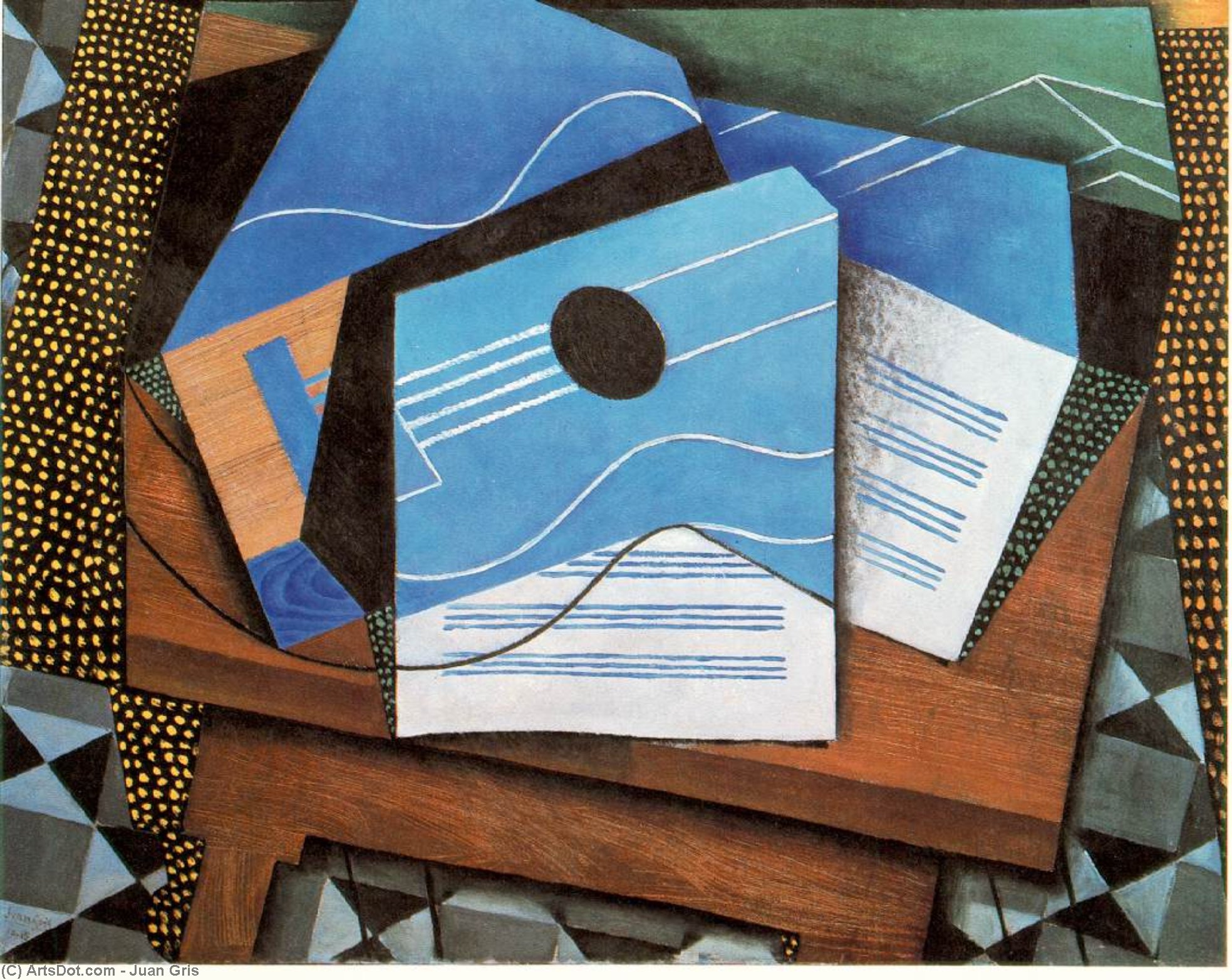
Guitar on a table - - (1915) autorstwa Juan Gris
5

Guitar on a table - -

1915 · Oil On Canvas

To stand before Juan Gris’s Guitar on a Table is to step directly into the intellectual fervor of the early twentieth century, a moment when art dared to dismantle and reassemble reality. This seminal work from 1915 is not merely a depiction of musical instruments and scattered books; it is a meticulously constructed meditation on form, perspective, and the very nature of representation itself. Gris, ever the analytical mind, approaches…

Still Life with Newspaper (1916) autorstwa Juan Gris
6

Still Life with Newspaper

1916 · Oil On Canvas

To stand before Juan Gris’s Still Life with Newspaper is to step directly into the vibrant, intellectual crucible of early twentieth-century art. This painting from 1916 is far more than a mere arrangement of objects; it is a meticulously constructed visual argument about perception itself. Gris, a master craftsman who navigated the revolutionary currents of Cubism, presents us with a seemingly simple still life—a bowl, scattered cups, and perhaps a…

The Smoker (1913) autorstwa Juan Gris
7

The Smoker

1913 · Acrylic On Paper · Thyssen-Bornemisza Museum, Madryt

Juan Gris’s “The Smoker,” painted in 1913, isn't merely a depiction of a man enjoying a cigarette; it’s a meticulously constructed meditation on perception, fragmentation, and the burgeoning anxieties of early 20th-century modernity. Created during his pivotal period as a pioneer of Synthetic Cubism alongside Pablo Picasso, this work embodies the movement’s radical departure from traditional representation, offering instead a fractured, multi-faceted view of its subject – a Spanish painter…

The painters window - - (1925) autorstwa Juan Gris
8

The painters window - -

1925 · Oil On Canvas

Juan Gris’s The Painter's Window is not merely a depiction of an interior scene; it is a meticulously constructed intellectual puzzle rendered in oil on canvas. Created in 1925, this work stands as a quintessential testament to the principles of Synthetic Cubism. To gaze upon it is to look through a multifaceted lens, where reality itself has been disassembled and reassembled according to the artist's rigorous geometric vision. The composition…

Landscape at Beaulieu (1918) autorstwa Juan Gris
9

Landscape at Beaulieu

1918 · Acrylic On Canvas · Kröller-Müller Museum, Otterlo

José Victoriano González-Pérez, known universally as Juan Gris (1887–1927), stands as a cornerstone figure in the genesis of Cubist art. Born in Madrid and nurtured by an analytical mind honed at the School of Arts and Sciences—a formative experience that foreshadowed his distinctive artistic approach—Gris embarked on a journey that would propel him to prominence within the vanguard of early 20th-century visual culture.

The Miller (1918) autorstwa Juan Gris
10

The Miller

1918 · Oil On Canvas

To stand before Juan Gris’s The Miller is not merely to observe a painting; it is to step into a meticulously constructed intellectual space where reality itself has been disassembled and reassembled. Created in 1918, this seminal work stands as a profound testament to the power of Cubism—an art movement that dared to shatter the polished veneer of traditional representation. Gris, deeply influenced by the revolutionary breakthroughs of Picasso and…

Więcej arcydzieł artysty Juan Gris, od 11 do 100

Lamp (1916) autorstwa Juan Gris
#11

Lamp

1916 · Philadelphia Museum of Art

A single lamp rests within a fractured landscape of shapes. It is not a whole object, but a collection of interlocking planes—triangles, trapezoids, and quadrilaterals that suggest a…

Zamów reprodukcję →
Fruit Bowl and Fruit (1916) autorstwa Juan Gris
#14

Fruit Bowl and Fruit

1916

In this 1916 work, oranges appear to float above a bowl, stripped of their organic weight through the language of Cubism. The composition relies on an interplay of…

Zabierz ją do domu →
Open Window (1917) autorstwa Juan Gris
#15

Open Window

1917 · Philadelphia Museum of Art

To stand before Open Window is to witness a quiet deconstruction of space. The composition does not rely on traditional perspective to guide the eye; instead, it uses…

Zamów reprodukcję →
Harlequin (1917) autorstwa Juan Gris
#16

Harlequin

1917 · Philadelphia Museum of Art

The figure of the Harlequin emerges from a series of interlocking planes, caught in a moment of geometric stillness. There is no soft flesh here, only the sharp…

Bottles and Knife (1912) autorstwa Juan Gris
#18

Bottles and Knife

1912

To stand before Juan Gris’s Bottles and Knife is not merely to observe a still life; it is to step into the very mechanism of modern vision. Created…

Zabierz ją do domu →
Portrait of Josette Gris (1916) autorstwa Juan Gris
#19

Portrait of Josette Gris

1916 · Museo Nacional Centro de Arte Reina Sofía

In the pantheon of early twentieth-century modernism, few works capture the intellectual rigor and visual poetry of the Cubist movement as profoundly as Juan Gris’s Portrait of Madame…

Zamów reprodukcję →
Still Life with Newspaper (1916) autorstwa Juan Gris
#20

Still Life with Newspaper

1916

To stand before Juan Gris’s Still Life with Newspaper is to step directly into the intellectual fervor of early twentieth-century Paris. This painting, executed in 1916, is far…

Zabierz ją do domu →
The Dice (1922) autorstwa Juan Gris
#22

The Dice

1922 · Centre Pompidou

In the quiet, intellectual atmosphere of 1922, Juan Gris orchestrated a visual revolution that would forever alter our perception of the mundane. His masterpiece, The Dice, is far…

Zamów reprodukcję →
Three lamps - - (1911) autorstwa Juan Gris
#23

Three lamps - -

1911

To stand before Juan Gris’s Three Lamps is not merely to observe still life; it is to enter the very crucible of early twentieth-century thought. Painted in 1911,…

Zamów reprodukcję →
Guitar on a chair - - (1913) autorstwa Juan Gris
#24

Guitar on a chair - -

1913

To stand before Juan Gris’s Guitar on a Chair is not merely to observe an arrangement of objects; it is to step into a meticulously constructed intellectual space…

Zamów reprodukcję →
The guitar - - (1918) autorstwa Juan Gris
#25

The guitar - -

1918 · Museo Nacional Centro de Arte Reina Sofía

To stand before Juan Gris’s The Guitar is not merely to observe an arrangement of objects; it is to step into the very architecture of modern thought. Created…

Zabierz ją do domu →
The Glass (1914) autorstwa Juan Gris
#28

The Glass

1914

To stand before Juan Gris’s The Glass is not merely to observe an arrangement of painted objects; it is to step into a meticulously constructed intellectual puzzle, a…

Zamów ręcznie malowaną kopię →
Glass and Ace of Clubs (1917) autorstwa Juan Gris
#30

Glass and Ace of Clubs

1917 · Muzeum Sztuki w Tel Awiwie

In the quiet evolution of modern art, few moments are as intellectually arresting as the creation of Juan Gris’s “Glass and Ace of Clubs.” Completed in 1917, this…

Zabierz ją do domu →
Guitar on the Table (1913) autorstwa Juan Gris
#32

Guitar on the Table

1913 · Museo Nacional Centro de Arte Reina Sofía

In the pantheon of early twentieth-century modernism, few names resonate with as much analytical precision and poetic grace as Juan Gris. His masterpiece, Guitar on the Table, created…

Zamów reprodukcję →
The Open Window (1921) autorstwa Juan Gris
#34

The Open Window

1921 · Museo Nacional Centro de Arte Reina Sofía

In the quiet intersection of interior intimacy and Mediterranean expanse lies The Open Window, a 1921 masterpiece by the Spanish virtuoso Juan Gris. This work serves as more…

Zamów reprodukcję →
Violin (1913) autorstwa Juan Gris
#39

Violin

1913 · Philadelphia Museum of Art

The painting Violin was created in 1913 by the Spanish artist Juan Gris. Born in 1887, Gris lived until 1927, leaving behind a body of work that redefined…

Zamów ręcznie malowaną kopię →
Harlequin with Guitar (1919) autorstwa Juan Gris
#40

Harlequin with Guitar

1919

The painting Harlequin with Guitar by Juan Gris is a quintessential example of Synthetic Cubism, a style that revolutionized the art world in the early 20th century. Created…

Zabierz ją do domu →
Pipe and Fruit Dish with Grapes (1918) autorstwa Juan Gris
#41

Pipe and Fruit Dish with Grapes

1918 · Kröller-Müller Museum

In the pantheon of early twentieth-century modernism, few works capture the intellectual rigor and sensory delight of Synthetic Cubism as exquisitely as Juan Gris’s Pipe and Fruit Dish…

Zabierz ją do domu →
A Pot of Geraniums (1915) autorstwa Juan Gris
#45

A Pot of Geraniums

1915

In the pantheon of modern art, few works capture the intellectual elegance and structural beauty of the early twentieth century quite like Juan Gris’s "A Pot of Geraniums."…

Zabierz ją do domu →
Violin and Guitar (1913) autorstwa Juan Gris
#46

Violin and Guitar

1913 · Museo Nacional Centro de Arte Reina Sofía

Juan Gris’s “Violin and Guitar,” painted in 1913, isn't merely a still life; it’s a meticulously constructed exploration of perception and the very nature of representation. Emerging from…

Zabierz ją do domu →
Pierrot (1922) autorstwa Juan Gris
#51

Pierrot

1922 · National Gallery of Ireland

Juan Gris’s “Pierrot,” painted in 1922, is more than just a depiction of a character from Commedia dell’Arte; it’s a meticulously constructed exploration of form and perception, a…

Zamów reprodukcję →
Grapes (1916) autorstwa Juan Gris
#54

Grapes

1916 · Museo Nacional Centro de Arte Reina Sofía

“Grapes,” painted in 1916 by Juan Gris, isn't merely a still life; it’s a meticulously constructed exploration of form, color, and the very nature of perception. Emerging from…

Zamów ręcznie malowaną kopię →
L autorstwa Juan Gris
#57

L

Biennale Internazionale dell'Antiquariato di Firenze

In the vibrant, avant-garde heart of early 20th-century Paris, a new visual language was being forged—one that dismantled the familiar to reveal a deeper, more structured truth. At…

Zamów ręcznie malowaną kopię →
Seated Harlequin (1920) autorstwa Juan Gris
#58

Seated Harlequin

1920 · Minneapolis Institute of Art

A figure sits, caught in the intersection of sharp angles and quiet stillness. This harlequin, a relic of the Italian commedia dell'arte, is stripped of his traditional whimsy…

Zabierz ją do domu →
The Guitar Player (1926) autorstwa Juan Gris
#59

The Guitar Player

1926 · Statens Museum for Kunst

In this 1926 work, we find ourselves in a quiet, structured space where a solitary figure sits with a guitar. The composition is framed by what feels like…

Zamów reprodukcję →
Grapes (1913) autorstwa Juan Gris
#63

Grapes

1913 · MoMA - Museum of Modern Art

The painting Grapes by Juan Gris is a quintessential representation of Synthetic Cubism, a style that the artist mastered alongside other notable figures like Pablo Picasso. Created in…

Zamów reprodukcję →
Newspaper and Fruit Dish (1916) autorstwa Juan Gris
#64

Newspaper and Fruit Dish

1916 · Yale University Art Gallery

Juan Gris’s contribution to the artistic landscape of the early 20th century transcends mere visual representation; it embodies a radical reimagining of perception itself. His work, particularly “Newspaper…

Zamów reprodukcję →
Guitar and Music Paper (1927) autorstwa Juan Gris
#70

Guitar and Music Paper

1927

The painting "Guitar and Music Paper" by Juan Gris is a masterpiece of Cubism, showcasing the artist's unique ability to blend everyday objects with abstracted forms. Created in…

Zamów reprodukcję →
The fruit bowl (1914) autorstwa Juan Gris
#71

The fruit bowl

1914 · Kröller-Müller Museum

Juan Gris's "The Fruit Bowl," painted in 1914, isn’t merely a still life; it’s a meticulously constructed meditation on perception and reality. Emerging from the vibrant crucible of…

Zamów reprodukcję →
Abstraction (1915) autorstwa Juan Gris
#72

Abstraction

1915 · The Phillips Collection

The canvas unfolds as a structured puzzle of intersecting planes, where the logic of engineering meets the fluidity of vision. In this 1915 composition, the eye does not…

Zabierz ją do domu →
Still Life (1917) autorstwa Juan Gris
#73

Still Life

1917 · Minneapolis Institute of Art

The canvas breathes with a quiet, architectural tension. Fragments of kitchenware and vessels appear to drift through a space where the distinction between object and void begins to…

Zabierz ją do domu →
Water-Bottle and Lemon (1916) autorstwa Juan Gris
#77

Water-Bottle and Lemon

1916 · Kröller-Müller Museum

In this 1916 composition, we find ourselves observing a quiet, fragmented moment. The subject—a tall glass vessel, a smaller drinking glass, a lemon slice, and a scrap of…

Zamów reprodukcję →
The Glass of Beer (1914) autorstwa Juan Gris
#78

The Glass of Beer

1914 · Art Institute of Chicago

The air in the cafe feels heavy with the scent of spilled beer and old newsprint. Within an oval frame that acts like a lens, the world breaks…

Zamów reprodukcję →
Coffeepot (1916) autorstwa Juan Gris
#87

Coffeepot

1916 · Philadelphia Museum of Art

The composition deconstructs a single object into a series of overlapping planes and intersecting lines. Through the lens of Synthetic Cubism, the coffeepot is no longer a singular,…

Zabierz ją do domu →
Glass and Playing Cards (1915) autorstwa Juan Gris
#89

Glass and Playing Cards

1915 · Art Institute of Chicago

Step closer and observe how the light settles upon these fragmented planes. In Glass and Playing Cards, created in 1915, we find a quiet moment of reconstruction rather…

Zamów reprodukcję →
Newspaper and Fruit Dish (1916) autorstwa Juan Gris
#90

Newspaper and Fruit Dish

1916 · Yale University Art Gallery

In this 1916 oil on canvas, the domestic sphere is dismantled and reconstructed through the lens of Synthetic Cubism. The composition centers on a collection of mundane objects—a…

Zamów reprodukcję →
Glass, Cup and Bottle (1914) autorstwa Juan Gris
#91

Glass, Cup and Bottle

1914

The painting titled Glass, Cup and Bottle was created in 1914 by the artist Juan Gris. The composition depicts a table featuring several items, including a bottle, a…

Zabierz ją do domu →
The Singer (1926) autorstwa Juan Gris
#94

The Singer

1926 · Museo Nacional Centro de Arte Reina Sofía

is a striking example of Synthetic Cubism. The artist, Juan Gris (born José Victoriano González Pérez), rendered this work between April and November of 1926. It captures a…

Zamów reprodukcję →
Checkerboard and Playing Cards (1915) autorstwa Juan Gris
#95

Checkerboard and Playing Cards

1915 · National Gallery of Australia

Checkerboard and Playing Cards is a painting from 1915 that exemplifies Synthetic Cubism through a fragmented arrangement of everyday objects. The composition utilizes a shallow, layered space where…

Zabierz ją do domu →
Still Life with a Glass (1917) autorstwa Juan Gris
#97

Still Life with a Glass

1917 · Philadelphia Museum of Art

A structured arrangement of overlapping planes defines this 1917 composition. The work utilizes sharp, angular lines to deconstruct a glass into a series of interlocking polygons. Through the…

Zabierz ją do domu →

Obrazy Juan Gris według okresów

Tematy, które najczęściej malował Juan Gris

Cztery tematy najczęściej powracające w tych arcydziełach, wraz z najdoskonalszym przykładem każdego z nich.

Gdzie można zobaczyć obrazy Juan Gris

8 muzeów, w których znajduje się najwięcej obrazów z tej strony.

Muzeum Miasto Dzieła artysty Juan Gris Obrazy z tej listy
Museo Nacional Centro de Arte Reina Sofía, MadrytMuseo Nacional Centro de Arte Reina Sofía Madryt 25 Portrait of Josette Gris, The guitar - -, Guitar on the Table
Philadelphia Museum of Art, FiladelfiaPhiladelphia Museum of Art Filadelfia 13 Kompozycja przed oknem, Lamp, Open Window
Kröller-Müller Museum, OtterloKröller-Müller Museum Otterlo 19 Landscape at Beaulieu, Guitar on a Table, Pipe and Fruit Dish with Grapes
Centre Pompidou, ParyżCentre Pompidou Paryż 14 The Dice, Still Life on a Chair, View across the Bay
Art Institute of Chicago, ChicagoArt Institute of Chicago Chicago 7 Abstraction (Guitar and Glass), The Glass of Beer, Glass and Playing Cards
MoMA - Museum of Modern Art, Nowy JorkMoMA - Museum of Modern Art Nowy Jork 6 Still Life with Flowers, Grapes
Minneapolis Institute of Art, MinneapolisMinneapolis Institute of Art Minneapolis 2 Seated Harlequin, Still Life
Metropolitan Museum of Art, Nowy JorkMetropolitan Museum of Art Nowy Jork 6 The Smoker

Juan Gris, rok po roku: najważniejsze obrazy

Od 1911 do 1927, 17 lat twórczości Juan Gris, rok po roku, poprzez jej najwspanialsze obrazy.

  1. 1911
    Three lamps - - (1911) autorstwa Juan Gris
    23 z 100

    Three lamps - -

    Wiek: 24

    To stand before Juan Gris’s Three Lamps is not merely to observe still life; it is to enter the very crucible of early twentieth-century thought. Painted in 1911,…

  2. 1912
    Bottles and Knife (1912) autorstwa Juan Gris
    Miejsce 18 / 100

    Bottles and Knife

    Wiek: 25

    To stand before Juan Gris’s Bottles and Knife is not merely to observe a still life; it is to step into the very mechanism of modern vision. Created…

  3. 1912
    Still life with oil lamp - - (1912) autorstwa Juan Gris
    27 z 100

    Still life with oil lamp - -

    Wiek: 25

    To stand before Juan Gris’s Still Life with Oil Lamp is not merely to observe an arrangement of objects; it is to enter a meticulously constructed intellectual space…

  4. 1913
    Jabłka i winogrona na stole (1913) autorstwa Juan Gris
    Nr 2 z 100

    Jabłka i winogrona na stole

    Wiek: 26

    Juan Gris’s 1913 masterpiece, “Pachnie i Winogronami na Stoliku,” to znacznie więcej niż proste przedstawienie owoców. To odważne oświadczenie nowego języka wizualnego, wyłaniające się z bogatej gleby wczesnych…

  5. 1913
    The Smoker (1913) autorstwa Juan Gris
    7 z 100

    The Smoker

    Wiek: 26 · Thyssen-Bornemisza Museum

    Juan Gris’s “The Smoker,” painted in 1913, isn't merely a depiction of a man enjoying a cigarette; it’s a meticulously constructed meditation on perception, fragmentation, and the burgeoning…

  6. 1914
    Bottle and glass on a table - - (1914) autorstwa Juan Gris
    Miejsce 26 / 100

    Bottle and glass on a table - -

    Wiek: 27

    To stand before Bottle and Glass on a Table is not merely to observe an arrangement of objects; it is to witness a profound intellectual exercise rendered in…

  7. 1914
    The Glass (1914) autorstwa Juan Gris
    Nr 28 z 100

    The Glass

    Wiek: 27

    To stand before Juan Gris’s The Glass is not merely to observe an arrangement of painted objects; it is to step into a meticulously constructed intellectual puzzle, a…

  8. 1915
    Kompozycja przed oknem (1915) autorstwa Juan Gris
    3 z 100

    Kompozycja przed oknem

    Wiek: 28 · Philadelphia Museum of Art

    Arcydzieło kubistycznej innowacji „Still Life before an Open Window aka Place Ravignan” autorstwa Juana Grisa to urzekający przykład kubizmu syntetycznego, ukazujący wyjątkową zdolność artysty do łączenia geometrycznej abstrakcji…

  9. 1915
    Śniadanie (1915) autorstwa Juan Gris
    Miejsce 4 / 100

    Śniadanie

    Wiek: 28

    Exploring the Subject and Composition Juan Gris’s “Śniadanie” (Breakfast), painted in 1915, is far more than a simple depiction of a morning meal; it's a meticulously constructed invitation…

  10. 1916
    Portret Madame Josette Gris (1916) autorstwa Juan Gris
    Miejsce 1 / 100

    Portret Madame Josette Gris

    Wiek: 29

    "Portret Madame Josette Gris" (1916) to urzekające arcydzieło Juana Grisa, czołowej postaci ruchu kubistycznego. Dzieło to zaprasza widzów do świata, w którym forma i perspektywa zostają zdekonstruowane, oferując…

  11. 1916
    Still Life with Newspaper (1916) autorstwa Juan Gris
    Nr 6 z 100

    Still Life with Newspaper

    Wiek: 29

    To stand before Juan Gris’s Still Life with Newspaper is to step directly into the vibrant, intellectual crucible of early twentieth-century art. This painting from 1916 is far…

  12. 1917
    Open Window (1917) autorstwa Juan Gris
    15 z 100

    Open Window

    Wiek: 30 · Philadelphia Museum of Art

    To stand before Open Window is to witness a quiet deconstruction of space. The composition does not rely on traditional perspective to guide the eye; instead, it uses…

  13. 1917
    Harlequin (1917) autorstwa Juan Gris
    Nr 16 z 100

    Harlequin

    Wiek: 30 · Philadelphia Museum of Art

    The figure of the Harlequin emerges from a series of interlocking planes, caught in a moment of geometric stillness. There is no soft flesh here, only the sharp…

  14. 1918
    Landscape at Beaulieu (1918) autorstwa Juan Gris
    Nr 9 z 100

    Landscape at Beaulieu

    Wiek: 31 · Kröller-Müller Museum

    José Victoriano González-Pérez, known universally as Juan Gris (1887–1927), stands as a cornerstone figure in the genesis of Cubist art. Born in Madrid and nurtured by an analytical…

  15. 1918
    The Miller (1918) autorstwa Juan Gris
    Nr 10 z 100

    The Miller

    Wiek: 31

    To stand before Juan Gris’s The Miller is not merely to observe a painting; it is to step into a meticulously constructed intellectual space where reality itself has…

  16. 1919
    Harlequin with Guitar (1919) autorstwa Juan Gris
    Miejsce 40 / 100

    Harlequin with Guitar

    Wiek: 32

    The painting Harlequin with Guitar by Juan Gris is a quintessential example of Synthetic Cubism, a style that revolutionized the art world in the early 20th century. Created…

  17. 1920
    Seated Harlequin (1920) autorstwa Juan Gris
    Miejsce 58 / 100

    Seated Harlequin

    Wiek: 33 · Minneapolis Institute of Art

    A figure sits, caught in the intersection of sharp angles and quiet stillness. This harlequin, a relic of the Italian commedia dell'arte, is stripped of his traditional whimsy…

  18. 1921
    The Open Window (1921) autorstwa Juan Gris
    34 z 100

    The Open Window

    Wiek: 34 · Museo Nacional Centro de Arte Reina Sofía

    In the quiet intersection of interior intimacy and Mediterranean expanse lies The Open Window, a 1921 masterpiece by the Spanish virtuoso Juan Gris. This work serves as more…

  19. 1922
    The Dice (1922) autorstwa Juan Gris
    22 z 100

    The Dice

    Wiek: 35 · Centre Pompidou

    In the quiet, intellectual atmosphere of 1922, Juan Gris orchestrated a visual revolution that would forever alter our perception of the mundane. His masterpiece, The Dice, is far…

  20. 1923
    Open Window with Hills (1923) autorstwa Juan Gris
    Nr 12 z 100

    Open Window with Hills

    Wiek: 36

    The painting depicts a window that looks out onto a landscape of hills. Within the frame of the window, a table is positioned, holding several items including books,…

  21. 1924
  22. 1925
    The painters window - - (1925) autorstwa Juan Gris
    Miejsce 8 / 100

    The painters window - -

    Wiek: 38

    Juan Gris’s The Painter's Window is not merely a depiction of an interior scene; it is a meticulously constructed intellectual puzzle rendered in oil on canvas. Created in…

  23. 1925
    The Guitar with Inlay (1925) autorstwa Juan Gris
    29 z 100

    The Guitar with Inlay

    Wiek: 38

    The painting The Guitar with Inlay is a Cubist work created in 1925. The central focus of the composition is a guitar with inlay, which is surrounded by…

  24. 1926
    The Guitar Player (1926) autorstwa Juan Gris
    59 z 100

    The Guitar Player

    Wiek: 39 · Statens Museum for Kunst

    In this 1926 work, we find ourselves in a quiet, structured space where a solitary figure sits with a guitar. The composition is framed by what feels like…

  25. 1927

Arcydzieła Juan Gris: pytania i odpowiedzi

Z jakiego obrazu najbardziej znany jest Juan Gris?Pokaż odpowiedź

Portret Madame Josette Gris (1916). Następnie Jabłka i winogrona na stole (1913) i Kompozycja przed oknem (1915).

Ile lat miał(a) Juan Gris, malując Portret Madame Josette Gris?Pokaż odpowiedź

29 lat: Portret Madame Josette Gris pochodzi z 1916, a Juan Gris urodził(a) się w 1887.

Jakie są dziesięć najwspanialszych obrazów Juan Gris?Pokaż odpowiedź

Portret Madame Josette Gris, Jabłka i winogrona na stole, Kompozycja przed oknem, Śniadanie, Guitar on a table - -, Still Life with Newspaper, The Smoker, The painters window - -, Landscape at Beaulieu i The Miller. Powyższy ranking zawiera rok oraz muzeum dla każdego z nich.

Ile dzieł namalował/a Juan Gris?Pokaż odpowiedź

Nasz katalog obejmuje 411 dzieł autorstwa Juan Gris, datowanych od 1911 do 1927.

W których muzeach można zobaczyć arcydzieła Juan Gris?Pokaż odpowiedź

Większość z nich znajduje się w Museo Nacional Centro de Arte Reina Sofía (Madryt), Philadelphia Museum of Art (Filadelfia) i Kröller-Müller Museum (Otterlo). Powyższa tabela zawiera listę muzeów po kolei.

Kiedy Juan Gris namalował swoje arcydzieła?Pokaż odpowiedź

W okresie 1916: 17 z 100 dzieł na tej stronie pochodzi z tego czasu, w tym Portret Madame Josette Gris.

Jakie są pierwsze i ostatnie słynne obrazy artysty Juan Gris?Pokaż odpowiedź

Najwcześniejszy na tej stronie to Three lamps - - (1911), najpóźniejszy Woman With Basket (1927).

Jakie tematy były ulubione dla Juan Gris?Pokaż odpowiedź

Geometric shapes (26), Still life (26) i Guitar (18), spośród 100 dzieł na tej stronie.

Której techniki preferował Juan Gris?Pokaż odpowiedź

Oil On Canvas: 60 z 100 dzieł na tej stronie.

Do jakiego nurtu artystycznego należy Juan Gris?Pokaż odpowiedź

Synthetic cubism, co pokazują obrazy na tej stronie.

Które arcydzieła Juan Gris znajdują się w Museo Nacional Centro de Arte Reina Sofía?Pokaż odpowiedź

Portrait of Josette Gris, The guitar - - i Guitar on the Table to jedne z 9 dzieł na tej stronie znajdujących się w zbiorach Museo Nacional Centro de Arte Reina Sofía, Madryt.

Czy mogę stać się właścicielem reprodukcji arcydzieła, którego autorem jest Juan Gris?Pokaż odpowiedź

Tak. Każdy obraz na tej stronie można zamówić jako ręcznie malowaną reprodukcję olejną o jakości muzealnej lub jako wysokiej jakości wydruk artystyczny w wybranym przez Ciebie rozmiarze, bezpośrednio ze strony danego dzieła.

Życie artysty Juan Gris

Wczesne lata, rodzina i kształcenie

Urodzony 23 marca 1887 roku w Madrycie jako José Victoriano González-Pérez, człowiek, który miał stać się znany jako Juan Gris, dorastał w licznej i pełnej życia rodzinie. Był trzynastym z czternauciga dzieci. Jego ojciec, Gregorio Gonzalez, był majętnym przedsiębiorcą, a domowe zacisze zapewniło mu stabilny fundament podczas kluczowych lat formacyjnych spędzonych w hiszpańskiej stolicy.

Jego wczesna edukacja nabrała technicznego charakteru w Madrycie, w Szkole Sztuk i Nauk, gdzie zgłębiał tajniki inżynierii. Ten okres studiów zaszczepił w nim poczucie strukturalnej logiki, która w późniejszych latach miała wyraźnie przejawiać się w jego twórczości wizualnej. Choć jego uwaga skupiona była na mechanice projektowania, twórczy impuls był już wówczas obecny. Między 1904 a 1905 rokiem zaczął formalizować swoje artystyczne wykształcenie, studiując malarstwo pod okiem akademickiego artysty, jakim był José Moreno Carbonero. Ten krótki, lecz znaczący okres nauki pomógł zasypać przepaść między studiami technicznymi a rozwijającym się językiem wizualnym.

W 1905 roku nastąpiła jednak głęboka przemiana tożsamościowa, gdy przyjął on imię Juan Gris. Ta zmiana stanowiła odejście od jego korzeni jako José Victoriano González-Pérez i zwiastowała zupełnie nowy kierunek w jego życiu. Porzucił on sztywne rygory inżynierii na rzecz bardziej płynnego, choć równie uporządkowanego świata reprezentacji wizualnej.

Paryskie przebudzenie i kubizm

Przeprowadzka do Paryża w 1906 roku nieodwracalnie zmieniła bieg jego życia. Do 1909 roku mieszkał w słynnym atelier Bateau-Lavoir przy 13 Rue Ravignan – miejscu tętniącym nieustannym ruchem, pełnym wspólnych przestrzeni i artystycznego fermentu. Choć spędził tamte lata, pracując jako karykaturzysta satyryczny, to dopiero około 1911 roku nastąpił jego prawdziwy zwrot ku malarstwu. Porzucił świat ilustracji, by w pełni oddać się płótnu, poszukując bardziej uporządkowanego, strukturalnego sposobu patrzenia na otaczające go przedmioty.

Jego obecność na paryskiej scenie artystycznej stała się oficjalna w 1912 roku, kiedy to po raz pierwszy zaprezentował swoje prace na Salon des Indépendants. Był to czas gwałtownego rozwoju; artysta odchodził od ekspresyjnych jakości fowizmu w stronę pofragmentowanej, intelektualnej logiki kubizmu. Jego twórczość szybko wykraczyła poza granice Francji, co zaowocowało wystawą na Exposició d'art cubista w Galeries Dalmau w Barcelonie. Jeszcze w 1912 roku podpisał kontrakt z Daniel-Henry Kahnweilerem, co ostatecznie ugruntowało jego pozycję w kręgu artystów redefiniujących pojęcie przestrzeni malarskiej.

Technika i styl artystyczny

Sposób, w jaki buduje płótno, opiera się na swoistej, matematycznej logice. Jego inżynieryjskie wykształcenie objawia się w sposobie, w jaki operuje geometrycznymi kształtami i pofragmentowanymi formami, traktując kompozycję z cichą, wyliczoną precyzją. Nie ogranicza się on do prostego rozbijania przedmiotu na części; on rekonstruuje go poprzez serię przecinających się płaszczyzn. W wielu swoich dziełach odchodzi od chaotycznej, roztrzaskanej abstrakcji widocznej we wczesnym kubizmie, wybierając zamiast tego bardziej uporządkowaną i czytelną strukturę. Ta klarowność często wynika z dyscypliny palety barw, opartej na szarościach, czerniach i bieli, co zmusza oko widza do skupienia się na ciężarze i rozmieszczeniu każdego kształtu.

Jego dłonie wykazywały niezwykłą biegłość w pracy z teksturami codzienności. Był wirtuozem w operowaniu materiałami, które większość mogłaby przeoczyć, włączając wycinki z gazet, tapety oraz inne przedmioty drukowane komercyjnie lub znalezione, bezpośrednio w swoje kompozycje. Posiadał specyficzny sposób traktowania tych elementów, używając czarnej masy w miejscach styku różnych papierów, aby ukryć szwy. Technika ta pozwalała mu tworzyć iluzję bezszwowości, sprawiając, że odrębne warstwy jawiły się jako pojedyncza, jednolita powierzchnia, a nie zbiór skrawków. Potrafił nawet z niezwykłą starannością dopasowywać wzory na drukowanym papierze, aby krawędzie całkowicie zniknęły wewnątrz dzieła.

Kluczowe dzieła i arcydzieła

W 1914 roku na światło dzienne ujrzały Kwiaty, które obok dzieła The Sunblind ukazały niezwykłą fascynację artysty sposobem, w jaki światło i przedmioty anektują przestrzeń. Już w czerwcu 1915 roku ukończona została kompozycja Still Life before an Open Window, Place Ravignan. To płótno wykorzystuje przecinające się płaszczyzny, aby zbudować poczucie głębi, wciągając widza w uporządkowaną, pełną spokoju scenę. Sposób, w jaki nakładają się na siebie kształty, tworzy specyficzny rodzaj ładu, w którym okno i znajdujące się w nim przedmioty zostają zrekonstruowane poprzez serię ostrych, geometrycznych kątów.

Lata następujące przyniosły zwrot ku bardziej osobistym tematom i złożonym teksturom. W październiku 1916 roku powstał Portrait of Josette Gris, uwieczniający podmiot poprzez zdyscyplinowane, niemal monochromatyczne spojrzenie. To podejście odrzuca zbędne detale, aby skupić się na rytmie linii. Później, w 1919 roku, Harlequin at a Table wprowadził na płótno zupełnie inną energię, wykorzystując fragmentaryczny język kubizmu do uporządkowania sceny. Pod koniec życia, około 1927 roku, stworzył Guitar and Music Paper – dzieło opierające się na interakcji prostych form i dotykowym sugestywnym charakterze papieru.

  • Still Life before an Open Window, Place Ravignan (1915)
  • Flowers (1914)
  • The Sunblind (1914)
  • Portrait of Josette Gris (1916)
  • Harlequin at a Table (1919)
  • Guitar and Music Paper (ok. 1927)

Krąg, rywale i inspiracje

Juan Gris poruszał się w ścisłych kręgach paryskiej awangardy, w świecie pełnym wspólnych idei i nieustannie zmieniających się perspektyw. Jego twórczość wyrastała z fundamentów położonych przez Paula Cézanne'a, a konkretnie z sposobu, w jaki ten starszy mistrz zgłębiał ukrytą strukturę formy i przestrzeni. To intelektualne podejście pozwoliło Juan Gris na odnalezienie własnej drogi u boku głównych wizjonerów ruchu. Stał się jedną z trzech czołowych postaci kubizmu, tworząc w tej samej orbicie co Pablo Picasso i Georges Braque. Choć czerpał z ich dokonań, jego ścieżka nie była jedynie prostą imitacją; wniósł on na płótno matematyczną precyzję, która wyraźnie odróżniała się od bardziej intuicyjnych eksperymentów jego rówieśników.

Relacje wewnątrz tego artystycznego kręgu bywały niezwykle skomplikowane. Mimo głębokich wpływów, jakie wywarł na niego Picasso, między artystami wyczuwalne było napięcie. Jeden z obserwatorów zauważył nawet, że Juan Gris był jedyną osobą, której obecność Picasso chciałby wymazać – szczegół ten doskonale oddaje konkurencyjny i intensywny charakter tamtej epoki. Mimo to, Juan Gris pozostał kluczową postacią w rozwoju tego nurtu, pomagając wyprowadzić kubizm z jego wczesnych, analitycznych faz ku bardziej ustrukturyzowanym, syntetycznym kompozycjom, które zdefiniowały późniejsze lata tego kierunku. Nie ograniczał się jedynie do podążania śladami innych; to on pomógł skierować ruch ku bardziej uporządkowanej i czytelnej logice.

Dziedzictwo i trwały wpływ

Juan Gris zrobił znacznie więcej niż tylko podążał ścieżkami wytyczonymi przez innych. Choć budował na fundamentach wczesnego kubizmu, nadał ruchowi zupełnie nowe kierunki, odchodząc od rozbijającej percepcję abstrakcji, którą prezentowali jego rówieśnicy. Jego obrazy posiadają odważny, graficzny wyraz, który sprawia, że są one natychmiast rozpoznawalne i odróżnialne od dzieł Picassa czy Braque’a. W sposobie, w jaki operuje kompozycją, wyczuwalna jest specyficzna, wręcz matematyczna klarowność – cecha ta wywodzi się bezpośrednio z jego wcześniejszych studiów inżynieryjnych. Nie ograniczał się on do prostego rozbijania przedmiotów na części; on rekonstruował je na nowo, niosąc ze sobą poczucie ładu i strukturalnej logiki.

Jego wpływ jest wyraźnie odczuwalny w sposobie, w jaki przeprowadził kubizm przez transformację z fazy analitycznej ku podejściu bardziej syntetycznemu. Poprzez wprowadzanie tekstur i wzorów, pomógł zdefiniować nowy sposób patrzenia, który kładł nacisk na płaskość płótna, zamiast dążyć do iluzji głębokiej przestrzeni. Ta metoda zmieniła akt malarski w precyzyjną aranżację geometrycznych płaszczyzn i koloru. Jego twórczość pozostaje fascynującym studium tego, jak umiejętnie równoważyć fragmentację z poczuciem spójnego, harmonijnego projektu.

  • Homage à Pablo Picasso (1912)
  • Still Life before an Open Window (1915)
  • Guitar with inlays (1925)

Gdzie dziś można podziwiać jego dzieła

Śledzenie fizycznej obecności twórczości tego artysty wymaga podróży przez kilka najważniejszych światowych kolekcji. W Madrycie Museo Nacional Centro de Arte Reina Sofía przechowuje trzynaście jego dzieł, oferując niezwykle istotny wgląd w proces jego artystycznego rozwoju. Z kolei Muzeum Thyssen-Bornemisza w tym samym mieście posiada dwa wybitne prace. Te hiszpańskie zbiory pozwalają dostrzec, jak jego madryckie korzenie ostatecznie przeobraziły się w radykalne struktury późniejszych lat twórczości.

Większość dorobku artysty pozostała we Francji, co stanowi żywe świadectwo lat spędzonych w Paryżu. Centre Pompidou posiada cztery dzieła, podczas gdy Muzeum Kröller-Müller w Otterlo skrywa aż dziewięć prac. To właśnie w tych salach można odnaleźć jego eksperymenty z teksturą i kolorem, gdzie zachowano ostre krawędzie geometrycznych form oraz unikalny sposób, w jaki nakładał papier i farbę, by budować iluzję głębi.

Po drugiej stronie Atlantyku Muzeum Sztuki w Filadelfii przechowuje trzy dzieła. Obcowanie z jego malarstwem w tak zróżnicowanych kontekstach ukazuje, jak jego podejście do przestrzeni i światła ewoluowało w zależności od wybranych materiałów. Niektóre z tych płócien zachwycają swoją monumentalnością, podczas gdy inne skupiają się na cichej, niemal intymnej aranżacji przedmiotów codziennego użytku.

Wszystkie 411 dzieła artysty Juan Gris →