Fernando Botero, 1932 – 2023

Fernando Botero: The 100 Most Famous Paintings

The President and First Lady is the most famous painting by Fernando Botero. la collectionneuse and Dancing in Colombia (1980) are the next two works the world knows best. From the 279 works of Fernando Botero in our catalogue, here are the 100 that collectors and museum visitors look at most, with the year, the museum and the story of each.

Ranking oparty na naszym wskaźniku popularności, który łączy liczbę wyszukiwań, wizyt oraz zamówień dla każdego dzieła. Aktualizacja: Październik 2026.

Portret Fernando Botero
Fernando Botero · 1932 – 2023
Urodzony · zmarł
1932 – 2023, Medellín
Nurt
Boterismo
Dzieła w naszym katalogu
279
Najsłynniejsze
The President and First Lady
Najwięcej dzieł w
Muzeum Narodowe w Kolumbii

Top 10: Fernando Botero's best-known paintings

The President and First Lady autorstwa Fernando Botero
1

The President and First Lady

Oil On Canvas

To stand before a work by Fernando Botero is not merely to observe paint on canvas; it is to encounter a celebration of form itself. His signature style, often termed Boterismo, immediately arrests the viewer with its magnificent exaggeration. Here, in "The President and First Lady," this characteristic volume takes center stage. The figures—the woman poised elegantly upon the horse, the attendant figures flanking the scene—are rendered with a delightful,…

la collectionneuse autorstwa Fernando Botero
2

la collectionneuse

Oil On Canvas

The gaze of the viewer meets the presence of la collectionneuse, a work that carries the unmistakable weight and volume of its creator. Fernando Botero, born in Medellín, Colombia, on April 19, 1932, breathes life into this scene through his singular way of seeing the world. The canvas holds a quiet, heavy energy that feels as though it has always existed in this specific, rounded state.

Dancing in Colombia (1980) autorstwa Fernando Botero
3

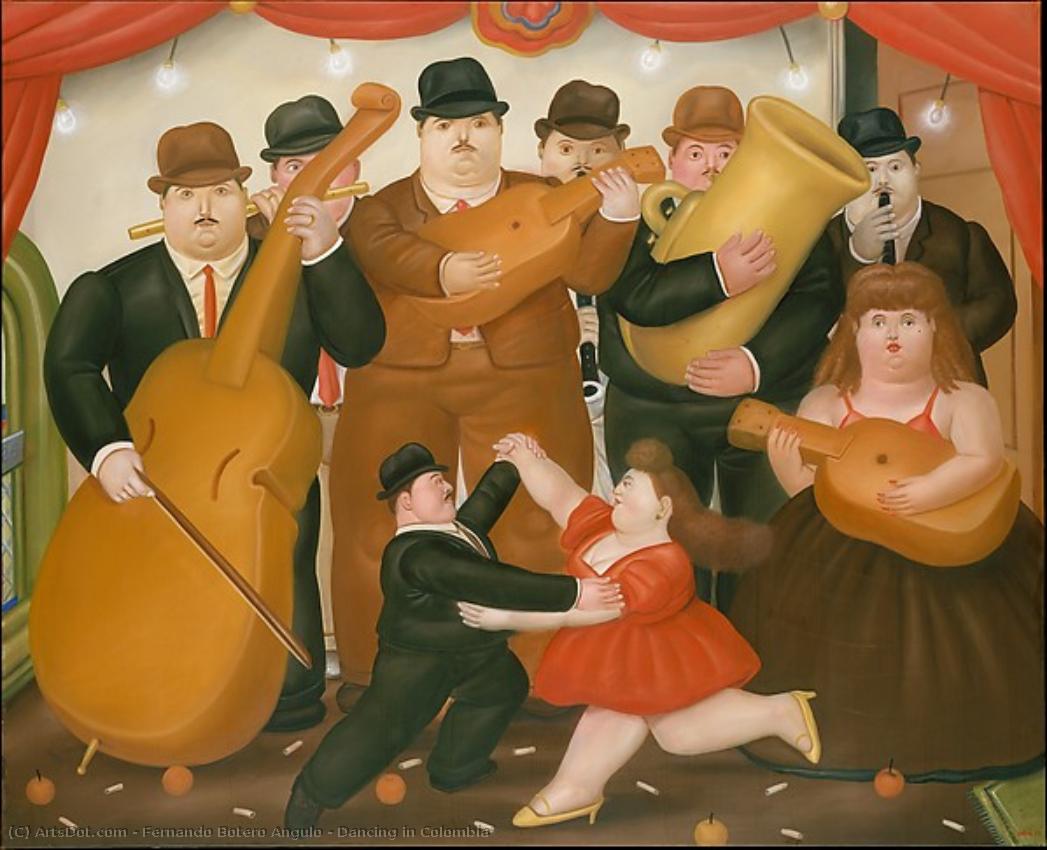
Dancing in Colombia

1980 · Oil On Canvas · Metropolitan Museum of Art, Nowy Jork

In the vibrant tapestry of twentieth-century Latin American art, few works capture the exuberant pulse of a nation quite like Fernando Botero’s Dancing in Colombia. Completed in 1980, this masterful oil painting serves as a window into a world where movement and mass coexist in a joyful, rhythmic embrace. At first glance, the viewer is swept up in a scene of delightful disorder; a crowded café or social gathering teems…

la famille autorstwa Fernando Botero
4

la famille

Oil On Canvas

To stand before Fernando Botero’s depiction of la famille is to be enveloped in an atmosphere of profound, almost monumental warmth. This painting transcends a mere portrait; it is a celebration of connection, a visual ode to the enduring bond that ties generations together. The composition centers on a family unit—a mother seated between her two children, all gathered beneath the sheltering canopy of a tree. Botero masterfully captures not…

scene de famille autorstwa Fernando Botero
5

scene de famille

Oil On Canvas

To gaze upon Fernando Botero’s Scene de Famille is to be enveloped in an atmosphere of profound, yet utterly comfortable, domesticity. This painting transcends a mere depiction; it captures the very essence of togetherness—the quiet moments shared between loved ones that form the bedrock of human experience. The composition centers around a family unit of four—a man, a woman, and two children—all settled into a tableau of relaxed intimacy. Botero’s…

mona lisa autorstwa Fernando Botero
6

mona lisa

Oil On Canvas

Introduction to the Artist and his Style Fernando Botero Angulo, a renowned Colombian figurative artist, is celebrated for his unique style characterized by voluminous, exaggerated forms. His work has been exhibited worldwide and can be found in prestigious museums such as the Metropolitan Museum of Art in New York City and the Museo de Arte Moderno in Bogotá. At AllPaintingsStore.com, we offer handmade oil paintings reproductions of famous artwork, including…

Frank Lloyd et sa famille à paradise island autorstwa Fernando Botero
7

Frank Lloyd et sa famille à paradise island

Oil On Canvas

In this scene, we find ourselves on a tropical shore, observing a quiet moment shared by a family of four. Two adults and two children are positioned amidst the soft sands of paradise island, their presence anchored to the landscape. There is a certain weight to the figures; they do not merely occupy the beach but seem to emerge from it, their rounded silhouettes mirroring the organic curves of the…

les musiciens autorstwa Fernando Botero
8

les musiciens

Oil On Canvas

The scene unfolds through les musiciens, a work that carries the unmistakable presence of its creator, Fernando Botero. Created in 1986, this piece captures a moment of quiet musicality. The artist, who was born in Medellín, Colombia, in 1932, brings a specific sense of weight and volume to the figures within the frame. Every shape feels substantial, as if the air in the room has a physical density that holds…

Dog Turning a Corner (1980) autorstwa Fernando Botero
9

Dog Turning a Corner

1980 · Oil On Canvas

In the masterful hands of Fernando Botero, a simple street corner is transformed into a theatrical stage where life unfolds with exaggerated grace and exuberant color. Dog Turning a Corner invites the viewer into a sun-drenched village scene, captured with the unmistakable warmth that defines the Colombian master's vision. The painting presents a bustling tableau of small-town life, where yellow buildings glow under an unseen sun, casting a nostalgic radiance…

Walk in the hills (1977) autorstwa Fernando Botero
10

Walk in the hills

1977 · Oil On Canvas

In the vast landscape of twentieth-century Latin American art, few figures command attention with as much whimsical gravity as Fernando Botero. His 1977 masterpiece, Walk in the hills, serves as a profound window into the artist's signature aesthetic, often referred to as "Boterismo." At first glance, the painting presents a scene of quietude: a solitary figure, draped in heavy, dark garments and crowned with a black hat, stands amidst the…

The rest of the Fernando Botero ranking, 11 to 100

July 20th (1984) autorstwa Fernando Botero
#11

July 20th

1984 · Muzeum Narodowe w Kolumbii

Fernando Botero’s “July 20th,” painted in 1984, isn't merely a depiction of two figures on a street; it’s a carefully constructed tableau brimming with quiet drama and subtle…

Quatre Musiciens autorstwa Fernando Botero
#12

Quatre Musiciens

Fernando Botero Angulo's "Quatre Musiciens" is a captivating oil painting that exemplifies the artist’s signature style – a harmonious blend of bold colors, exaggerated forms, and a playful…

couple dansant autorstwa Fernando Botero
#13

couple dansant

is an oil painting by the Colombian artist Fernando Botero. The work captures a couple lost in the rhythm of dance, presenting a scene of movement and intimacy.…

monna lisa autorstwa Fernando Botero
#14

monna lisa

The gaze of the woman in monna lisa by Fernando Botero holds a quiet, heavy presence. She sits before us, draped in a black dress that anchors her…

danse en colombie autorstwa Fernando Botero
#15

danse en colombie

The painting "Danse en Colombie" by Fernando Botero Angulo is a captivating representation of the rich cultural heritage of Colombia. This vibrant artwork, available as a handmade oil…

tablao flamenco autorstwa Fernando Botero
#16

tablao flamenco

In the painting tablao flamenco by Fernando Botero, the scene captures a lively performance taking place within a club setting. At the center of the activity is a…

le chasseur autorstwa Fernando Botero
#17

le chasseur

The work before us is titled le chasseur, a painting by the Colombian artist Fernando Botero. Born in Medellín, Colombia, in 1932, Botero developed a singular visual language…

pastèques et oranges autorstwa Fernando Botero
#18

pastèques et oranges

To stand before a piece evoking the spirit of Fernando Botero’s still life compositions is to encounter an immediate sense of opulent, almost monumental presence. This painting, featuring…

tête de christ autorstwa Fernando Botero
#20

tête de christ

The work before us is titled tête de christ, a painting by the Colombian artist Fernando Botero. Born in 1932 in Medellín, Colombia, Botero developed a singular visual…

oranges autorstwa Fernando Botero
#21

oranges

In the vibrant world of Fernando Botero, even the simplest objects undergo a profound transformation. His painting, oranges, invites the viewer into a tactile universe where volume and…

nature morte à la soupe verte autorstwa Fernando Botero
#22

nature morte à la soupe verte

To stand before Nature Morte à la Soupe Verte is to be enveloped in the warm, generous embrace of Colombian artistry. Fernando Botero Angulo’s vision here transcends a…

les soeurs autorstwa Fernando Botero
#23

les soeurs

In the captivating realm of Fernando Botero’s les soeurs, the viewer is immediately enveloped by a sense of profound intimacy and exaggerated grace. The painting presents a tender…

The Widower (1968) autorstwa Fernando Botero
#30

The Widower

1968

“The Widower,” painted in 1968 by Colombian artist Fernando Botero, is a striking oil painting depicting a poignant family portrait set within the confines of a domestic interior.…

jeune fille sur l'ane autorstwa Fernando Botero
#46

jeune fille sur l'ane

jeune fille sur l'ane is an oil painting by Fernando Botero. The artist was born in 1932 in Medellín, Colombia, and maintained a presence in international art hubs…

nature morte de fruits autorstwa Fernando Botero
#73

nature morte de fruits

Fernando Botero Angulo's “nature morte de fruits” is more than just a depiction of fruit; it’s an embodiment of the artist’s singular vision, a testament to his mastery…

El Presidente (1969) autorstwa Fernando Botero
#76

El Presidente

1969 · Bawarskie Państwowe Zbiory Malarstwa
Guitar Lesson (1960) autorstwa Fernando Botero
#81

Guitar Lesson

1960 · Muzeum Narodowe w Kolumbii

Fernando Botero’s “Guitar Lesson,” painted in 1960, isn’t merely a depiction of a musical scene; it’s an embodiment of the artist’s signature style – what he himself termed…

hommage à Bonnard autorstwa Fernando Botero
#83

hommage à Bonnard

The painting Hommage à Bonnard by Fernando Botero Angulo is a unique and fascinating work of art that pays tribute to the French painter Pierre Bonnard. As a…

rubens et sa femme autorstwa Fernando Botero
#84

rubens et sa femme

In the captivating realm of Fernando Botero, reality is not merely observed but reimagined through a lens of magnificent abundance. His work, rubens et sa femme, serves as…

chambre avec jeux d'enfants autorstwa Fernando Botero
#85

chambre avec jeux d'enfants

In the captivating realm of Fernando Botero, reality is not merely observed but reimagined through a lens of magnificent abundance. The painting chambre avec jeux d'enfants invites the…

le bain des évêques dans un fleuve autorstwa Fernando Botero
#86

le bain des évêques dans un fleuve

A Moment of Leisure: "Le Bain des Évêques dans un Fleuve" by Fernando Botero Angulo This captivating painting, “Le Bain des Évêques dans un Fleuve” (The Bathing of…

l'étude de vermeer autorstwa Fernando Botero
#87

l'étude de vermeer

The painting l'étude de vermeer emerges from the year 1964, a moment when Fernando Botero captures a singular presence on canvas. This work presents a portrait of a…

The subjects Fernando Botero painted most

The four subjects that return most often among these masterpieces, with the finest example of each.

Where to see Fernando Botero's paintings

6 muzeów, w których znajduje się najwięcej obrazów z tej strony.

Muzeum Miasto Dzieła artysty Fernando Botero Obrazy z tej listy
Muzeum Narodowe w Kolumbii, BogotaMuzeum Narodowe w Kolumbii Bogota 2 July 20th, Guitar Lesson
Bawarskie Państwowe Zbiory Malarstwa, MonachiumBawarskie Państwowe Zbiory Malarstwa Monachium 2 The First Lady, El Presidente
Metropolitan Museum of Art, Nowy JorkMetropolitan Museum of Art Nowy Jork 1 Dancing in Colombia
Museum of Latin American Art, Long BeachMuseum of Latin American Art Long Beach 1 Title translation: The Family
Tucson Museum of Art, TucsonTucson Museum of Art Tucson 1 Sailor Boy
Królewskie Muzeum Sztuk Pięknych Antwerpia, AntwerpiaKrólewskie Muzeum Sztuk Pięknych Antwerpia Antwerpia 1 The Prima Donna

Fernando Botero through the decades: one masterpiece for each

  1. 1950s
  2. 1960s
  3. 1970s
    Walk in the hills (1977) autorstwa Fernando Botero
    No. 10 of 100

    Walk in the hills

    Wiek 38 – 47

    In the vast landscape of twentieth-century Latin American art, few figures command attention with as much whimsical gravity as Fernando Botero. His 1977 masterpiece, Walk in the hills,…

  4. 1980s
    Dancing in Colombia (1980) autorstwa Fernando Botero
    #3 of 100

    Dancing in Colombia

    Wiek 48 – 57 · Metropolitan Museum of Art

    In the vibrant tapestry of twentieth-century Latin American art, few works capture the exuberant pulse of a nation quite like Fernando Botero’s Dancing in Colombia. Completed in 1980,…

  5. 1990s

Fernando Botero's paintings: frequently asked questions

What is the most famous Fernando Botero painting?Show the answer

The President and First Lady. Next come la collectionneuse and Dancing in Colombia (1980).

Which are the 10 most famous Fernando Botero paintings?Show the answer

The President and First Lady, la collectionneuse, Dancing in Colombia, la famille, scene de famille, mona lisa, Frank Lloyd et sa famille à paradise island, les musiciens, Dog Turning a Corner i Walk in the hills. The ranking above gives the year and the museum of each.

How many paintings by Fernando Botero are there?Show the answer

Our catalogue lists 279 works by Fernando Botero, dated from 1959 to 1992.

Where can I see the most famous Fernando Botero paintings?Show the answer

Most of them are in Muzeum Narodowe w Kolumbii (Bogota), Bawarskie Państwowe Zbiory Malarstwa (Monachium) i Metropolitan Museum of Art (Nowy Jork). The table above lists the museums one by one.

In which period did Fernando Botero paint the best-known works?Show the answer

In 1960s: 10 of the 100 works on this page date from then, among them Camera degli Sposi (Homage to Mantegna) II.

What is the earliest famous Fernando Botero painting, and the latest?Show the answer

The earliest on this page is Mona Lisa, Age Twelve (1959), the latest Title translation: The Family (1992).

What subjects did Fernando Botero paint?Show the answer

Woman (14), Portrait (9) i Volume (8), among the 100 works on this page.

What did Fernando Botero paint on, and with what?Show the answer

Oil On Canvas: 22 of the 100 works on this page.

Which movement does Fernando Botero's art belong to?Show the answer

Boterismo, as the paintings on this page show.

What Fernando Botero paintings does the Muzeum Narodowe w Kolumbii hold?Show the answer

July 20th i Guitar Lesson are among the 2 works on this page held by the Muzeum Narodowe w Kolumbii, Bogota.

Fernando Botero: biography

Wczesne lata, rodzina i kształcenie

Fernando Botero przyszedł na świat 19 kwietnia 1932 roku w Medellín w Kolumbii. Jego dzieciństwo zostało ukształtowane przez ciche, miarowe rytmy domowego ogniska, w którym codzienność była nieustanną walką o przetrwanie. Jego ojciec, David Botero, utrzymywał rodzinę jako handlarz, często przemierzając szlaki konno, aby dotrzeć do swoich klientów. Matka, Flora Angulo, pracowała jako szwaczka, zapewniając niezbędne wsparcie dla domu. To wczesne otoczenie zaszczepiło w nim głębokie poczucie przynależności do miejsca, które towarzyszyło mu przez długie lata, nawet po opuszczeniu rodzinnego miasta.

W czasach młodości Fernando Botero spędził kilka lat w szkole dla matadorów. Przeszedł tam szkolenie w zakresie ruchów i tradycji związanych z areną walk byków, jednak jego zainteresowania ostatecznie pchnęły go w zupełnie innym kierunku, z dala od piasku areny. Gdy miał szesnaście lat, jego pasja przeniosła się w stronę rysunku i szkicowania. W 1948 roku jego pierwsze ilustracje ukazały się w niedzielnym dodatku do gazety El Colombiano, co stanowiło początek jego publicznej obecności poprzez twórczość wizualną.

Szkolenie artystyczne i europejskie podróże

W 1952 roku Botero, wykorzystując środki z uzyskanych sprzedaży w galerii, wyruszył w podróż ku Europie. Jego pierwszym przystankiem była Barcelona, lecz wkrótce przeniósł się do Madrytu. To właśnie w Hiszpanii rozpoczął studia w Academia de San Fernando. Spędzał długie godziny w Muzeum Prado, gdzie w skupieniu kopiował dzieła Goyi i Velázqueza. Ten nawyk studiowania dawnych mistrzów stał się nieodłącznym i trwałym elementem jego artystycznej praktyki.

Jego edukacja zaprowadziła go ostatecznie do Florencji, gdzie studiował w Academia de San Marcos. Do 1953 roku przeniósł się już do Paryża. Większość czasu spędzał w Luwrze, z fascynacją obserwując, w jaki sposób światło i forma osiadają na postaciach w muzealnych salach. Te lata spędzone w Europie upłynęły na nieustannym przemieszczaniu się między Madrytem, Florencją a Paryżem, podczas gdy on chłonął ciężar i majestatyczną obecność sztuki klasycznej.

Rozwój stylu Boterismo

Kształty w jego twórczości niosą ze sobą niezwykłą, niemal namacalną wagę. To podejście, znane powszechnie jako Boterismo, koncentruje się na postaciach i figurach przedstawionych w monumentalnych, wyolbrzymionych objętościach. Zamiast skupiać się na smukłych liniach, artysta kładzie nacisk na obłe, krępe formy, które wypełniają przestrzeń z przytłaczającą, ciężką obecnością. Te figury posiadają masę, którą niemal można poczuć fizycznie, jakby sama farba nabrała ciężaru. Często posługuje się on żywymi kolorami i wyrazistym konturem, aby zdefiniować te kształty, sprawiając, że tematy dzieł stają się niezwykle wyraziste na tle otoczenia.

Około 1964 roku to fascynujące zainteresowanie wolumenem przeniosło się z płótna w trzeci wymiar. Fernando Botero zaczął tworzyć rzeźby, przekładając to samo poczucie ekspansji na brąz i inne materiały. Obłość widoczna na jego obrazach zyskała nowe życie w tych solidnych formach, pozwalając wyolbrzymionym proporcjom zaistnieć w przestrzeni publicznej. Jego praca pozostaje skupiona na czystej fizyczności podmiotu, niezależnie od tego, czy jest to postać ludzka, czy zwierzę.

Kluczowe dzieła i tematy artystyczne

Twórczość Fernando Botero często koncentruje się wokół ciężaru ludzkiej formy oraz cichego napięcia skrytego w ramach konwencji społecznych. W dziele Mona Lisa, Age Twelve (1959) podmiot zostaje przedstawiony z charakterystyczną, zaokrągloną obecnością, która odchodzi od tradycyjnych proporcji. To skupienie na objętości stało się dla artysty sposobem na zgłębianie bardziej złożonych struktur społecznych. Z kolei w The Presidential Family (1967) wyolbrzymione kształty postaci oferują subtelne spojrzenie na elity polityczne, wykorzystując masę ciała jako komentarz do statusu osób sprawujących władzę. Botero używał tych form, aby poruszyć zarówno radosną stronę życia, jak i przytłaczający ciężar konfliktów.

Tematyka jego prac często oscyluje między celebracją życia a brutalną rzeczywistością przemocy. Dancing in Colombia (1980) ukazuje tętniącą życiem scenę muzyków i tancerzy, gdzie grube warstwy farby nadają postaciom niemal namacalną, ciężką jakość. W przeciwieństwie do tego, jego późniejsze dzieła częściej konfrontowały mroczne aspekty jego ojczyzny. The Death of Pablo Escobar (1999/2006) oraz liczne cykle poruszające temat nadużyć w Abu Ghraib świadczą o gotowości artysty do wykorzystania swojego unikalnego stylu w celu zmierzenia się z bolesną prawdą. Nawet jego późniejsze kompozycje, takie jak La paloma de la paz (2016), niosą ze sobą poczucie monumentalnego ciężaru, niezależnie od tego, czy tematem jest człowiek, zwierzę, czy symbol pokoju.

  • Mona Lisa, Age Twelve (1959)
  • The Presidential Family (1967)
  • Dancing in Colombia (1980)
  • The Death of Pablo Escobar (1999/2006)
  • La paloma de la paz (2016)

Późne lata i śmierć

Ostatnie dekady jego życia upłynęły na nieustannym przemieszczaniu się między wielkimi światowymi metropoliami. Utrzymywał rezydencje w Nowym Jorku, Paryżu i Monte Carlo, jednak w sercu zawsze nosił Medellín, do którego często powracał, by zachować żywą więź ze swoimi korzeniami. Jego obecność w przestrzeni publicznej stawała się coraz bardziej namacalna, gdy jego monumentalne, brązowe rzeźby zaczęły zdobić parki i place na wielu kontynentach. Mimo upływu lat, jego twórczość nie straciła na sile i nie unikała trudnych tematów; wciąż z odwagą podejmował kwestie napięć społecznych i politycznych w Kolumbii oraz mroczne wydarzenia z więzienia Abu Ghraib.

W ostatnich latach życia osiadł w Księstwie Monako. To właśnie tam, 15 września 2023 roku, odszedł w wieku 91 lat, w wyniku powikłań po zapaleniu płuc. Jego odejście położyło kres niezwykle długiej i fascynującej karierze, podczas której z nieustanną pasją obserwował ludzką formę oraz zawiłości życia społecznego, interpretując je przez swój unikalny, niepodrabialny pryzmat objętości i proporcji.

Dziedzictwo i wpływ

Obecność Fernando Botero w sferze publicznej była nieustanna i wszechobecna. W Nowym Jorku jego rzeźby zajmują prestiżowe przestrzenie, takie jak Park Avenue, gdzie ciężkie, zaokrąglone formy współistnieją w dialogu z monumentalną architekturą metropolii. W swojej ojczyźnie, Kolumbii, stał się skarbem narodowym – postacią, której twórczość została trwale wpleciona w codzienność narodu. Za życia był najbardziej rozpoznawalnym i cytowanym artystą z Ameryki Łacińskiej, co znajduje odzwierciedlenie w sposobie, w jaki jego charakterystyczne figury stały się bliskie ludziom przekraczającym liczne granice.

Jego głębokie przywiązanie do ojczyzny objawiło się poprzez niezwykle hojne, wielkoskalowe darowizny. W 2000 roku przekazał 208 dzieł sztuki Bankowi Republiki, co odegrało kluczową rolę w kształtowaniu krajobrazu kulturalnego Bogoty. Artysta zdecydował się również podzielić znaczną częścią swojej prywatnej kolekcji, przekazując 123 dzieła oraz 85 obiektów do Museo Botero. Te bezprecedensowe gesty sprawiły, że jego unikalny sposób postrzegania świata pozostał dostępny dla przyszłych pokoleń, stając się fundamentem dla innych.

  • La paloma de la paz
  • The Death of Pablo Escobar
  • Mona Lisa, Age Twelve

Gdzie dziś można podziwiać jego dzieła

Obecność artysty jest wyczuwalna w cichych zakamarkach Bogoty, a w szczególności w malowniczej dzielnicy La Candelaria. To właśnie tam Museo Botero przechowuje ogromną część jego dorobku – kolekcję, która powstała dzięki jego własnej, niezwykłej decyzji o przekazaniu wielu dzieł narodowi. W Medellín, Museum of Antioquia również opiekuje się znaczącą liczbą jego prac, podtrzymując tym samym żywą więź z jego korzeniami. Te przestrzenie dają możliwość niespiesznej kontemplacji sposobu, w jaki Fernando Botero operował wolumenem i ciężarem swoich tematów.

Poza Kolumbią, jego malarstwo można odnaleźć w Metropolitan Museum of Art w Nowym Jorku. Tam skala jego monumentalnych postaci nabiera zupełnie innego charakteru na tle tej światowej instytucji. Jego brązowe rzeźby znalazły również swoje stałe miejsca w przestrzeni publicznej, zapraszając przechodniów do spacerów wokół nich na ulicach Florencji i Medellín. Te ciężkie, zaokrąglone formy trwają na wolnym powietrzu, podlegając nieustannym zmianom światła i rytmowi miejskiego życia.

  • Dancing in Colombia (1980)
  • July 20th (1984)
  • Mona Lisa (ok. 1959)
  • The Death of Pablo Escobar (ok. 1999)

Wszystkie 279 dzieła artysty Fernando Botero →