Emanuel De Witte, 1617 – 1692

Emanuel De Witte: 99 najsłynniejszych obrazów

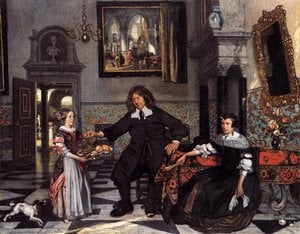
Portrait of a Family in an Interior (detail) (1678) to najsłynniejszy obraz autorstwa Emanuel De Witte, znajdujący się w Alte Pinakothek w Monachium. The Interior of a Dutch Church (1680) i Interior of the Nieuwe Kerk in Delft (1664) to dwa kolejne dzieła, które świat zna najlepiej. Z 99 dzieł Emanuel De Witte w naszym katalogu, oto 99 najczęściej wybieranych przez kolekcjonerów i zwiedzających muzea, wraz z rokiem powstania, informacją o muzeum oraz historią każdego z nich.

Ranking oparty na naszym wskaźniku popularności, który łączy liczbę wyszukiwań, wizyt oraz zamówień dla każdego dzieła. Aktualizacja: Październik 2026. Każde arcydzieło na tej stronie można zamówić jako ręcznie malowaną reprodukcję olejną o jakości muzealnej lub jako wysokiej jakości wydruk artystyczny, w wybranym przez Ciebie rozmiarze.

Portret Emanuel De Witte
Emanuel De Witte · 1617 – 1692
Urodzony · zmarł
1617 – 1692, Alkmaar
Nurt
Dutch golden age
Dzieła w naszym katalogu
99
Najsłynniejsze
Portrait of a Family in an Interior (detail) (1678)
Najwięcej dzieł w
Museum Boijmans Van Beuningen

Top 10: najsłynniejsze obrazy artysty Emanuel De Witte

Portrait of a Family in an Interior (detail) (1678) autorstwa Emanuel De Witte
1

Portrait of a Family in an Interior (detail)

1678 · Oil On Canvas · Alte Pinakothek, Monachium

Emanuel de Witte's “Portrait of a Family in an Interior” (1678) isn’t merely a depiction of a wealthy household; it’s a carefully constructed tableau vivant, a frozen moment brimming with quiet dignity and subtle narrative. Painted during the height of the Dutch Golden Age, this oil on canvas offers a rare glimpse into the lives of a prosperous family within their richly appointed home—a space designed to project status, comfort,…

Interior of the Nieuwe Kerk in Delft (1664) autorstwa Emanuel De Witte
3

Interior of the Nieuwe Kerk in Delft

1664 · Oil On Canvas · Residenzgalerie, Salzburg

To stand before an interior scene like this depiction of the Nieuwe Kerk in Delft is to step across a threshold, leaving the clamor of the outside world behind. The artwork does not merely show us a church; it envelops us within its monumental silence. Emanuel de Witte masterfully captures that unique atmosphere found only in grand, aged sacred architecture—a place where history seems palpable in the very dust motes…

Rest During the Flight (1654) autorstwa Emanuel De Witte
4

Rest During the Flight

1654 · Oil · Bawarskie Państwowe Zbiory Malarstwa, Monachium

The oil painting titled Rest During the Flight by Emanuel de Witte depicts a specific narrative from religious history. Created about 1654, the work presents a scene likely representing the Flight into Egypt. This biblical event is rendered through a composition centered on a nocturnal landscape where light and shadow define the primary figures.

The Interior of the Oude Kerk, Amsterdam, during a Sermon (1658) autorstwa Emanuel De Witte
5

The Interior of the Oude Kerk, Amsterdam, during a Sermon

1658 · Oil On Canvas · National Gallery, Londyn

To stand before this depiction of The Interior of the Oude Kerk in Amsterdam is to step across the threshold of time itself. This painting, executed in 1658 by Emanuel de Witte, is far more than a mere record of an architectural space; it is a meticulously crafted meditation on faith, community, and the sublime interplay between human life and divine structure. The high-angle perspective immediately envelops the viewer, drawing…

Portrait of a woman (1648) autorstwa Emanuel De Witte
6

Portrait of a woman

1648 · Oil On Canvas · Museum Boijmans Van Beuningen, Rotterdam

A single female figure occupies the center of this oval vignette, presented in a bust-length view. She wears a dark garment, accented by a prominent white collar with scalloped edges and a small black bow. The composition draws the eye directly to her face, where a calm and composed expression suggests a dignified emotional tone. Light originates from the upper left, casting gentle shadows across the right side of her…

Portrait of a man (1648) autorstwa Emanuel De Witte
7

Portrait of a man

1648 · Oil · Museum Boijmans Van Beuningen, Rotterdam

is an oil painting by the Dutch artist Emanuel de Witte. Executed about 1648, the work represents a significant example of the artist's early engagement with portraiture before his later specialization in church interiors. The sitter is presented in a bust-length composition, positioned slightly off-center to create a sense of depth and presence.

Interior of a Protestant Gothic Church (1669) autorstwa Emanuel De Witte
8

Interior of a Protestant Gothic Church

1669 · Oil On Canvas · Rijksmuseum, Amsterdam

Emanuel de Witte's "Interior of a Protestant Gothic Church," painted in 1669, isn’t merely a depiction of a sacred space; it’s an immersive experience. This remarkable work transcends the simple act of recording architecture, instead capturing the very *feeling* of being within a grand, dimly lit cathedral – a testament to de Witte's unique artistic vision. Unlike his contemporary Pieter Saenredam, who meticulously documented architectural details with photographic precision, de…

Pozostała część rankingu Emanuel De Witte, od 11 do 99

Interior of the Oude Kerk, Delft (1650) autorstwa Emanuel De Witte
#38

Interior of the Oude Kerk, Delft

1650 · Metropolitan Museum of Art

Despite its profusion of realistic details, de Witte’s interior view of Delft’s Oude Kerk (Old Church) takes considerable liberties with the actual architecture of the church—omitting, for example,…

Zabierz ją do domu →
Interior of a Church (1674) autorstwa Emanuel De Witte
#67

Interior of a Church

1674 · Wallraf-Richartz-Museum

In this work, titled Interior of a Church, we encounter a significant example of the Dutch Golden Age. Painted by Emanuel de Witte in 1660, the oil on…

Zamów reprodukcję →
Interior of the Oude Kerk, Delft (1650) autorstwa Emanuel De Witte
#73

Interior of the Oude Kerk, Delft

1650 · Metropolitan Museum of Art

Emanuel de Witte's “Interior of the Oude Kerk, Delft” isn’t merely a depiction of a church; it’s an immersive experience. Painted in 1650, this remarkable work transports us…

Zamów reprodukcję →
Interior of a Gothic church autorstwa Emanuel De Witte
#86

Interior of a Gothic church

Museum Boijmans Van Beuningen

The scene unfolds within the quiet, soaring reaches of an Interior of a Gothic church. This work, painted by Emanuel de Witte, captures a moment of stillness amidst…

Zamów reprodukcję →

Tematy, które najczęściej malował Emanuel De Witte

Cztery tematy najczęściej powracające w tych arcydziełach, wraz z najdoskonalszym przykładem każdego z nich.

Gdzie można zobaczyć obrazy Emanuel De Witte

8 muzeów, w których znajduje się najwięcej obrazów z tej strony.

Muzeum Miasto Dzieła artysty Emanuel De Witte Obrazy z tej listy
Museum Boijmans Van Beuningen, RotterdamMuseum Boijmans Van Beuningen Rotterdam 11 Portrait of a woman, Portrait of a man, Vertumnus and Pomona
Rijksmuseum, AmsterdamRijksmuseum Amsterdam 8 Interior of a Protestant Gothic Church, Interior of a Protestant Gothic Church, Interior of the Portuguese Synagogue in Amsterdam
National Gallery, LondynNational Gallery Londyn 4 The Interior of the Oude Kerk, Amsterdam, during a Sermon, The Interior of the Oude Kerk, Amsterdam, The Interior of the Oude Kerk, Amsterdam, during a Sermon
Amsterdam Museum, AmsterdamAmsterdam Museum Amsterdam 3 Interior of the Oude Kerk in Amsterdam, Interior of the Oude Kerk in Amsterdam, Interior of the Oude Kerk in Amsterdam
Gemäldegalerie, BerlinGemäldegalerie Berlin 3 Interior View of a Synagogue, Interior of a Gothic Church, Interior of the Nieuwe Kerk in Amsterdam
Ermitaż, Sankt PetersburgErmitaż Sankt Petersburg 3 Square in front of the Palace in an Italian Town, Old Church in Delft, Interior of a Church
Metropolitan Museum of Art, Nowy JorkMetropolitan Museum of Art Nowy Jork 3 Interior of the Oude Kerk, Delft, Interior of the Oude Kerk, Delft (detail), Interior of the Oude Kerk, Delft
Detroit Institute of Arts, DetroitDetroit Institute of Arts Detroit 3 The Nieuwe Kerk at Delft with the Tomb of Willem the Silent, Interior of a Protestant Church, Interior of the Oude Kerk in Amsterdam

Emanuel De Witte na przestrzeni dekad: jedno arcydzieło na każde dziesięciolecie

  1. 1640s
    Portrait of a woman (1648) autorstwa Emanuel De Witte
    6 z 99

    Portrait of a woman

    Wiek 23 – 32 · Museum Boijmans Van Beuningen

    A single female figure occupies the center of this oval vignette, presented in a bust-length view. She wears a dark garment, accented by a prominent white collar with…

  2. 1650s
    Rest During the Flight (1654) autorstwa Emanuel De Witte
    4 z 99

    Rest During the Flight

    Wiek 33 – 42 · Bawarskie Państwowe Zbiory Malarstwa

    The oil painting titled Rest During the Flight by Emanuel de Witte depicts a specific narrative from religious history. Created about 1654, the work presents a scene likely…

  3. 1660s
    Interior of the Nieuwe Kerk in Delft (1664) autorstwa Emanuel De Witte
    Nr 3 z 99

    Interior of the Nieuwe Kerk in Delft

    Wiek 43 – 52 · Residenzgalerie

    To stand before an interior scene like this depiction of the Nieuwe Kerk in Delft is to step across a threshold, leaving the clamor of the outside world…

  4. 1670s
    Portrait of a Family in an Interior (detail) (1678) autorstwa Emanuel De Witte
    Nr 1 z 99

    Portrait of a Family in an Interior (detail)

    Wiek 53 – 62 · Alte Pinakothek

    Emanuel de Witte's “Portrait of a Family in an Interior” (1678) isn’t merely a depiction of a wealthy household; it’s a carefully constructed tableau vivant, a frozen moment…

  5. 1680s
    The Interior of a Dutch Church (1680) autorstwa Emanuel De Witte
    Miejsce 2 / 99

    The Interior of a Dutch Church

    Wiek 63 – 72 · Scottish National Gallery

    The Interior of a Dutch Church is an oil on canvas by Emanuel de Witte. Created about 1680, the work reflects the artist's specialization in the architectural spaces…

  6. 1690s

Obrazy artysty Emanuel De Witte: najczęściej zadawane pytania

Który obraz Emanuel De Witte jest najbardziej znany?Pokaż odpowiedź

Portrait of a Family in an Interior (detail) (1678), Alte Pinakothek, Monachium. Następnie pojawiają się The Interior of a Dutch Church (1680) oraz Interior of the Nieuwe Kerk in Delft (1664).

W jakim wieku Emanuel De Witte namalował/a Portrait of a Family in an Interior (detail)?Pokaż odpowiedź

61 lat: Portrait of a Family in an Interior (detail) pochodzi z 1678, a Emanuel De Witte urodził(a) się w 1617.

Które są 10 najsłynniejszych obrazów, których autorem jest Emanuel De Witte?Pokaż odpowiedź

Portrait of a Family in an Interior (detail), The Interior of a Dutch Church, Interior of the Nieuwe Kerk in Delft, Rest During the Flight, The Interior of the Oude Kerk, Amsterdam, during a Sermon, Portrait of a woman, Portrait of a man, Interior of a Protestant Gothic Church, Danaë and the Shower of Gold i Vertumnus and Pomona. Powyższy ranking zawiera rok oraz muzeum dla każdego z nich.

Ile obrazów autorstwa Emanuel De Witte znajduje się w kolekcji?Pokaż odpowiedź

Nasz katalog obejmuje 99 dzieł autorstwa Emanuel De Witte, datowanych od 1641 do 1692.

Gdzie mogę zobaczyć najsłynniejsze obrazy, których autorem jest Emanuel De Witte?Pokaż odpowiedź

Większość z nich znajduje się w Museum Boijmans Van Beuningen (Rotterdam), Rijksmuseum (Amsterdam) i National Gallery (Londyn). Powyższa tabela zawiera listę muzeów po kolei.

W jakim okresie Emanuel De Witte namalował swoje najsłynniejsze dzieła?Pokaż odpowiedź

W okresie 1650s: 27 z 99 dzieł na tej stronie pochodzi z tego czasu, w tym Rest During the Flight.

Jakie jest najwcześniejsze i najpóźniejsze słynne dzieło, którego autorem jest Emanuel De Witte?Pokaż odpowiedź

Najwcześniejszy na tej stronie to Danaë and the Shower of Gold (1641), najpóźniejszy The Nieuwe Vismarkt (New Fish Market) in Amsterdam, Emanuel de Witte, 1655 - 1692 (1692).

Jakie tematy malował Emanuel De Witte?Pokaż odpowiedź

Church interior (16), 17th century (10) i Architecture (10), spośród 99 dzieł na tej stronie.

Na czym i czym malował Emanuel De Witte?Pokaż odpowiedź

Oil On Canvas: 22 z 99 dzieł na tej stronie.

Do jakiego nurtu należy twórczość Emanuel De Witte?Pokaż odpowiedź

Dutch golden age i Baroque, co pokazują obrazy na tej stronie.

Jakie obrazy Emanuel De Witte znajdują się w zbiorach Museum Boijmans Van Beuningen?Pokaż odpowiedź

Portrait of a woman, Portrait of a man i Vertumnus and Pomona to jedne z 11 dzieł na tej stronie znajdujących się w zbiorach Museum Boijmans Van Beuningen, Rotterdam.

Gdzie mogę kupić reprodukcję Emanuel De Witte?Pokaż odpowiedź

Tak. Każdy obraz na tej stronie można zamówić jako ręcznie malowaną reprodukcję olejną o jakości muzealnej lub jako wysokiej jakości wydruk artystyczny w wybranym przez Ciebie rozmiarze, bezpośrednio ze strony danego dzieła.

Emanuel De Witte: biografia

A Life in Perspective: The World of Emanuel de Witte

Emanuel de Witte, a name perhaps less instantly recognizable than some of his Dutch Golden Age contemporaries, nevertheless occupies a significant and fascinating niche within the pantheon of 17th-century masters. Born in Alkmaar in 1617, De Witte’s artistic journey was one marked by both remarkable talent and considerable personal turmoil – a duality that seems to subtly infuse itself into the very atmosphere of his paintings. He wasn't driven by meticulous architectural documentation like Pieter Saenredam; instead, he sought to capture the *feeling* of space, the quality of light, and the subtle drama unfolding within sacred interiors. His canvases aren’t merely representations of churches; they are immersive experiences, inviting viewers into a world of quiet contemplation and spiritual resonance.

From Delft Training to Amsterdam's Embrace

De Witte’s early life provided a solid foundation for his artistic pursuits. His father, a schoolmaster, instilled in him an appreciation for learning and intellectual curiosity – qualities that would later manifest in his careful observation of perspective and light. He formally entered the art world by joining the Guild of St Luke in Alkmaar in 1636, but it was his subsequent apprenticeship with Evert van Aelst in Delft that proved particularly formative. Van Aelst, a renowned still-life painter, imparted to De Witte a keen eye for detail and a masterful command of light and shadow – skills that would become hallmarks of his mature style. Initially, De Witte explored various genres—portraits, mythological scenes, religious narratives—but it was upon relocating to Amsterdam in 1651 that he truly found his calling. The city’s wealth of magnificent churches provided an inexhaustible source of inspiration, and he began to specialize in depicting their awe-inspiring interiors. He didn't simply replicate existing church spaces; rather, he skillfully synthesized elements from different buildings, creating idealized interiors that felt both familiar and subtly otherworldly.

Master of Atmosphere and Imaginary Spaces

Amsterdam proved pivotal for De Witte's artistic development. He didn’t just paint what he saw; he painted *how* it felt to be in those spaces. The Oude Kerk in Amsterdam became a frequent subject, appearing repeatedly on his canvases from various vantage points. But these weren’t straightforward depictions. De Witte manipulated perspective, played with light and shadow, and populated the spaces with carefully arranged figures – often anonymous worshippers – to evoke a specific mood or atmosphere. As Walter Liedtke noted, his primary interest lay not in the architecture itself but in “the space itself – its light, color, sheer extent, and mood.” This emphasis on atmospheric effect distinguishes him from more rigidly topographical painters of the era. He wasn’t concerned with precise accuracy; he was interested in creating a *feeling* of grandeur, reverence, and spiritual depth. His paintings are filled with a sense of quiet solemnity, as if one were stepping into a sacred space themselves.

The Influence of Light and Perspective

De Witte's technique was deceptively simple yet profoundly effective. He often employed a limited palette – predominantly browns, grays, and ochres – to create a sense of muted depth and atmosphere. He meticulously studied the effects of light filtering through stained glass windows, casting dramatic shadows and highlighting architectural details. His use of perspective wasn't always mathematically precise; he sometimes exaggerated certain elements to heighten the emotional impact of the scene. He frequently used *chiaroscuro* – the contrast between light and dark – to draw the viewer’s eye to key figures or focal points within the composition. This masterful manipulation of light and perspective is what truly sets his work apart, transforming ordinary churches into extraordinary realms of spiritual contemplation.

A Life Marked by Shadows

Despite his artistic success, De Witte's personal life was plagued by hardship. The death of his first wife brought profound grief, and subsequent legal troubles involving his second wife and daughter cast a long shadow over his later years. Financial difficulties led him to the humiliating position of indentured servitude to an art dealer, Joris de Wijs, a situation he ultimately breached, leading to further complications. Contemporary accounts paint a picture of a volatile temperament – a man prone to shouting at clients and engaging in disputes. This inner turmoil perhaps contributed to the unevenness of his later work, but it also adds another layer of complexity to our understanding of the artist and his creations. Tragically, De Witte’s life came to a devastating end in 1692 when he reportedly attempted suicide by hanging himself from a canal bridge; the rope broke, and he drowned. It was a grim finale for a man who had dedicated his life to capturing the beauty and serenity of sacred spaces.

Legacy and Enduring Influence

Emanuel de Witte stands as an important figure in the last phase of architectural painting in the Netherlands, bridging the gap between meticulous documentation and atmospheric interpretation. His innovative use of light and perspective influenced subsequent generations of artists, and his paintings continue to offer valuable insights into 17th-century Dutch religious life and social customs. Today, works by De Witte are held in prestigious collections worldwide – at the Metropolitan Museum of Art, the National Gallery of Art, and the Rijksmuseum, among others—testifying to his enduring legacy as a master of perspective, atmosphere, and emotional resonance. He reminds us that art is not merely about what we see but how we *feel* when we look.

Wszystkie 99 dzieła artysty Emanuel De Witte →
