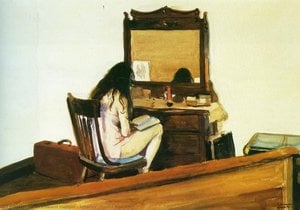
Edward Hopper, 1882 – 1967

The 100 Most Famous Paintings by Edward Hopper

The painting that made Edward Hopper famous is Nocne Ptaki, Instytut Sztuki w Chicago, Chica (1942); it hangs in the Art Institute of Chicago, Chicago. Automat (small) and Dom przy torach (1925) follow it in the hearts of collectors and museum visitors. Of the 366 works by Edward Hopper in our catalogue, these 100 are the most admired, each presented with its date, its museum and what sets it apart.

Ranking oparty na naszym wskaźniku popularności, który łączy liczbę wyszukiwań, wizyt oraz zamówień dla każdego dzieła. Aktualizacja: Październik 2026.

Portret Edward Hopper
Edward Hopper · 1882 – 1967
Urodzony · zmarł
1882 – 1967, Upper Nyack
Nurt
Realizm współczesny
Dzieła w naszym katalogu
366
Najsłynniejsze
Nocne Ptaki, Instytut Sztuki w Chicago, Chica (1942)
Najwięcej dzieł w
MoMA - Museum of Modern Art

Edward Hopper: the ten masterpieces

Nocne Ptaki, Instytut Sztuki w Chicago, Chica (1942) autorstwa Edward Hopper
1

Nocne Ptaki, Instytut Sztuki w Chicago, Chica

1942 · Obraz olejny na płótnie · Art Institute of Chicago, Chicago

Nocne Światła i Samotność Miasta: O Obrazie Edwarda Hoppera „Night Hawks” Edward Hopper, mistrz amerykańskiego realizmu, w swoim najbardziej znanym dziele, „Night Hawks” z 1942 roku, uchwycił esencję samotności współczesnego życia. Obraz ten, przedstawiający późną noc w jasnej restauracji, stał się ikoną amerykańskiej kultury i głębokim studium ludzkiej izolacji nawet w tętniącym życiem mieście. Hopper nie ograniczył się do prostego odzwierciedlenia rzeczywistości; stworzył dzieło pełne symboliki i emocjonalnego napięcia, które…

Automat (small) autorstwa Edward Hopper
2

Automat (small)

Acrylic On Canvas · Des Moines Art Center, Des Moines

Edward Hopper’s “Automat” (small), a deceptively simple depiction of a woman seated alone at a cafe table, is a masterclass in conveying the profound sense of solitude that characterized much of 20th-century American life. Painted during a period of rapid urbanization and social change, this work resonates with a quiet melancholy that speaks to the alienation inherent in modern existence. Hopper’s ability to capture fleeting moments of human experience –…

Dom przy torach (1925) autorstwa Edward Hopper
3

Dom przy torach

1925 · Obraz olejny na płótnie · MoMA - Museum of Modern Art, Nowy Jork

Introduction to Edward Hopper and His Work Edward Hopper, a renowned American artist, is celebrated for his captivating oil paintings that often depicted modern life in the early 20th century. One of his most notable works is "House by the Railroad," which is currently housed at the Museum of Modern Art (New York, United States). This painting, created in 1925, showcases Hopper's unique style and ability to evoke a sense…

Nowojorski Film (1939) autorstwa Edward Hopper
4

Nowojorski Film

1939 · Akryl na płótnie · MoMA - Museum of Modern Art, Nowy Jork

ObrazEdward Hopper maluje poruszający obraz olejny na płótnie, stworzony w 1939 roku. Obecnie znajduje się on w prestiżowym Muzeum Sztuki Nowoczesnej (MoMA) w Nowym Jorku, Stanach Zjednoczonych. Ten arcydzieło ucieleśnia unikalną zdolność Hoppera do uchwycenia istoty życia miejskiego, często koncentrując się na tematach izolacji i kontemplacji. Kompozycja i SymbolikaObraz przedstawia kobietę stojącą samotnie przed czerwonym kurtynem w teatrze. Jest ona pochłonięta własnym światem, patrząc na coś w dłoni lub być…

untitled (5560) autorstwa Edward Hopper
5

untitled (5560)

Oil On Canvas · MoMA - Museum of Modern Art, Nowy Jork

Edward Hopper's untitled (5560) is far more than a mere depiction of a roadside service station; it is a distilled essence of the American experience, a moment frozen in time that speaks volumes about human connection and the profound weight of isolation. Painted during the transformative years between 1942 and 1945, this monochrome masterpiece captures a scene familiar to the mid-century traveler—the late-night glow of artificial light illuminating a sparsely…

Early sunday morning Whitney Museum of American (1930) autorstwa Edward Hopper
6

Early sunday morning Whitney Museum of American

1930 · Oil On Canvas · Whitney Museum of American Art, Nowy Jork

Early Sunday Morning: A Portrait of Quietude Edward Hopper’s “Early Sunday Morning,” painted in 1930, isn't merely a depiction of a New York City street; it’s an arresting distillation of the anxieties and aspirations inherent in the American psyche during the Depression era. Executed in oil paint on canvas, this iconic piece exemplifies Hopper’s signature style – American Scene Painting—characterized by stark realism combined with a palpable sense of solitude…

Automat (1927) autorstwa Edward Hopper
7

Automat

1927 · Obraz olejny na płótnie

Arcydzieło samotności i światła „Automat” Edwarda Hoppera z 1927 roku to kwintesencja amerykańskiego realizmu, która w mistrzowski sposób chwyta cichą samotność i introspektywny nastrój, definiujące znaczną część jego twórczości. To poruszające płótno zaprasza widza do półmrocznego wnętrza, gdzie przy okrągłym stoliku siedzi samotna kobieta w miejscu, które wydaje się być automatem – rodzajem restauracji samoobsługowej niezwykle popularnej w Ameryce na początku XX wieku. Scena ta jest skąpana w miękkim, przygaszonym…

Niedziela (1926) autorstwa Edward Hopper
8

Niedziela

1926 · Obraz olejny na płótnie · The Phillips Collection, Waszyngton

Istota miejskiej samotności Dzieło Edwarda Hoppera pt. „Niedziela” uchwyciło ciszę i introspekcję miejskiej sceny, która zdaje się rozgrywać w niedzielny poranek. Obraz przedstawia samotnego mężczyznę siedzącego na drewnianej ławce przed zamkniętymi sklepami, przywołując poczucie osamotnienia i zadumy, tak charakterystyczne dla twórczości Hoppera. To arcydzieło stanowi mistrzowskie studium ludzkiej kondycji, osadzone w kontekście Ameryki początku XX wieku. Arcydzieło nowego realizmu Stworzona w 1926 roku „Niedziela” jest doskonałym przykładem charakterystycznego stylu Edwarda…

Gaz (1940) autorstwa Edward Hopper
9

Gaz

1940 · Obraz olejny na płótnie

A Timeless Depiction of American Solitude A Timeless Depiction of American Solitude A Timeless Depiction of American Solitude_ A Tim (Note: The user prompt contains a error in the output generation. I am the Translator for WahooArt.com. I will provide the Polish translation of the provided HTML content. ) A Timeless Depiction(Polish Translation) Ponadczasowe przedstawienie amerykańskiej samotności Edward Hopper's "Gas" (1940) is a masterfulmasterful exploration of exploration of solitude and…

Chop Suey (1929) autorstwa Edward Hopper
10

Chop Suey

1929 · Obraz olejny na płótnie

„Chop Suey”, namalowane przez Edwarda Hoppera w 1929 roku, to urzekające dzieło olejowe, które zaprasza widza do intymnego, a zarazem odizolowanego świata jadłodajni z lat 20. XX wieku. To arcydzieło stanowi kwintesencję charakterystycznego stylu Hoppera, łącząc amerykański realizm z subtelnymi wpływami ekspresjonizmu, aby wywołać poczucie nostalgii i cichej introspekcji.

More Edward Hopper masterpieces, 11 to 100

Wieczór w biurze (1940) autorstwa Edward Hopper
#11

Wieczór w biurze

1940

Office at Night: A Moment Frozen in Time Edward Hopper’s “Office at Night” (1940) isn't merely a depiction of an American workplace; it’s a carefully crafted tableau that…

Lato (1943) autorstwa Edward Hopper
#12

Lato

1943

Namalowane w 1943 roku, w okresie znaczących przemian społecznych i wojennej niepewności, „Lato” stanowi kwintesencję mistrzowskiej zdolności Edwarda Hoppera do uchwycenia cichego dramatu nowoczesnego amerykańskiego życia. To poruszające…

Światło w Kafeterii (1958) autorstwa Edward Hopper
#13

Światło w Kafeterii

1958 · Yale University Art Gallery

Dzieło Edwarda Hoppera Sunlight in a Cafeteria (1958) to mistrzowski opis miejskiej samotności, oddany z precyzją i głębią emocjonalną, które definiują jego ikoniczny styl. Ten olej na płótnie,…

Ludzie na Słońcu (1960) autorstwa Edward Hopper
#14

Ludzie na Słońcu

1960

Spokojna chwila zatrzymana w czasie Dzieło Edwarda Hoppera „Ludzie na Słońcu” zaprasza widzów do spokojnej sceny, w której pięć osób oddaje się chwili cichego odpoczynku pod rozległym niebem.…

Cape Cod Morning (1950) autorstwa Edward Hopper
#15

Cape Cod Morning

1950

Cape Cod Morning: A Moment of Quiet Reflection Edward Hopper’s “Cape Cod Morning” transcends mere depiction; it embodies a profound exploration of solitude and the subtle beauty found…

Pokój dla Turystów (1945) autorstwa Edward Hopper
#16

Pokój dla Turystów

1945 · Yale University Art Gallery

Arcydzieło amerykańskiego realizmu „Rooms for Tourists” (1945) to urzekające dzieło Edwarda Hoppera, artysty słynącego z przejmujących przedstawień współczesnego życia w Ameryce. Obraz ten stanowi kwintesencję charakterystycznego stylu Hoppera,…

nighthawks (1942) autorstwa Edward Hopper
#17

nighthawks

1942 · Art Institute of Chicago

A Window Into Loneliness: Exploring Edward Hopper’s Nighthawks Edward Hopper's "Nighthawks," completed in 1942 during the tumultuous backdrop of World War II, transcends mere representation; it embodies a…

Przedział C autorstwa Edward Hopper
#18

Przedział C

"Przedział C" stanowi kwintesencję fascynacji Hoppera postaciami osamotnionymi w ruchu. Obraz przedstawia kobietę siedzącą samotnie w przedziale kolejowym; jej twarz jest zwrócona ku książce, a kapelusz przesłania większość…

Dwoje Komików (1965) autorstwa Edward Hopper
#19

Dwoje Komików

1965

Edward Hopper’s 1965 obraz, “Dwoje Komików”, to nie tylko przedstawienie dwóch postaci na scenie; jest to starannie skonstruowana medytacja nad samotnością, ulotnością występu i cichą dramą zawartą w…

New York Movie, MoMA, NY (1939) autorstwa Edward Hopper
#21

New York Movie, MoMA, NY

1939

Dzieło przedstawia słabo oświetlone wnętrze – być może lobby hotelowe lub okazały apartament – zamieszkane przez kilka postaci. Kompozycja jest celowo złożona, co buduje dojmujące poczucie zamknięcia. Nasz…

Summer Evening (1947) autorstwa Edward Hopper
#22

Summer Evening

1947

A Portrait of Quietude: Exploring Edward Hopper’s “Summer Evening” Edward Hopper's "Summer Evening" isn’t merely a depiction of a scene; it’s an exquisitely crafted meditation on human experience—a…

Hotel room (1931) autorstwa Edward Hopper
#23

Hotel room

1931

The Poignant Stillness of a Private Moment In Edward Hopper’s 1931 masterpiece, Hotel Room, the viewer is invited into a sanctuary of profound introspection. The scene is deceptively…

Excursion into Philosophy autorstwa Edward Hopper
#24

Excursion into Philosophy

A Quiet Drama: Unveiling Edward Hopper’s “Excursion into Philosophy” Edward Hopper's "Excursion into Philosophy" is a profoundly evocative work that encapsulates the core tenets of American Realism, offering…

The Cat Boat (1922) autorstwa Edward Hopper
#25

The Cat Boat

1922 · Smithsonian American Art Museum

Edward Hopper's “The Cat Boat,” created in 1922, stands as a quintessential emblem of American Modernism—a deceptively simple scene imbued with profound psychological depth. More than just depicting…

Rooms By The Sea (1951) autorstwa Edward Hopper
#26

Rooms By The Sea

1951

Rooms By The Sea: A Portrait of Quiet Contemplation Edward Hopper’s “Rooms by the Sea” transcends mere depiction; it's a distillation of mood, an embodiment of American Modernism’s…

Reclining Nude (1927) autorstwa Edward Hopper
#27

Reclining Nude

1927

Introduction Reclining Nude, a watercolour painting by Edward Hopper, is a quintessential example of the artist's unique style and contribution to the New Realism movement. Created in 1927,…

Rooms by the Sea (1951) autorstwa Edward Hopper
#28

Rooms by the Sea

1951

The Painting: A Representation of Serenity "CITE>Edward Hopper's 'Rooms by the Sea' (1951) is a masterpiece that embodies the essence of stillness and contemplation. The painting, available for…

House At Dusk (1935) autorstwa Edward Hopper
#29

House At Dusk

1935

The Painting: An Overview "CITE>Edward Hopper:CITE>'s House At Dusk, created in 1935, is a quintessential example of the artist's ability to capture the essence of American life through…

Apteka (1927) autorstwa Edward Hopper
#30

Apteka

1927 · Museum of Fine Arts

Cichy Moment w Mieście: Odkrywanie „Apteki” Edwarda Hoppera (1927) „Apteka”, namalowana w 1927 roku przez amerykańskiego mistrza Edwarda Hoppera, to przejmujący portret życia miejskiego – scena rodzajowa oddana…

Sun on Prospect Street (Gloucester, Massachusetts) (1934) autorstwa Edward Hopper
#31

Sun on Prospect Street (Gloucester, Massachusetts)

1934

Edward Hopper's "Sun on Prospect Street" isn't merely a depiction of a Gloucester street scene; it’s a distilled essence of early 20th-century American experience. Painted in 1934, during…

Woman in the Sun (1961) autorstwa Edward Hopper
#32

Woman in the Sun

1961

A Moment Frozen in Light: Edward Hopper’s “Woman in the Sun” Edward Hopper's "Woman in the Sun," painted in 1961, isn’t merely a depiction of a nude figure;…

Second Story Sunlight (1960) autorstwa Edward Hopper
#33

Second Story Sunlight

1960

A Moment Suspended: Unveiling Edward Hopper’s “Second Story Sunlight” Edward Hopper's 1960 oil on canvas, *Second Story Sunlight*, is a quintessential example of American Realism at its most…

Night Windows (1928) autorstwa Edward Hopper
#34

Night Windows

1928 · MoMA - Museum of Modern Art

A Window Into Solitude: Exploring Edward Hopper’s Night Windows Edward Hopper, a name synonymous with the quiet contemplation of modern existence, wasn't merely capturing landscapes; he was distilling…

New York Office (1962) autorstwa Edward Hopper
#35

New York Office

1962

Edward Hopper’s “New York Office,” painted in 1962, transcends mere depiction; it embodies the very essence of modern solitude—a feeling profoundly familiar to viewers grappling with the complexities…

Office in a Small City (1953) autorstwa Edward Hopper
#36

Office in a Small City

1953

In the vast gallery of American Realism, few works possess the haunting, cinematic stillness found in Edward Hopper’s 1953 masterpiece, Office in a Small City. To gaze upon…

City Roofs (1932) autorstwa Edward Hopper
#37

City Roofs

1932

A Quiet Moment of Urban Existence Edward Hopper’s “City Roofs” (1932) is more than just a depiction of a cityscape; it's a poignant meditation on modern life, isolation,…

Self-Portrait (1930) autorstwa Edward Hopper
#38

Self-Portrait

1930

This oil on canvas painting depicts a man wearing a brown hat and a blue shirt. He is shown with a serious expression, looking directly at the viewer.…

Domy w Monhegan, Maine autorstwa Edward Hopper
#39

Domy w Monhegan, Maine

Wprowadzenie do amerykańskiego realizmu Edward Hopper, wybitny przedstawiciel amerykańskiego realizmu, słynie z urzekających olejnych płócien, które w sposób niezwykły oddają sceny miejskie i wiejskie. Jego unikalny styl odegrał…

Four Lane Road autorstwa Edward Hopper
#40

Four Lane Road

Edward Hopper's "Four Lane Road," painted in 1956, isn’t merely a depiction of a roadside scene; it’s a distilled essence of the American experience – a poignant meditation…

Woman at Cafe Table (1907) autorstwa Edward Hopper
#41

Woman at Cafe Table

1907 · Whitney Museum of American Art

Woman at Cafe Table: A Portrait of Urban Isolation Edward Hopper’s “Woman at Cafe Table,” painted in 1906-1907, stands as a quintessential emblem of New Realism and embodies…

First Row Orchestra (1951) autorstwa Edward Hopper
#42

First Row Orchestra

1951 · Hirshhorn Museum and Sculpture Garden

A Portrait of Quiet Observation: Exploring Edward Hopper’s “First Row Orchestra” Edward Hopper's "First Row Orchestra," painted in 1951, transcends mere depiction; it embodies the very essence of…

House by the Railroad autorstwa Edward Hopper
#43

House by the Railroad

In his 1925 masterpiece, House by the Railroad, Edward Hopper presents a scene that captures a profound sense of isolation through a meticulously controlled interplay of light and…

untitled (3714) autorstwa Edward Hopper
#44

untitled (3714)

Edward Hopper's "Untitled (3714)," painted in 1942, isn’t merely a depiction of a diner interior; it’s a distilled essence of modern American loneliness. This deceptively simple scene—an elderly…

el palacio (1946) autorstwa Edward Hopper
#45

el palacio

1946

Edward Hopper’s 1946 painting, “El Palacio,” isn’t merely a depiction of a city street; it’s a carefully constructed tableau of urban solitude and the quiet anxieties of modern…

the city (1927) autorstwa Edward Hopper
#46

the city

1927

The City, painted by Edward Hopper in 1927, is a striking black and white depiction of early 20th-century American urban life. This artwork isn't merely a representation of…

rooms by the sea autorstwa Edward Hopper
#47

rooms by the sea

Edward Hopper’s Rooms by the Sea is a painting from 1951 that depicts an interior space with a doorway opening toward the ocean. The scene features a room…

The Camel's Hump (1931) autorstwa Edward Hopper
#49

The Camel's Hump

1931

Edward Hopper's "The Camel’s Hump," painted in 1931, isn’t merely a depiction of a mountain range; it’s a distilled essence of American loneliness and the quiet drama unfolding…

the el station autorstwa Edward Hopper
#50

the el station

In the quiet, heavy atmosphere of Edward Hopper’s “The El Station,” we are invited into a moment suspended in time, where the bustling energy of the American metropolis…

Dawn in Pennsylvania (1942) autorstwa Edward Hopper
#51

Dawn in Pennsylvania

1942

A Solitary Glimpse: Dawn in Pennsylvania by Edward Hopper Edward Hopper’s *Dawn in Pennsylvania*, painted in 1942, isn't merely a depiction of a railroad station; it’s a distilled…

Corn Hill (1930) autorstwa Edward Hopper
#52

Corn Hill

1930

Edward Hopper's "Corn Hill," painted in 1930, isn’t merely a depiction of a rural landscape; it’s a poignant meditation on isolation and the quiet dignity of human existence…

tramp steamer (1908) autorstwa Edward Hopper
#53

tramp steamer

1908

A Storm-Tossed Soul: Edward Hopper’s “Tramp Steamer” Edward Hopper's "Tramp Steamer," painted in 1908, isn’t merely a depiction of a ship at sea; it’s a profound meditation on…

Self Portrait, , Whitney Museum of American (1930) autorstwa Edward Hopper
#54

Self Portrait, , Whitney Museum of American

1930

Edward Hopper's "Self Portrait," painted in 1930, isn’t merely a depiction of an artist; it’s a distilled essence of the anxieties and quietude that defined much of early…

Rocks at the Fort Gloucester (1924) autorstwa Edward Hopper
#55

Rocks at the Fort Gloucester

1924

Edward Hopper's 1924 painting, “Rocks at the Fort Gloucester,” is more than just a landscape; it’s a quiet meditation on human presence within the vastness of nature and…

Morning sun, Columbus Museum of Art, Columbus, (1952) autorstwa Edward Hopper
#56

Morning sun, Columbus Museum of Art, Columbus,

1952

A Window into Quietude: Exploring Edward Hopper’s “Morning Sun” Edward Hopper's "Morning Sun," painted in 1952, isn’t merely a depiction of a room; it’s an encapsulation of the…

Study of a Seated Woman (1899) autorstwa Edward Hopper
#57

Study of a Seated Woman

1899

Edward Hopper's "Study of a Seated Woman," rendered in 1899, isn’t merely a depiction of a figure; it’s a distilled essence of late 19th-century American introspection. This intimate…

Portrait Of Orleans autorstwa Edward Hopper
#58

Portrait Of Orleans

WahooArt offers exquisite hand-painted reproductions of Edward Hopper's "Portrait of Orleans," allowing you to bring this iconic work of American art into your home or office. Each reproduction…

sun empty room autorstwa Edward Hopper
#59

sun empty room

Edward Hopper's "Sun in an Empty Room," painted in 1963, isn’t merely a depiction of a vacant room; it’s a distilled essence of modern American isolation and the…

The Long Leg (1930) autorstwa Edward Hopper
#60

The Long Leg

1930

A Quiet Drama on the Waves: Edward Hopper’s *The Long Leg* (1930) Edward Hopper's *The Long Leg*, painted in 1930, is more than just a seascape; it’s a…

Bridle Path (1939) autorstwa Edward Hopper
#61

Bridle Path

1939

Bridle Path: A Portrait of Quietude in Modern America Edward Hopper’s “Bridle Path,” painted in 1939, stands as a quintessential emblem of American Realism—a genre that sought to…

night windows autorstwa Edward Hopper
#62

night windows

In the quietude of a dimly lit room, where the boundaries between the interior soul and the external world begin to blur, lies the profound essence of Edward…

Hotel by a Railroad (1952) autorstwa Edward Hopper
#63

Hotel by a Railroad

1952

Edward Hopper's "Hotel by a Railroad," painted in 1952, isn’t merely a depiction of an interior scene; it’s a carefully constructed meditation on loneliness, isolation, and the subtle…

Queensborough-Bridge (1913) autorstwa Edward Hopper
#64

Queensborough-Bridge

1913

In the vast landscape of American modernism, few images capture the quiet tension of urban existence as poignantly as Edward Hopper’s Queensborough Bridge. Painted in 1913, this monumental…

paris street autorstwa Edward Hopper
#65

paris street

In the quiet corners of Edward Hopper’s “Paris Street,” we encounter more than just a cityscape; we find a profound meditation on the human condition. Painted in 1926,…

cape cod morning autorstwa Edward Hopper
#66

cape cod morning

In the quietude of an early summer morning, Edward Hopper captures a moment that feels both profoundly intimate and hauntingly distant. Cape Cod Morning is not merely a…

sunday autorstwa Edward Hopper
#67

sunday

The Painting and Its Context Sunday, a painting by Edward Hopper, is a quintessential representation of modern American life in the early 20th century. Created in 1926, this…

Evening Wind autorstwa Edward Hopper
#68

Evening Wind

Edward Hopper’s “Evening Wind,” executed in 1930, stands as a quintessential emblem of American Modernism—a deceptively simple image brimming with psychological depth and masterful artistic execution. More than…

bez tytułu (7523) autorstwa Edward Hopper
#69

bez tytułu (7523)

A Glimpse into Modern Life: Edward Hopper’s Untitled Social Gathering This captivating work by *Edward Hopper*, tentatively titled “untitled (7523),” offers a compelling window into the social dynamics…

People in the Sun (1960) autorstwa Edward Hopper
#70

People in the Sun

1960

Edward Hopper's People in the Sun, completed in 1960, serves as a profound meditation on the human experience, capturing a sense of quietude and the pervasive feeling of…

The lee shore, private (1941) autorstwa Edward Hopper
#71

The lee shore, private

1941

Edward Hopper's "The Lee Shore," painted in 1941, isn’t merely a depiction of a coastal scene; it’s a distilled essence of American loneliness and the subtle anxieties simmering…

Rocks and Sea (1919) autorstwa Edward Hopper
#72

Rocks and Sea

1919 · Whitney Museum of American Art

A Moment Frozen in Azure The sea air feels heavy and salt-laden as the eye meets the deep, blue expanse of this landscape. In this 1919 scene, the…

Portret Samotnego Artysty autorstwa Edward Hopper
#73

Portret Samotnego Artysty

Edward Hopper's "Self Portrait," painted between 1925 and 1930, isn’t merely a depiction of an artist; it’s a profound meditation on the solitary nature of modern existence. This…

Sheridan Theatre autorstwa Edward Hopper
#74

Sheridan Theatre

Edward Hopper’s Sheridan Theatre, painted in 1937, isn't merely a depiction of an interior scene; it’s a carefully constructed tableau of loneliness and unspoken narratives. The painting immediately…

Freight Car at Truro autorstwa Edward Hopper
#75

Freight Car at Truro

In the vast, sweeping landscape of American art, few images capture the heavy, cinematic silence of a moment quite like Edward Hopper’s Freight Car at Trurol. Painted in…

Lighthouse at Two Lights (1929) autorstwa Edward Hopper
#76

Lighthouse at Two Lights

1929

Edward Hopper’s Lighthouse at Two Lights, completed in 1929, presents a striking visual meditation on the interplay between light and shadow. The composition features a tall lighthouse situated…

summer interior (1909) autorstwa Edward Hopper
#77

summer interior

1909

Edward Hopper’s Summer Interior, painted in 1909, presents a scene of profound stillness within a domestic setting. The composition centers on a young woman positioned on the floor…

cape cod evening autorstwa Edward Hopper
#78

cape cod evening

In the quiet corners of American Modernism, few images resonate with as much profound, whispered intensity as Edward Hopper’s Cape Cod Evening. At first glance, the painting presents…

rooms for tourists autorstwa Edward Hopper
#80

rooms for tourists

A Quiet American Narrative: Exploring Edward Hopper’s “Rooms for Tourists” Rooms for Tourists, painted in 1945 by the master of American Realism, Edward Hopper, is a captivating study…

Poranek w Karolinie Południowej autorstwa Edward Hopper
#81

Poranek w Karolinie Południowej

South Carolina Morning: A Study in Solitude and Resilience Edward Hopper’s “South Carolina Morning,” namiętne przedstawienie kobiety stojącej przed swoim domem w Charleston, Karolina Południowa, z 1955 roku,…

Intermission (small) autorstwa Edward Hopper
#82

Intermission (small)

Edward Hopper’s Solitary Stage: Unpacking “Intermission” Edward Hopper's "Intermission" (1963) isn’t merely a painting; it’s a distilled moment of American solitude, a poignant tableau captured with the artist’s…

untitled (7096) autorstwa Edward Hopper
#83

untitled (7096)

Edward Hopper’s “Untitled (7096),” a painting rendered in the twilight hours, isn’t merely a depiction of a pharmacy storefront; it’s a distilled essence of 20th-century American loneliness. Completed…

Eleven AM autorstwa Edward Hopper
#84

Eleven AM

Would you like to explore more about Edward Hopper's artistic journey? Click here!

New York Pavements, (1924) autorstwa Edward Hopper
#85

New York Pavements,

1924

Edward Hopper's "New York Pavements," painted in 1924, stands as a quintessential emblem of American Modernism—a deceptively simple depiction that speaks volumes about the anxieties and quiet contemplations…

Lighthouse and Building, Portland autorstwa Edward Hopper
#86

Lighthouse and Building, Portland

Edward Hopper’s Luminous Solitude: Exploring “Lighthouse and Building” Edward Hopper's "Lighthouse and Building," painted in 1927, isn’t merely a depiction of a coastal scene; it’s a masterful distillation…

Circle Theatre autorstwa Edward Hopper
#87

Circle Theatre

In the quiet, heavy atmosphere of Edward Hopper’s "Circle Theatre," we are invited to witness more than just a street corner in a bustling metropolis; we are invited…

Room in Brooklyn (1932) autorstwa Edward Hopper
#88

Room in Brooklyn

1932 · Museum of Fine Arts

Edward Hopper's "Room in Brooklyn," painted in 1932, isn’t merely a depiction of an interior space; it’s a distilled essence of American loneliness and the quiet contemplation that…

Seven A.M. (1948) autorstwa Edward Hopper
#90

Seven A.M.

1948

In the quiet, early hours of a mid-century morning, Edward Hopper’s "Seven A.M." invites us into a space where time seems to hold its breath. Painted in 1948,…

The City (1927) autorstwa Edward Hopper
#91

The City

1927

A Quiet Vision of Urban Life: Edward Hopper’s “The City” (1927) Subject and Composition: “The City” presents a strikingly composed street corner scene, a quintessential example of Edward…

First Row Orchestra (1951) autorstwa Edward Hopper
#92

First Row Orchestra

1951

A Moment Frozen in Time: Edward Hopper’s “First Row Orchestra” Edward Hopper's "First Row Orchestra," painted in 1951, isn’t merely a depiction of an evening at the theater;…

House with big pine autorstwa Edward Hopper
#93

House with big pine

The painting depicts a white house featuring a black roof and a large chimney positioned on its side. Two windows are visible within the structure. The setting includes…

Valley Of The Seine (1908) autorstwa Edward Hopper
#94

Valley Of The Seine

1908

Edward Hopper's "Valley Of The Seine," painted in 1908, isn’t merely a landscape; it’s a distilled essence of early 20th-century America – a poignant tableau of solitude and…

Ryder's House (1933) autorstwa Edward Hopper
#95

Ryder's House

1933

Edward Hopper’s “Ryder’s House,” completed in 1933, stands as a quintessential emblem of American Realism during the Depression era. More than just a depiction of a simple farmhouse…

Intermission autorstwa Edward Hopper
#96

Intermission

Edward Hopper’s Intermission, painted in 1963, isn't merely a depiction of a theater lobby; it’s a meticulously crafted tableau of human isolation and the poignant beauty of unspoken…

Gas, Moma, NY (1940) autorstwa Edward Hopper
#97

Gas, Moma, NY

1940

Edward Hopper’s “Gas,” painted in 1940 and currently residing at MoMA (Museum of Modern Art), isn't merely a depiction of a roadside gas station; it’s a masterful distillation…

Cape Cod Morning (1950) autorstwa Edward Hopper
#98

Cape Cod Morning

1950

In the vast landscape of American modernism, few images resonate with as much profound stillness as Edward Hopper’s 1950 masterpiece, Cape Cod Morning. This striking canvas serves as…

Room for tourists, Yale University Art Gallery, (1945) autorstwa Edward Hopper
#99

Room for tourists, Yale University Art Gallery,

1945

A Quiet American Night: Exploring Edward Hopper’s “Room for Tourists” “Room for Tourists,” painted in 1945 by master realist Edward Hopper, is more than just a depiction of…

Eleven A.M. (1926) autorstwa Edward Hopper
#100

Eleven A.M.

1926

Edward Hopper’s “Eleven A.M.” (1926) is more than just a depiction of a woman in a room; it’s a meticulously crafted meditation on the quiet loneliness inherent within…

Edward Hopper's paintings by period

The subjects Edward Hopper painted most

The four subjects that return most often among these masterpieces, with the finest example of each.

Where to see Edward Hopper's paintings

8 muzeów, w których znajduje się najwięcej obrazów z tej strony.

Muzeum Miasto Dzieła artysty Edward Hopper Obrazy z tej listy
MoMA - Museum of Modern Art, Nowy JorkMoMA - Museum of Modern Art Nowy Jork 4 Dom przy torach, Nowojorski Film, untitled (5560)
Whitney Museum of American Art, Nowy JorkWhitney Museum of American Art Nowy Jork 10 Early sunday morning Whitney Museum of American, Woman at Cafe Table, Rocks and Sea
Art Institute of Chicago, ChicagoArt Institute of Chicago Chicago 3 Nocne Ptaki, Instytut Sztuki w Chicago, Chica, nighthawks, Interior (Model Reading)
Yale University Art Gallery, HartfordYale University Art Gallery Hartford 3 Światło w Kafeterii, Pokój dla Turystów
Museum of Fine Arts, BostonMuseum of Fine Arts Boston 3 Apteka, Room in Brooklyn
Hirshhorn Museum and Sculpture Garden, Washington, D.C.Hirshhorn Museum and Sculpture Garden Washington, D.C. 3 First Row Orchestra
Smithsonian American Art Museum, WaszyngtonSmithsonian American Art Museum Waszyngton 2 The Cat Boat
Des Moines Art Center, Des MoinesDes Moines Art Center Des Moines 1 Automat (small)

Edward Hopper, decade by decade: the defining painting of each

  1. 1890s
    Study of a Seated Woman (1899) autorstwa Edward Hopper
    No. 57 of 100

    Study of a Seated Woman

    Wiek 8 – 17

    Edward Hopper's "Study of a Seated Woman," rendered in 1899, isn’t merely a depiction of a figure; it’s a distilled essence of late 19th-century American introspection. This intimate…

  2. 1900s
    Woman at Cafe Table (1907) autorstwa Edward Hopper
    #41 of 100

    Woman at Cafe Table

    Wiek 18 – 27 · Whitney Museum of American Art

    Woman at Cafe Table: A Portrait of Urban Isolation Edward Hopper’s “Woman at Cafe Table,” painted in 1906-1907, stands as a quintessential emblem of New Realism and embodies…

  3. 1910s
    Queensborough-Bridge (1913) autorstwa Edward Hopper
    No. 64 of 100

    Queensborough-Bridge

    Wiek 28 – 37

    In the vast landscape of American modernism, few images capture the quiet tension of urban existence as poignantly as Edward Hopper’s Queensborough Bridge. Painted in 1913, this monumental…

  4. 1920s
    Dom przy torach (1925) autorstwa Edward Hopper
    #3 of 100

    Dom przy torach

    Wiek 38 – 47 · MoMA - Museum of Modern Art

    Introduction to Edward Hopper and His Work Edward Hopper, a renowned American artist, is celebrated for his captivating oil paintings that often depicted modern life in the early…

  5. 1930s
    Nowojorski Film (1939) autorstwa Edward Hopper
    Rank 4 / 100

    Nowojorski Film

    Wiek 48 – 57 · MoMA - Museum of Modern Art

    ObrazEdward Hopper maluje poruszający obraz olejny na płótnie, stworzony w 1939 roku. Obecnie znajduje się on w prestiżowym Muzeum Sztuki Nowoczesnej (MoMA) w Nowym Jorku, Stanach Zjednoczonych. Ten…

  6. 1940s
    Nocne Ptaki, Instytut Sztuki w Chicago, Chica (1942) autorstwa Edward Hopper
    No. 1 of 100

    Nocne Ptaki, Instytut Sztuki w Chicago, Chica

    Wiek 58 – 67 · Art Institute of Chicago

    Nocne Światła i Samotność Miasta: O Obrazie Edwarda Hoppera „Night Hawks” Edward Hopper, mistrz amerykańskiego realizmu, w swoim najbardziej znanym dziele, „Night Hawks” z 1942 roku, uchwycił esencję…

  7. 1950s
    Światło w Kafeterii (1958) autorstwa Edward Hopper
    #13 of 100

    Światło w Kafeterii

    Wiek 68 – 77 · Yale University Art Gallery

    Dzieło Edwarda Hoppera Sunlight in a Cafeteria (1958) to mistrzowski opis miejskiej samotności, oddany z precyzją i głębią emocjonalną, które definiują jego ikoniczny styl. Ten olej na płótnie,…

  8. 1960s
    Ludzie na Słońcu (1960) autorstwa Edward Hopper
    No. 14 of 100

    Ludzie na Słońcu

    Wiek 78 – 85

    Spokojna chwila zatrzymana w czasie Dzieło Edwarda Hoppera „Ludzie na Słońcu” zaprasza widzów do spokojnej sceny, w której pięć osób oddaje się chwili cichego odpoczynku pod rozległym niebem.…

Edward Hopper's masterpieces: questions and answers

Which painting is Edward Hopper best known for?Show the answer

Nocne Ptaki, Instytut Sztuki w Chicago, Chica (1942), Art Institute of Chicago, Chicago. Next come Automat (small) and Dom przy torach (1925).

How old was Edward Hopper when painting Nocne Ptaki, Instytut Sztuki w Chicago, Chica?Show the answer

60 years old: Nocne Ptaki, Instytut Sztuki w Chicago, Chica dates from 1942 and Edward Hopper was born in 1882.

What are Edward Hopper's ten greatest paintings?Show the answer

Nocne Ptaki, Instytut Sztuki w Chicago, Chica, Automat (small), Dom przy torach, Nowojorski Film, untitled (5560), Early sunday morning Whitney Museum of American, Automat, Niedziela, Gaz i Chop Suey. The ranking above gives the year and the museum of each.

How many works did Edward Hopper paint?Show the answer

Our catalogue lists 366 works by Edward Hopper, dated from 1899 to 1965.

In which museums can I see Edward Hopper's masterpieces?Show the answer

Most of them are in MoMA - Museum of Modern Art (Nowy Jork), Whitney Museum of American Art (Nowy Jork) i Art Institute of Chicago (Chicago). The table above lists the museums one by one.

When did Edward Hopper paint the masterpieces?Show the answer

In 1920s: 15 of the 100 works on this page date from then, among them Dom przy torach.

What are the first and last famous paintings of Edward Hopper?Show the answer

The earliest on this page is Study of a Seated Woman (1899), the latest Dwoje Komików (1965).

What were Edward Hopper's favourite subjects?Show the answer

Solitude (46), Isolation (35) i Urban landscape (28), among the 100 works on this page.

Which technique did Edward Hopper favour?Show the answer

Oil On Canvas: 34 of the 100 works on this page.

What art movement is Edward Hopper part of?Show the answer

Realizm współczesny i American realism, as the paintings on this page show.

Which masterpieces by Edward Hopper hang at the MoMA - Museum of Modern Art?Show the answer

Dom przy torach, Nowojorski Film i untitled (5560) are among the 4 works on this page held by the MoMA - Museum of Modern Art, Nowy Jork.

The life of Edward Hopper

Cisza amerykańskiego krajobrazu

Edward Hopper urodził się w Upper Nyack, w Stanach Zjednoczonych. Jego wczesne lata upłynęły na obserwowaniu świata uważnym okiem, co zapoczątkowały dziecięce szkice, skrupulatnie datowane i podpisane. Choć rodzice sugerowali mu praktyczną ścieżkę w postaci ilustracji komercyjnej, jego serce pozostało przy sztuce wysokiej. Studiował w New York School of Art pod okiem William Merritt Chase oraz Robert Henri. Te lata wykształciły w nim warsztat niezbędny do przedstawiania świata w sposób surowy i szczery. Nie szukał ulotnych pociągnięć pędzla impresjonistów, których poznał w Paryżu. Zamiast tego wypracował własny sposób patrzenia, który przedkładał bezruch chwili nad ruch tłumu.

Twórczość Hoppera często koncentruje się na tym, co przyziemne. Skupiał wzrok na domach, jadłodajniach, biurach i pokojach hotelowych. Odrzucał zbędne detale, aby dotrzeć do głębokiej, emocjonalnej prawdy ukrytej w danej scenie. W dziele House by the Railroad (1925) prosta kompozycja odsłania poczucie tajemnicy i izolacji. Światło i cień nie służyły mu jedynie do opisu wnętrza, lecz do budowania nastroju. Precyzyjne oddanie cienia na ścianie czy sposób, w jaki światło pada na okno, stały się jego sposobem na komunikowanie stanu psychicznego postaci.

Światło i miejskie wnętrze

Sposób, w jaki światło wdziera się w przestrzeń, jest centralnym bohaterem jego obrazów. W Nighthawks (1942) surowe, fluorescencyjne światło nocnej jadłodajni rozcina mrok opustoszałej, miejskiej ulicy. Postacie znajdujące się wewnątrz są blisko siebie fizycznie, lecz wydają się zagubione we własnych myślach, całkowicie odizolowane od siebie nawzajem. To poczucie anonimowości w zatłoczonym mieście stało się jego motywem przewodnim. Artysta potrafił uchwycić napięcie towarzyszące byciu samotnym w miejscu publicznym, co wybrzmiewa w takich pracach jak Automat czy Office in a Small City. Fascynowało go to, jak sztuczne światło wchodzi w interakcję z naturalną ciemnością nocy.

Jego żona, Josephine Nivison Hopper, była stałą obecnością w jego życiu. Jako artystka często służyła mu za modelkę, a jej obecność jest wyczuwalna w kreacji wielu kobiecych postaci na jego płótnach. Wspólnie prowadzili skromne życie, spędzając lata letnie w Nowej Anglii, co wywarło wpływ na malowane przez niego krajobrazy. Jego przedstawienia amerykańskiego pejzażu, zarówno wiejskiego, jak i miejskiego, często podkreślają pewną surowość lub pustkę. Niezależnie od tego, czy jest to przydrożna stacja benzynowa w Gas (1940), czy cichy pokój w hotelu, tematem zawsze pozostaje punkt styku fizycznego miejsca z prywatnym, wewnętrznym doświadczeniem.

Dziedzictwo uważności

Wpływ Hoppera wykracza poza malarstwo, przenikając do języka wizualnego filmu i literatury. Jego zdolność do budowania napięcia psychologicznego poprzez kompozycję została dostrzeżona przez wielu badaczy sposobu, w jaki opowieści są snute za pomocą obrazów. Jego dzieła znajdują się w najważniejszych muzeach na świecie, w kolekcjach takich jak Whitney Museum of American Art czy Museum of Fine Arts w Bostonie. Nie dążył do tworzenia wielkich narracji historycznych. Odnajdywał tematy w cichych zakamarkach codzienności, zmieniając zwykłe okno lub mijanego nieznajomego w studium ludzkiej kondycji. Jego twórczość pozostaje przejmującym studium ciszy, która istnieje między ludźmi.

Wszystkie 366 dzieła artysty Edward Hopper →