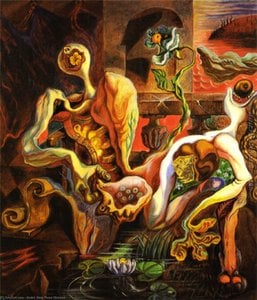
André Masson, 1896 – 1987

Obrazy: 100 najsłynniejszych dzieł artysty André Masson, zestawienie

Najsłynniejszym obrazem André Masson jest Goethe or the metamorphosis of plants (1940). Wraz z Massacre (1932) i Children of the Islands (1926) tworzy to zestaw trzech dzieł, które zna każdy. Nasz katalog zawiera 273 dzieł autorstwa André Masson; poniższych 100 to te, na które świat patrzy najczęściej – każde z podaniem roku powstania, muzeum, w którym się znajduje, oraz uzasadnieniem jego znaczenia.

Ranking oparty na naszym wskaźniku popularności, który łączy liczbę wyszukiwań, wizyt oraz zamówień dla każdego dzieła. Aktualizacja: Październik 2026.

Portret André Masson
André Masson · 1896 – 1987
Urodzony · zmarł
1896 – 1987, Balagny-sur-Thérain
Nurt
Surrealizm
Dzieła w naszym katalogu
273
Najsłynniejsze
Goethe or the metamorphosis of plants (1940)
Najwięcej dzieł w
Tate Modern

10 najsłynniejszych obrazów artysty André Masson

Goethe or the metamorphosis of plants (1940) autorstwa André Masson
1

Goethe or the metamorphosis of plants

1940 · Oil On Canvas

The canvas titled Goethe or the metamorphosis of plants was brought into being by the hand of André Masson. In 1940, the artist captured a vision of organic change, translating the concept of botanical transformation into a visual language. This work exists now within the walls of The Israel Museum in Jerusalem, Israel.

Will-o'-the-Wisp (1942) autorstwa André Masson
7

Will-o'-the-Wisp

1942 · Black and White Photography · The Phillips Collection, Waszyngton

In "Will-o'-the-Wisp" by André Masson, a young girl in traditional folk attire occupies the center of a vertically oriented frame. She is a still point amidst a geometry of wood and light. The monochromatic palette strips the scene to essential shades of grey, black, and white. This lack of hue focuses the eye on the sharp lines of the window frames and the long, receding planks of the floorboards. The…

André Masson, obrazy od 11 do 100

Guitar and Profile (1924) autorstwa André Masson
#79

Guitar and Profile

1924 · Tate Modern

In the delicate interplay of shadow and line found within André Masson’s 1924 work, Guitar and Profile, we encounter a profound moment of artistic metamorphosis. This exquisite pencil…

Portrait of Curt Valentin (1946) autorstwa André Masson
#80

Portrait of Curt Valentin

1946

Portrait of Curt Valentin: An Exploration of Expressionist Intensity Subject: This artwork presents a striking black and white portrait of Curt Valentin, a figure known for his influential…

Leda (1947) autorstwa André Masson
#82

Leda

1947

A Descent into Myth: Exploring Masson's "Leda" André Masson’s 1947 work, “Leda,” is far more than a depiction of a classical myth; it's an intensely personal and psychologically…

Childbirth (1955) autorstwa André Masson
#83

Childbirth

1955 · Tate Modern

The artwork is a black and white lithograph on paper depicting a woman in the process of giving birth. The woman is shown lying horizontally and appears to…

Owięziony lustrem: Przemiany śmierci (1939) autorstwa André Masson
#84

Owięziony lustrem: Przemiany śmierci

1939 · MoMA - Museum of Modern Art

André Masson: Prisoner of the Mirror – A Surrealist Descent into Inner Landscape André Masson’s “Prisoner of the Mirror: Transfiguring Your Death,” created in 1939, stands as a…

Obrazy André Masson według okresów

Tematy, które najczęściej malował André Masson

Cztery tematy najczęściej powracające w tych arcydziełach, wraz z najdoskonalszym przykładem każdego z nich.

Gdzie można zobaczyć obrazy André Masson

6 muzeów, w których znajduje się najwięcej obrazów z tej strony.

Muzeum Miasto Dzieła artysty André Masson Obrazy z tej listy
Tate Modern, LondynTate Modern Londyn 4 Guitar and Profile, Childbirth
MoMA - Museum of Modern Art, Nowy JorkMoMA - Museum of Modern Art Nowy Jork 5 Owięziony lustrem: Przemiany śmierci
Muzeum Izraela, JerozolimaMuzeum Izraela Jerozolima 2 Triangle Ruler (L'equerre)
The Phillips Collection, WaszyngtonThe Phillips Collection Waszyngton 1 Will-o'-the-Wisp
Art Institute of Chicago, ChicagoArt Institute of Chicago Chicago 1 The Figure
Statens Museum for Kunst, KopenhagaStatens Museum for Kunst Kopenhaga 1 Automatic drawing 03

Najsłynniejsze obrazy André Masson z każdej dekady

  1. 1910s
  2. 1920s
  3. 1930s
    Massacre (1932) autorstwa André Masson
    Miejsce 2 / 100

    Massacre

    Wiek 34 – 43
  4. 1940s
    Goethe or the metamorphosis of plants (1940) autorstwa André Masson
    1 z 100

    Goethe or the metamorphosis of plants

    Wiek 44 – 53

    The canvas titled Goethe or the metamorphosis of plants was brought into being by the hand of André Masson. In 1940, the artist captured a vision of organic…

  5. 1950s
  6. 1960s
  7. 1970s
    The maid (1973) autorstwa André Masson
    Miejsce 66 / 100

    The maid

    Wiek 74 – 83

Pytania o obrazy André Masson

Jakie jest najsłynniejsze dzieło André Masson?Pokaż odpowiedź

Goethe or the metamorphosis of plants (1940). Następnie Massacre (1932) i Children of the Islands (1926).

Ile lat miał André Masson, gdy namalowano Goethe or the metamorphosis of plants?Pokaż odpowiedź

44 lat: Goethe or the metamorphosis of plants pochodzi z 1940, a André Masson urodził(a) się w 1896.

Jakie są 10 najlepszych obrazów autorstwa André Masson?Pokaż odpowiedź

Goethe or the metamorphosis of plants, Massacre, Children of the Islands, Portrait of Emily Brontë, Portrait of the poet Kleist, Meditation on an Oak Leaf, Will-o'-the-Wisp, Landscape with Rocks, The horses of Diomedes i Seeded Earth. Powyższy ranking zawiera rok oraz muzeum dla każdego z nich.

Ile obrazów stworzył/a André Masson?Pokaż odpowiedź

Nasz katalog obejmuje 273 dzieł autorstwa André Masson, datowanych od 1919 do 1975.

Gdzie znajdują się najsłynniejsze obrazy André Masson?Pokaż odpowiedź

Większość z nich znajduje się w Tate Modern (Londyn), MoMA - Museum of Modern Art (Nowy Jork) i Muzeum Izraela (Jerozolima). Powyższa tabela zawiera listę muzeów po kolei.

Kiedy André Masson namalował swoje najsłynniejsze dzieła?Pokaż odpowiedź

W okresie 1920s: 36 z 100 dzieł na tej stronie pochodzi z tego czasu, w tym Children of the Islands.

Jakie są najwcześniejsze i najpóźniejsze słynne obrazy André Masson?Pokaż odpowiedź

Najwcześniejszy na tej stronie to The Capuchin monastery in Ceret (1919), najpóźniejszy Fruits devastating (1975).

Co najczęściej malował André Masson?Pokaż odpowiedź

Portraits (10), Arts (10) i Violence (4), spośród 100 dzieł na tej stronie.

Do jakiego nurtu artystycznego należy André Masson?Pokaż odpowiedź

Surrealizm, co pokazują obrazy na tej stronie.

Które obrazy André Masson można zobaczyć w Tate Modern?Pokaż odpowiedź

Guitar and Profile i Childbirth to jedne z 2 dzieł na tej stronie znajdujących się w zbiorach Tate Modern, Londyn.

O André Masson

André Masson: A Life Dedicated to the Unconscious

André Masson, a name synonymous with Surrealism and groundbreaking artistic techniques, was born on January 4th, 1896, in Balagny-sur-Thérain, a small town just north of Paris. From his earliest years, he exhibited an intense connection to nature, spending much of his youth immersed in the landscapes surrounding his home – a formative experience that would profoundly influence his later work. His artistic journey began at the age of eleven when he enrolled at the Académie Royale des Beaux-Arts in Brussels, where he received a foundational training under Constant Montald, laying the groundwork for his future explorations of various styles and movements. Early works hinted at an interest in Cubism, demonstrating an immediate engagement with the radical innovations shaping the art world of the early 20th century.

The Surrealist Embrace: Automatic Drawing and Collaborative Visions

Masson’s life took a dramatic turn when he became deeply involved in the burgeoning Surrealist movement in the mid-1920s. He wholeheartedly embraced automatic drawing – a technique that prioritized spontaneity and intuition, rejecting conscious control in favor of allowing the subconscious to guide the hand. This process involved creating artwork without deliberate thought, trusting the unconscious mind to manifest itself on paper. This approach wasn’t practiced in isolation; Masson actively collaborated with other leading figures within the Surrealist circle, including Antonin Artaud, Michel Leiris, Joan Miró, Georges Bataille, Jean Dubuffet, and Georges Malkine. These collaborations fostered a vibrant artistic community, characterized by experimentation, shared ideas, and a relentless pursuit of new forms of expression. Masson’s work during this period frequently delved into unsettling themes – violence, eroticism, and the raw, visceral experience of metamorphosis – deliberately challenging conventional notions of beauty and representation.

Revolutionary Techniques: Sand and Glue on Canvas

Perhaps Masson's most distinctive contribution to the art world lies in his innovative technique of applying sand and glue directly onto canvas. This process involved throwing handfuls of dry sand and adhesive onto a prepared surface, creating an unpredictable and chaotic pattern. The resulting textured surface was then painted over with oil paints, transforming the random shapes into evocative landscapes and dynamic compositions. This method, born out of a desire to capture the fluidity and dynamism of the unconscious mind, resulted in paintings that possessed a unique energy and depth. Alongside automatic drawing, this technique became synonymous with Masson’s artistic identity, establishing him as a pioneer of unconventional materials and processes.

A Shift Towards Landscape: War, Exile, and Artistic Rebirth

By the late 1920s, Masson began to move away from the strict confines of Surrealism, developing a more structured style influenced by artists like André Derain. This shift is particularly evident in his landscape paintings, which showcased a newfound interest in capturing the beauty and power of nature. The Second World War brought immense upheaval to Masson’s life. His work was condemned as “degenerate” by the Nazi regime, forcing him to flee France with the assistance of Varian Fry. He found refuge in the United States, where his presence significantly impacted American Abstract Expressionists like Jackson Pollock, who were deeply influenced by his techniques and approach to spontaneous creation. After returning to France following the war, Masson settled in Aix-en-Provence, dedicating himself to landscape painting – a return to his roots, but now imbued with a new sense of maturity and perspective.

Legacy and Enduring Influence

André Masson’s legacy extends far beyond his own lifetime. His pioneering work in Surrealism, coupled with his revolutionary techniques, fundamentally altered the course of modern art. He demonstrated that art could be a direct expression of the unconscious mind, bypassing rational thought and embracing spontaneity. His influence can be seen across numerous artistic movements, from Cubism to Abstract Expressionism, solidifying his position as a pivotal figure in 20th-century art history. Masson’s exploration of subconscious imagery and innovative processes continues to inspire artists today, reminding us of the boundless potential of creative expression. He died on October 28th, 1987, leaving behind a body of work that remains both challenging and profoundly rewarding for those willing to delve into its depths.

Wszystkie 273 dzieła artysty André Masson →