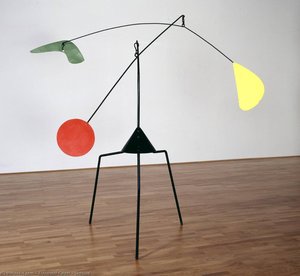
Alexander Calder, 1898 – 1976

Obrazy: 98 najsłynniejszych dzieł artysty Alexander Calder, zestawienie

Najsłynniejszym obrazem Alexander Calder jest Untitled, znajdujący się w Biennale Internazionale dell'Antiquariato di Firenze w Florencja. Wraz z Mobile (1932) i Romulus and Remus (1928) tworzy to zestaw trzech dzieł, które zna każdy. Nasz katalog zawiera 98 dzieł autorstwa Alexander Calder; poniższych 98 to te, na które świat patrzy najczęściej – każde z podaniem roku powstania, muzeum, w którym się znajduje, oraz uzasadnieniem jego znaczenia.

Ranking oparty na naszym wskaźniku popularności, który łączy liczbę wyszukiwań, wizyt oraz zamówień dla każdego dzieła. Aktualizacja: Październik 2026.

Portret Alexander Calder
Alexander Calder · 1898 – 1976
Urodzony · zmarł
1898 – 1976, Aberdeen
Nurt
Abstract expressionism
Dzieła w naszym katalogu
98
Najsłynniejsze
Untitled
Najwięcej dzieł w
Biennale Internazionale dell'Antiquariato di Firenze

10 najsłynniejszych obrazów artysty Alexander Calder

Romulus and Remus (1928) autorstwa Alexander Calder
3

Romulus and Remus

1928 · Solomon R. Guggenheim Museum, Nowy Jork

Alexander Milne Calder's "Romulus and Remus," crafted in 1928, isn’t merely a sculpture; it’s a distilled essence of myth rendered in delicate wire. This piece, a testament to the artist’s pioneering approach to three-dimensional form, transcends its subject matter – the legendary founders of Rome – to become a profound meditation on beginnings, brotherhood, and the very act of creation itself. Calder, deeply influenced by Constructivism and early Modernism, sought…

Red Lily Pads (Nénuphars rouges) (1956) autorstwa Alexander Calder
5

Red Lily Pads (Nénuphars rouges)

1956 · Acrylic · Solomon R. Guggenheim Museum, Nowy Jork

Alexander Milne Calder's "Red Lily Pads (Nénuphars rouges)" isn’t merely a depiction of a serene pond; it’s an invitation to lose oneself in the delicate balance of form, color, and movement. Created in 1956, this captivating sculpture – captured through a masterful photograph – embodies Calder's signature approach: embracing chance and celebrating the ephemeral beauty of nature within a distinctly modern aesthetic. The piece resides within a contemporary architectural space,…

Black Sun (1953) autorstwa Alexander Calder
9

Black Sun

1953 · Acrylic On Canvas · Tate Britain, Londyn

Alexander Milne Calder's "Black Sun," painted in 1953, isn’t merely a depiction of abstract forms; it’s an invitation to contemplate the interplay between chaos and order, darkness and light. Born in Aberdeen, Scotland, and later establishing himself as a pivotal figure in American sculpture alongside his son Alexander Stirling Calder and grandson Alexander ‘Sandy’ Calder, Milne Calder possessed a singular vision – one that sought to capture dynamic movement and…

Colored Spots (1970) autorstwa Alexander Calder
10

Colored Spots

1970 · Gouache

In Colored Spots, created in 1970, we encounter a moment of pure rhythmic energy. This gouache work moves away from the heavy permanence of sculpture to explore the lightness of color and shape. The composition is defined by a series of circles, varying in scale, that appear to drift across the surface. There is a specific tension in how these forms are placed; they do not sit static but seem…

Alexander Calder, obrazy od 11 do 98

Calder's Circus (1931) autorstwa Alexander Calder
#11

Calder's Circus

1931 · Whitney Museum of American Art

Alexander Milne Calder’s “Calder’s Circus,” created in 1931, is more than just a charming miniature scene; it’s a meticulously crafted meditation on movement, spectacle, and the enduring allure…

Czerwony Słońce (1968) autorstwa Alexander Calder
#12

Czerwony Słońce

1968 · Des Moines Art Center

Alexander Milne Calder’s “Red Sun” stands as a testament to the power of reductive art – a deceptively simple black and white linocut print that encapsulates the spirit…

Lobster Trap and Fish Tail (1939) autorstwa Alexander Calder
#13

Lobster Trap and Fish Tail

1939 · MoMA - Museum of Modern Art

Alexander Milne Calder's "Lobster Trap and Fish Tail," created in 1939, isn’t merely a depiction of marine life; it’s an embodiment of movement captured within a strikingly reductive…

Violin (1960) autorstwa Alexander Calder
#14

Violin

1960

In the evocative realm of mid-century graphic expression, Alexander Milne Calder’s "Violin" emerges as a mesmerizing dialogue between form and abstraction. Created in 1960, this striking screenprint transcends…

Untitled (1948) autorstwa Alexander Calder
#20

Untitled

1948 · The Phillips Collection
A R autorstwa Alexander Calder
#40

A R

The artwork titled "A R" is a metal piece featuring the letter A. Created by the sculptor Alexander Milne Calder, this work is crafted from a silver material.…

Untitled (1968) autorstwa Alexander Calder
#42

Untitled

1968 · Buffalo AKG Art Museum
Crosshatch autorstwa Alexander Calder
#55

Crosshatch

A Striking Encounter: "Crosshatch" by Alexander Milne Calder This captivating painting, currently residing within the esteemed Smithsonian American Art Museum, presents a unique and visually arresting depiction of…

Fish at Sunrise (1974) autorstwa Alexander Calder
#56

Fish at Sunrise

1974

The artwork 'Fish at Sunrise' by Alexander Milne Calder is a mesmerizing piece that showcases the artist's unique style and technique. Created in 1974, this gouache painting measures…

Nemo autorstwa Alexander Calder
#95

Nemo

Biennale Internazionale dell'Antiquariato di Firenze

Nemo by Alexander Calder presents an intricate arrangement of geometric forms. The composition is built upon a series of overlapping circles and squares. Large circles act as central…

Red, Yelloe and Blue Gongs autorstwa Alexander Calder
#96

Red, Yelloe and Blue Gongs

Ca' Pesaro - Międzynarodowa Galeria Sztuki Współczesnej

Red, Yellow and Blue Gongs – Alexander Milne Calder Alexander Milne Calder’s “Red, Yellow and Blue Gongs” stands as a testament to the sculptor's pioneering exploration of kinetic…

Tache Bleu autorstwa Alexander Calder
#97

Tache Bleu

The painting Tache Bleu is a remarkable work of art created by the talented artist Alexander Milne Calder. This stunning piece is a tapestry, measuring 103 x 152…

Red Mobile autorstwa Alexander Calder
#98

Red Mobile

Galleria Civica di Arte Moderna e Contemporanea Torino

Between the 1920s and ‘30s, Calder regularly made long study and work trips to Paris, where he began to participate in the Abstraction-Création group. Finally, in 1932, at…

Obrazy Alexander Calder według okresów

Tematy, które najczęściej malował Alexander Calder

Cztery tematy najczęściej powracające w tych arcydziełach, wraz z najdoskonalszym przykładem każdego z nich.

Gdzie można zobaczyć obrazy Alexander Calder

8 muzeów, w których znajduje się najwięcej obrazów z tej strony.

Muzeum Miasto Dzieła artysty Alexander Calder Obrazy z tej listy
Biennale Internazionale dell'Antiquariato di Firenze, FlorencjaBiennale Internazionale dell'Antiquariato di Firenze Florencja 2 Untitled, Nemo
Solomon R. Guggenheim Museum, Nowy JorkSolomon R. Guggenheim Museum Nowy Jork 2 Romulus and Remus, Red Lily Pads (Nénuphars rouges)
The Phillips Collection, WaszyngtonThe Phillips Collection Waszyngton 2 Untitled, Red Polygons
Tate Britain, LondynTate Britain Londyn 1 Black Sun
Whitney Museum of American Art, Nowy JorkWhitney Museum of American Art Nowy Jork 1 Calder's Circus
Des Moines Art Center, Des MoinesDes Moines Art Center Des Moines 1 Czerwony Słońce
MoMA - Museum of Modern Art, Nowy JorkMoMA - Museum of Modern Art Nowy Jork 1 Lobster Trap and Fish Tail
Metropolitan Museum of Art, Nowy JorkMetropolitan Museum of Art Nowy Jork 1 "Calder #1" Textile (Model No. 1-145)

Najsłynniejsze obrazy Alexander Calder z każdej dekady

  1. 1920s
    Romulus and Remus (1928) autorstwa Alexander Calder
    Miejsce 3 / 98

    Romulus and Remus

    Wiek 22 – 31 · Solomon R. Guggenheim Museum

    Alexander Milne Calder's "Romulus and Remus," crafted in 1928, isn’t merely a sculpture; it’s a distilled essence of myth rendered in delicate wire. This piece, a testament to…

  2. 1930s
    Mobile (1932) autorstwa Alexander Calder
    Nr 2 z 98

    Mobile

    Wiek 32 – 41
  3. 1940s
    Untitled (1948) autorstwa Alexander Calder
    Miejsce 20 / 98

    Untitled

    Wiek 42 – 51 · The Phillips Collection
  4. 1950s
    Red Lily Pads (Nénuphars rouges) (1956) autorstwa Alexander Calder
    Nr 5 z 98

    Red Lily Pads (Nénuphars rouges)

    Wiek 52 – 61 · Solomon R. Guggenheim Museum

    Alexander Milne Calder's "Red Lily Pads (Nénuphars rouges)" isn’t merely a depiction of a serene pond; it’s an invitation to lose oneself in the delicate balance of form,…

  5. 1960s
  6. 1970s
    Colored Spots (1970) autorstwa Alexander Calder
    Nr 10 z 98

    Colored Spots

    Wiek 72 – 78

    In Colored Spots, created in 1970, we encounter a moment of pure rhythmic energy. This gouache work moves away from the heavy permanence of sculpture to explore the…

Pytania o obrazy Alexander Calder

Jakie jest najsłynniejsze dzieło Alexander Calder?Pokaż odpowiedź

Untitled, Biennale Internazionale dell'Antiquariato di Firenze, Florencja. Następnie pojawiają się Mobile (1932) oraz Romulus and Remus (1928).

Jakie są 10 najlepszych obrazów autorstwa Alexander Calder?Pokaż odpowiedź

Untitled, Mobile, Romulus and Remus, Abstraction, Red Lily Pads (Nénuphars rouges), Orange and Black Composition, Puppet Man, Slanting Red Nose, Black Sun i Colored Spots. Powyższy ranking zawiera rok oraz muzeum dla każdego z nich.

Ile obrazów stworzył/a Alexander Calder?Pokaż odpowiedź

Nasz katalog obejmuje 98 dzieł autorstwa Alexander Calder, datowanych od 1928 do 1975.

Gdzie znajdują się najsłynniejsze obrazy Alexander Calder?Pokaż odpowiedź

Większość z nich znajduje się w Biennale Internazionale dell'Antiquariato di Firenze (Florencja), Solomon R. Guggenheim Museum (Nowy Jork) i The Phillips Collection (Waszyngton). Powyższa tabela zawiera listę muzeów po kolei.

Kiedy Alexander Calder namalował swoje najsłynniejsze dzieła?Pokaż odpowiedź

W okresie 1960s: 17 z 98 dzieł na tej stronie pochodzi z tego czasu, w tym Abstraction.

Jakie są najwcześniejsze i najpóźniejsze słynne obrazy Alexander Calder?Pokaż odpowiedź

Najwcześniejszy na tej stronie to Romulus and Remus (1928), najpóźniejszy Pyramids (1975).

Co najczęściej malował Alexander Calder?Pokaż odpowiedź

Sculpture (6), Geometric (5) i Geometric design (5), spośród 98 dzieł na tej stronie.

Jakiej techniki najczęściej używał/a Alexander Calder?Pokaż odpowiedź

Acrylic On Canvas: 4 z 98 dzieł na tej stronie.

Do jakiego nurtu artystycznego należy Alexander Calder?Pokaż odpowiedź

Abstract expressionism, co pokazują obrazy na tej stronie.

Które obrazy Alexander Calder można zobaczyć w Biennale Internazionale dell'Antiquariato di Firenze?Pokaż odpowiedź

Untitled i Nemo to jedne z 2 dzieł na tej stronie znajdujących się w zbiorach Biennale Internazionale dell'Antiquariato di Firenze, Florencja.

O Alexander Calder

Introduction to Alexander Milne Calder

Alexander Milne Calder (MILL-nee) was a Scottish American sculptor born in Aberdeen, Scotland, on August 23, 1846. He is best known for his architectural sculpture of Philadelphia City Hall and both his son, Alexander Stirling Calder, and grandson, Alexander ‘sandy’ Calder, became significant sculptors in the 20th century. His artistic journey began with a formative influence from his father, John Rhind, a sculptor who instilled in him an early appreciation for stone carving during his childhood years. Calder attended the Royal Academy in Edinburgh where he honed his skills and studied alongside fellow artists, shaping his understanding of classical sculpture traditions. He subsequently moved to London, immersing himself in the vibrant artistic milieu of Victorian England, and undertook commissions that showcased his versatility and technical prowess.

Early Life and Education

Calder’s upbringing was marked by a profound connection to art from a young age. His father, John Rhind, nurtured his talent for sculpting stone—a craft passed down through generations—providing him with invaluable experience in mastering the medium. Calder pursued formal artistic training at the Royal Academy of Edinburgh, immersing himself in the study of classical sculpture and gaining insights into influential artistic movements of the time. This early education laid the groundwork for his future endeavors as a sculptor and cemented his dedication to artistic excellence. He traveled extensively throughout Europe, absorbing diverse cultural influences that enriched his creative vision.

Career Highlights

Calder’s professional life unfolded with remarkable achievements, most notably his monumental contribution to Philadelphia City Hall. Recognizing the need for innovative sculptural designs, he embarked on a transformative project—a commission that demanded more than 250 pieces of marble and bronze over a span of two decades. This ambitious undertaking showcased Calder's unparalleled skill in crafting large-scale architectural sculptures and solidified his reputation as one of Scotland’s foremost sculptors. Furthermore, Calder captivated audiences with his creation of William Penn, a colossal bronze statue that served as the centerpiece of Philadelphia City Hall’s tower—a testament to his artistic ambition and technical mastery. His work extended beyond monumental sculpture; he produced numerous smaller pieces, exploring diverse materials and techniques while maintaining a consistent commitment to artistic innovation.

Notable Sculptures and Artistic Style

Calder's sculptural style is characterized by its exploration of kinetic art—the incorporation of movement into static sculptures. He pioneered the technique of “mobiles,” delicate structures composed of suspended metal rods and balanced weights that oscillate rhythmically with air currents, capturing the essence of chance and spontaneity. These mobiles exemplify Calder’s fascination with natural phenomena and his desire to translate organic rhythms into artistic form. His monumental sculptures, such as *Man Cub* and *Indian Figure*, stand as enduring symbols of sculptural artistry—reflecting Calder's profound understanding of form and balance. Calder’s distinctive approach to sculpture continues to inspire artists today, cementing his legacy as a visionary innovator who reshaped the landscape of modern art.

Legacy and Influence

Alexander Stirling Calder and Alexander ‘sandy’ Calder followed in their father’s footsteps, establishing themselves as prominent sculptors—carrying forward Calder's artistic vision and furthering his exploration of kinetic sculpture. Their contributions to the art world underscore the enduring impact of Calder’s pioneering spirit and demonstrate the transmission of artistic heritage across generations. Calder’s sculptures reside in museums worldwide—a testament to their universal appeal and lasting significance—inspiring artists and audiences alike with their beauty, innovation, and contemplation of movement and balance. His legacy continues to resonate within the art community—affirming Calder's position as a pivotal figure who transformed sculptural practice and captivated viewers with his groundbreaking aesthetic.

Wszystkie 98 dzieła artysty Alexander Calder →