Adolph Menzel, 1815 – 1905

Obrazy: 99 najsłynniejszych dzieł artysty Adolph Menzel, zestawienie

Najsłynniejszym obrazem Adolph Menzel jest A Flute Concert of Frederick the Great at Sanssouci (1852), znajdujący się w Nationalgalerie w Berlin. Wraz z Koncert na Fletę w Sanssouci (1848) i William I Departs for the Front, July 31, 1870 (1871) tworzy to zestaw trzech dzieł, które zna każdy. Nasz katalog zawiera 358 dzieł autorstwa Adolph Menzel; poniższych 99 to te, na które świat patrzy najczęściej – każde z podaniem roku powstania, muzeum, w którym się znajduje, oraz uzasadnieniem jego znaczenia.

Ranking oparty na naszym wskaźniku popularności, który łączy liczbę wyszukiwań, wizyt oraz zamówień dla każdego dzieła. Aktualizacja: Październik 2026. Każde arcydzieło na tej stronie można zamówić jako ręcznie malowaną reprodukcję olejną o jakości muzealnej lub jako wysokiej jakości wydruk artystyczny, w wybranym przez Ciebie rozmiarze.

Portret Adolph Menzel
Adolph Menzel · 1815 – 1905
Urodzony · zmarł
1815 – 1905, Wrocław
Nurt
Romantic realism
Dzieła w naszym katalogu
358
Najsłynniejsze
A Flute Concert of Frederick the Great at Sanssouci (1852)
Najwięcej dzieł w
Hamburger Kunsthalle

10 najsłynniejszych obrazów artysty Adolph Menzel

A Flute Concert of Frederick the Great at Sanssouci (1852) autorstwa Adolph Menzel
1

A Flute Concert of Frederick the Great at Sanssouci

1852 · Oil On Canvas · Nationalgalerie, Berlin

Adolph von Menzel's "A Flute Concert of Frederick the Great at Sanssouci," painted in 1852, isn’t merely a historical depiction; it’s a meticulously crafted portal into the opulent heart of 18th-century Prussian society. More than just a portrait of a royal gathering, this oil painting is a vibrant tableau vivant—a snapshot of an evening filled with music, conversation, and carefully orchestrated power. Menzel, a master of realism who sought to…

Koncert na Fletę w Sanssouci (1848) autorstwa Adolph Menzel
2

Koncert na Fletę w Sanssouci

1848 · Obraz olejny na płótnie

Zanurz się w atmosferze kulturowej wyrafinowania i towarzyskiej radości, uchwyconych w tym fascynującym szkicu. "Koncert na Fagot w Sanssouci" to dzieło Adolpha von Menzela z 1848 roku, które przedstawia intymny, a zarazem żywy moment rozgrywający się w przestronnej sali dworskiej – prawdopodobnie podczas muzycznego spotkania lub uroczystości w historycznym pałacu. Szkic emanuje szlachecką elegancją i dynamizmem, zapraszając do podróży w czasie do epoki pełnej splendoru i towarzyskich spotkań. Centralnym punktem…

William I Departs for the Front, July 31, 1870 (1871) autorstwa Adolph Menzel
3

William I Departs for the Front, July 31, 1870

1871 · Acrylic On Canvas · Alte Nationalgalerie, Berlin

Adolph von Menzel’s “The Flying Man,” completed in 1871, stands as an emblem of German Realism—a movement dedicated to portraying the world with unflinching accuracy and capturing the psychological complexities inherent within ordinary existence. More than just a depiction of a fantastical event, it's a meditation on human ambition, vulnerability, and the enduring fascination with defying gravity.

Knife-grinder's Workshop in the Hofgastein Smithy (1881) autorstwa Adolph Menzel
4

Knife-grinder's Workshop in the Hofgastein Smithy

1881 · Oil On Canvas · Hamburger Kunsthalle, Hamburg

In the heart of the Austrian Alps, within the soot-stained walls of the Hofgastein smithy, Adolph von Menzel captured a moment that transcends mere documentation to become a profound meditation on human industry. Knife-grinder's Workshop in the Hofgastein Smithy, completed in 1881, is far more than a depiction of manual labor; it is an immersive window into the soul of German Realism. As one gazes upon this monumental oil on…

Living Room with the Artist's Sister (1847) autorstwa Adolph Menzel
5

Living Room with the Artist's Sister

1847 · Oil On Canvas · Neue Pinakothek, Monachium

A Window into Domesticity: Adolph von Menzel’s “Living Room with the Artist’s Sister” Adolph von Menzel's "Living Room with the Artist’s Sister," painted in 1847, isn’t merely a depiction of a domestic scene; it’s a meticulously observed study of quietude, familial connection, and the subtle complexities of Prussian life. The painting immediately draws the eye to Emilie Menzel, the artist's sister, positioned within a modestly furnished room – a space…

Studio Wall (1872) autorstwa Adolph Menzel
6

Studio Wall

1872 · Oil On Canvas · Hamburger Kunsthalle, Hamburg

In the quiet, shadowed corners of art history, few works possess the haunting intimacy of Adolph von Menzel’s “Studio Wall.” Completed in 1872, this masterpiece of German Realism transcends the boundaries of a mere studio interior, inviting the viewer into a profound, nocturnal meditation on existence itself. At first glance, one might see only a cluttered workspace, yet as the eyes adjust to the dramatic interplay of light and shadow,…

Corner of a House in the Moonlight (1863) autorstwa Adolph Menzel
7

Corner of a House in the Moonlight

1863 · Oil On Canvas

The oil painting titled Corner of a House in the Moonlight was executed by the artist Adolph von Menzel. This specific work dates to 1863. The composition focuses on urban architecture under nocturnal conditions, capturing a scene of buildings and illuminated windows.

Supper at the Ball (1878) autorstwa Adolph Menzel
8

Supper at the Ball

1878 · Oil On Canvas · Alte Nationalgalerie, Berlin

Step into the luminous embrace of Adolph von Menzel’s Supper at the Ball, an extraordinary window into the opulent heart of 1878 high society. This masterpiece serves as a breathtaking visual chronicle, capturing a moment of profound elegance and social ritual. As your eyes wander through the crowded ballroom, you are immediately swept up in a whirlwind of movement and light. The scene is a dense tapestry of human interaction,…

Crown Prince Frederick Pays a Visit to the Painter Pesne on his Scaffold at Rheinsberg (1861) autorstwa Adolph Menzel
9

Crown Prince Frederick Pays a Visit to the Painter Pesne on his Scaffold at Rheinsberg

1861 · Oil On Canvas · Alte Nationalgalerie, Berlin

The painting Crown Prince Frederick Pays a Visit to the Painter Pesne on his Scaffold at Rheinsberg by Adolph Von Menzel is a masterpiece of 19th-century German art. Created in 1861, this oil on canvas painting measures and is a testament to Menzel's skill as a realist painter. The Artist and His Style Adolph Von Menzel was a renowned German artist known for his detailed and realistic paintings. He was…

The Studio Wall (1872) autorstwa Adolph Menzel
10

The Studio Wall

1872 · Oil On Canvas · Hamburger Kunsthalle, Hamburg

Adolph von Menzel's "The Studio Wall," painted in 1872, isn’t merely a depiction of a cluttered artist’s workspace; it’s a profoundly layered meditation on mortality, memory, and the very nature of artistic creation. At first glance, it presents a seemingly simple scene: a red-walled studio bathed in the soft glow of lamplight, populated by an array of plaster casts – busts, torsos, even a dog – arranged with meticulous care.…

Adolph Menzel, obrazy od 11 do 99

German Treppenflur bei Nachtbeleuchtung (1848) autorstwa Adolph Menzel
#12

German Treppenflur bei Nachtbeleuchtung

1848 · Museum Folkwang

A Window Into Victorian Wrocław: Menzel’s “German Treppenflur bei Nachtbeleuchtung” The painting "German Treppenflur bei Nachtbeleuchtung" ("German Staircase Hall at Night Illumination") by Adolph von Menzel stands as…

Zabierz ją do domu →
Recollection of Paris (1855) autorstwa Adolph Menzel
#13

Recollection of Paris

1855 · Hamburger Kunsthalle

Adolph von Menzel's “Recollection of Paris,” completed in 1855, isn’t merely a drawing; it’s a meticulously crafted snapshot of Parisian life—a testament to the artist’s unwavering dedication to…

Zamów ręcznie malowaną kopię →
Ball Pause (1870) autorstwa Adolph Menzel
#14

Ball Pause

1870 · Bawarskie Państwowe Zbiory Malarstwa

In 1870, Adolph von Menzel captures a fleeting moment of social suspension within the oil painting Ball Pause. The scene unfolds inside a crowded, opulent ballroom, a space…

Zamów reprodukcję →
Folk theatre in Tyrol (1859) autorstwa Adolph Menzel
#15

Folk theatre in Tyrol

1859 · Hamburger Kunsthalle

This evocative oil painting, titled Folk theatre in Tyrol, transports the viewer into the heart of a deeply rooted cultural moment. One can almost feel the press of…

Zamów reprodukcję →
Study of a man's head (1855) autorstwa Adolph Menzel
#23

Study of a man's head

1855 · Staatliche Kunsthalle Karlsruhe

Study of a man's head by Adolph von Menzel is a close-up bust-length portrait of an elderly man. The subject is positioned slightly off-center within the frame, looking…

Zamów reprodukcję →
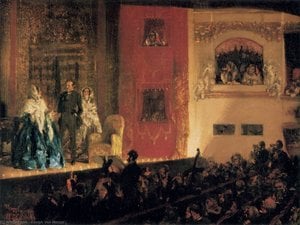
Théatre du Gymnase (1856) autorstwa Adolph Menzel
#53

Théatre du Gymnase

1856 · Nationalgalerie

In the heart of 1856, amidst the vibrant energy of the World’s Fair, Adolph von Menzel captured a moment that transcends mere theatrical documentation. His masterpiece, Théâtre du…

Zabierz ją do domu →
Japoński Artysta Przez Pracę (1886) autorstwa Adolph Menzel
#57

Japoński Artysta Przez Pracę

1886 · National Gallery of Art

Obraz “Japoński Artysta Praca” Adolfa von Menzela, namalowany w 1886 roku, to więcej niż tylko reprodukcja sceny z pracowni. To głębokie studium ludzkiej pasji, koncentracji i relacji między…

Zabierz ją do domu →
Night in the Forest (1851) autorstwa Adolph Menzel
#67

Night in the Forest

1851 · Kunsthaus Zürich

To gaze upon this depiction of "Night in the Forest" is to step across a threshold into a realm suspended between waking reality and deep mystery. The monochrome…

Zabierz ją do domu →
Outing in a Dinghy (1892) autorstwa Adolph Menzel
#74

Outing in a Dinghy

1892 · Hamburger Kunsthalle

Adolph von Menzel’s Outing in a Dinghy transports the viewer to a moment suspended in time—a perfect tableau of leisure and quiet companionship. The scene unfolds upon a…

Zabierz ją do domu →
Deutsch Ballsouper, Detail (1878) autorstwa Adolph Menzel
#78

Deutsch Ballsouper, Detail

1878

Adolph von Menzel’s Deutsch Ballsouper, Detail transports us directly into the vibrant heart of 19th-century social life. This is not merely a collection of figures gathered in a…

Zamów reprodukcję →
Recollection of the Luxembourg Gardens (1872) autorstwa Adolph Menzel
#81

Recollection of the Luxembourg Gardens

1872 · Państwowe Muzeum Sztuki Dawnej im. A.S. Puškina

Adolph von Menzel's "Recollection of the Luxembourg Gardens," painted in 1872, is more than just a depiction of a park scene; it’s a window into Victorian-era Parisian society…

Zamów reprodukcję →
German Atelierwand (1872) autorstwa Adolph Menzel
#84

German Atelierwand

1872 · Hamburger Kunsthalle

Adolph von Menzel's "German Atelierwand" (1872) isn’t merely a painting; it’s an immersive experience, a visual plunge into the depths of human consciousness. Immediately arresting, the work confronts…

Zamów ręcznie malowaną kopię →
On the Kreuzberg, near Berlin (1847) autorstwa Adolph Menzel
#97

On the Kreuzberg, near Berlin

1847 · Stiftung Stadtmuseum

Adolph von Menzel’s “On the Kreuzberg, near Berlin,” painted in 1847, isn't merely a landscape; it’s a meticulously crafted snapshot of rural life in mid-19th century Germany –…

Zabierz ją do domu →

Obrazy Adolph Menzel według okresów

Tematy, które najczęściej malował Adolph Menzel

Cztery tematy najczęściej powracające w tych arcydziełach, wraz z najdoskonalszym przykładem każdego z nich.

Gdzie można zobaczyć obrazy Adolph Menzel

8 muzeów, w których znajduje się najwięcej obrazów z tej strony.

Muzeum Miasto Dzieła artysty Adolph Menzel Obrazy z tej listy
Hamburger Kunsthalle, HamburgHamburger Kunsthalle Hamburg 10 Knife-grinder's Workshop in the Hofgastein Smithy, Studio Wall, The Studio Wall
Alte Nationalgalerie, BerlinAlte Nationalgalerie Berlin 31 William I Departs for the Front, July 31, 1870, Supper at the Ball, Crown Prince Frederick Pays a Visit to the Painter Pesne on his Scaffold at Rheinsberg
Nationalgalerie, BerlinNationalgalerie Berlin 6 A Flute Concert of Frederick the Great at Sanssouci, The Allegiance of the Silesian Diet before Frederick II in Breslau, Théatre du Gymnase
Museum Georg Schäfer, SchweinfurtMuseum Georg Schäfer Schweinfurt 7 German Emilie Menzel am Klavier stehend, German Husaren bringen eine polnische Familie auf, Beati Possidentes (Blessed are those who have)
Neue Pinakothek, MonachiumNeue Pinakothek Monachium 5 Living Room with the Artist's Sister, Deutsch Blücher und Wellington bei Belle Alliance, Living Room with the Artist's Sister
Bawarskie Państwowe Zbiory Malarstwa, MonachiumBawarskie Państwowe Zbiory Malarstwa Monachium 6 Ball Pause, Study of a head of an old Jew
Staatliche Kunsthalle Karlsruhe, KarlsruheStaatliche Kunsthalle Karlsruhe Karlsruhe 4 Study of a man's head, The Interruption (also known as The Visit)
Museum Folkwang, EssenMuseum Folkwang Essen 2 German Treppenflur bei Nachtbeleuchtung

Najsłynniejsze obrazy Adolph Menzel z każdej dekady

  1. 1820s
  2. 1830s
  3. 1840s
    Koncert na Fletę w Sanssouci (1848) autorstwa Adolph Menzel
    Miejsce 2 / 99

    Koncert na Fletę w Sanssouci

    Wiek 25 – 34

    Zanurz się w atmosferze kulturowej wyrafinowania i towarzyskiej radości, uchwyconych w tym fascynującym szkicu. "Koncert na Fagot w Sanssouci" to dzieło Adolpha von Menzela z 1848 roku, które…

  4. 1850s
    A Flute Concert of Frederick the Great at Sanssouci (1852) autorstwa Adolph Menzel
    Miejsce 1 / 99

    A Flute Concert of Frederick the Great at Sanssouci

    Wiek 35 – 44 · Nationalgalerie

    Adolph von Menzel's "A Flute Concert of Frederick the Great at Sanssouci," painted in 1852, isn’t merely a historical depiction; it’s a meticulously crafted portal into the opulent…

  5. 1860s
    Corner of a House in the Moonlight (1863) autorstwa Adolph Menzel
    7 z 99

    Corner of a House in the Moonlight

    Wiek 45 – 54

    The oil painting titled Corner of a House in the Moonlight was executed by the artist Adolph von Menzel. This specific work dates to 1863. The composition focuses…

  6. 1870s
    William I Departs for the Front, July 31, 1870 (1871) autorstwa Adolph Menzel
    Nr 3 z 99

    William I Departs for the Front, July 31, 1870

    Wiek 55 – 64 · Alte Nationalgalerie

    Adolph von Menzel’s “The Flying Man,” completed in 1871, stands as an emblem of German Realism—a movement dedicated to portraying the world with unflinching accuracy and capturing the…

  7. 1880s
    Knife-grinder's Workshop in the Hofgastein Smithy (1881) autorstwa Adolph Menzel
    4 z 99

    Knife-grinder's Workshop in the Hofgastein Smithy

    Wiek 65 – 74 · Hamburger Kunsthalle

    In the heart of the Austrian Alps, within the soot-stained walls of the Hofgastein smithy, Adolph von Menzel captured a moment that transcends mere documentation to become a…

  8. 1890s
  9. 1900s

Pytania o obrazy Adolph Menzel

Jakie jest najsłynniejsze dzieło Adolph Menzel?Pokaż odpowiedź

A Flute Concert of Frederick the Great at Sanssouci (1852), Nationalgalerie, Berlin. Następnie pojawiają się Koncert na Fletę w Sanssouci (1848) oraz William I Departs for the Front, July 31, 1870 (1871).

Ile lat miał Adolph Menzel, gdy namalowano A Flute Concert of Frederick the Great at Sanssouci?Pokaż odpowiedź

37 lat: A Flute Concert of Frederick the Great at Sanssouci pochodzi z 1852, a Adolph Menzel urodził(a) się w 1815.

Jakie są 10 najlepszych obrazów autorstwa Adolph Menzel?Pokaż odpowiedź

A Flute Concert of Frederick the Great at Sanssouci, Koncert na Fletę w Sanssouci, William I Departs for the Front, July 31, 1870, Knife-grinder's Workshop in the Hofgastein Smithy, Living Room with the Artist's Sister, Studio Wall, Corner of a House in the Moonlight, Supper at the Ball, Crown Prince Frederick Pays a Visit to the Painter Pesne on his Scaffold at Rheinsberg i The Studio Wall. Powyższy ranking zawiera rok oraz muzeum dla każdego z nich.

Ile obrazów stworzył/a Adolph Menzel?Pokaż odpowiedź

Nasz katalog obejmuje 358 dzieł autorstwa Adolph Menzel, datowanych od 1829 do 1901.

Gdzie znajdują się najsłynniejsze obrazy Adolph Menzel?Pokaż odpowiedź

Większość z nich znajduje się w Hamburger Kunsthalle (Hamburg), Alte Nationalgalerie (Berlin) i Nationalgalerie (Berlin). Powyższa tabela zawiera listę muzeów po kolei.

Kiedy Adolph Menzel namalował swoje najsłynniejsze dzieła?Pokaż odpowiedź

W okresie 1850s: 27 z 99 dzieł na tej stronie pochodzi z tego czasu, w tym A Flute Concert of Frederick the Great at Sanssouci.

Jakie są najwcześniejsze i najpóźniejsze słynne obrazy Adolph Menzel?Pokaż odpowiedź

Najwcześniejszy na tej stronie to Commander With Soldiers (1829), najpóźniejszy A Mustachioed gentleman in profile (Three Studies) (1901).

Co najczęściej malował Adolph Menzel?Pokaż odpowiedź

19th century (11), Portrait (11) i People (10), spośród 99 dzieł na tej stronie.

Jakiej techniki najczęściej używał/a Adolph Menzel?Pokaż odpowiedź

Oil On Canvas: 41 z 99 dzieł na tej stronie.

Do jakiego nurtu artystycznego należy Adolph Menzel?Pokaż odpowiedź

Romantic realism, co pokazują obrazy na tej stronie.

Które obrazy Adolph Menzel można zobaczyć w Hamburger Kunsthalle?Pokaż odpowiedź

Knife-grinder's Workshop in the Hofgastein Smithy, Studio Wall i The Studio Wall to jedne z 8 dzieł na tej stronie znajdujących się w zbiorach Hamburger Kunsthalle, Hamburg.

Czy mogę kupić reprodukcję obrazu Adolph Menzel?Pokaż odpowiedź

Tak. Każdy obraz na tej stronie można zamówić jako ręcznie malowaną reprodukcję olejną o jakości muzealnej lub jako wysokiej jakości wydruk artystyczny w wybranym przez Ciebie rozmiarze, bezpośrednio ze strony danego dzieła.

O Adolph Menzel

A Life Etched in Realism: The World of Adolph von Menzel

Adolph Friedrich Erdmann von Menzel, a name synonymous with German Realism, was more than just a painter; he was a visual chronicler of 19th-century life. Born on December 8, 1815, in Breslau (now Wrocław, Poland), his journey began not amidst the hallowed halls of artistic academies, but within the practical world of his father’s lithographic workshop. This early immersion in reproduction and detail would profoundly shape his aesthetic sensibilities. Though initially intended for a professorial path by his father, young Adolph's passion for art proved undeniable, leading to brief studies at the Berlin Academy of Art in 1833 before embracing a largely self-taught approach. He quickly distinguished himself through meticulous draftsmanship and an uncanny ability to capture the essence of everyday scenes, initially through lithography, but soon expanding into painting and etching—media he would master with unparalleled skill. Menzel’s life was one dedicated to observation, to translating the world around him onto canvas and paper with a precision that bordered on photographic realism, yet always imbued with a subtle emotional depth.

Early Years and Artistic Beginnings

Menzel's early years were marked by a unique blend of practicality and artistic inclination. His father, a skilled lithographer, established a successful workshop in Breslau, providing Adolph with invaluable experience in the techniques of reproduction and printmaking. This hands-on training instilled in him a deep appreciation for detail and precision—qualities that would become hallmarks of his later work. Despite his father’s initial aspirations for him to pursue a career in academia, young Adolph's passion for art quickly overshadowed all other considerations. He enrolled briefly at the Berlin Academy of Art in 1833, but found the formal training restrictive and ultimately opted for a largely self-taught path. This decision allowed him to develop his own unique style, characterized by its meticulous draftsmanship and unflinching realism. His early works primarily focused on lithography, producing stunningly detailed reproductions of historical events and contemporary scenes. These prints demonstrated an exceptional command of technique and a keen eye for observation—qualities that would serve as the foundation for his later paintings.

Historical Grandeur and Patriotic Imagery

Menzel’s career gained significant momentum through his illustrations for historical works, particularly those depicting the reign of Frederick the Great. Commissioned to create large-scale compositions for historical narratives, he meticulously researched each scene, striving for an unparalleled level of accuracy and detail. These paintings resonated deeply with a burgeoning national pride in Prussia during a period of significant political and social change. The dramatic lighting, dynamic composition, and carefully rendered costumes conveyed a sense of grandeur and power—elements that appealed to the public’s desire for patriotic imagery. Works like *The Battle of Jena-Auerstedt* exemplify this early success, capturing the intensity and chaos of battle with remarkable realism. However, Menzel's artistic vision extended beyond mere historical recreation; he sought to imbue his paintings with a sense of drama and emotion, creating works that were both visually stunning and intellectually stimulating.

Shifting Focus: Genre Scenes and Modern Life

As the 19th century progressed, Menzel’s artistic focus began to shift away from grand historical narratives towards more intimate and contemporary subjects. He increasingly turned his attention to genre scenes—depictions of everyday life in Berlin—and studies of modern industrial labor. This transition marked a significant departure from the conventions of academic painting and signaled Menzel's commitment to capturing the realities of the modern world. His masterpiece, *The Iron Rolling Mill*, completed between 1872 and 1875, stands as a testament to this shift in focus. The monumental canvas depicts the grueling labor of ironworkers, capturing their physical strength, exhaustion, and camaraderie with unflinching honesty. This work was not romanticized; it was raw, visceral, and profoundly modern in its approach—a stark contrast to the idealized depictions of industry prevalent at the time. Alongside *The Iron Rolling Mill*, Menzel produced a wealth of other genre paintings that offered insightful glimpses into the lives of ordinary Berliners.

Influences and Artistic Style

Menzel’s artistic style was shaped by a complex interplay of influences. While largely self-taught, he deeply admired the Dutch Masters—artists like Rembrandt and Vermeer—for their mastery of light and shadow, their ability to capture the essence of human emotion, and their commitment to realism. He also drew inspiration from the works of other German artists, including Caspar David Friedrich, though Menzel’s approach differed in its emphasis on observation and detail. His meticulous draftsmanship is evident in every work, characterized by a remarkable level of precision and attention to detail. Furthermore, his skill with etching—a medium he mastered throughout his career—allowed him to create incredibly detailed drawings that served as studies for his paintings. Menzel’s artistic development was not linear; he continually experimented with technique and subject matter, adapting his style to suit the demands of each project.

Legacy and Historical Significance

Adolph von Menzel's impact on German art is undeniable. He bridged the gap between traditional historical painting and modern realism, paving the way for future generations of artists to explore new subjects and techniques. His posthumous reputation rests not only on his paintings but also on his extensive graphic work—drawings and etchings that reveal a remarkable sensitivity and observational skill. He was knighted by Kaiser Wilhelm II in 1898, becoming Adolph von Menzel, a recognition of his immense contribution to the cultural landscape of Germany. His works are now celebrated in museums across the country, including the Museum Georg Schäfer and the Städtische Galerie im Lenbachhaus. Menzel’s art serves as a powerful reminder of the beauty and complexity inherent in everyday life, and his dedication to capturing reality with honesty and precision ensures his enduring place as one of the most important German artists of the 19th century. His legacy continues to inspire artists and viewers alike, offering insights into a pivotal period of social and industrial transformation.

Wszystkie 358 dzieła artysty Adolph Menzel →