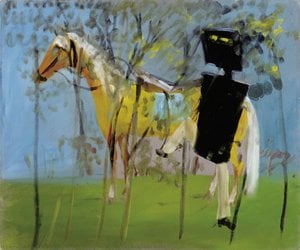
A Life Painted in Myth and Landscape
Sir Sidney Robert Nolan, born in Melbourne in 1917, stands as a monumental figure in 20th-century Australian art. His journey was not one of conventional artistic training but rather an explosive emergence from the working-class streets of St Kilda into a world of vibrant imagination and relentless experimentation. Nolan wasn’t simply a painter; he was a visual storyteller, a mythmaker who wrestled with Australia's history, its landscapes, and its very identity. From his early days as a runner for an illegal betting ring to his eventual acclaim on the international stage, Nolan’s life was marked by a restless energy and a refusal to be confined by artistic norms. He absorbed influences from diverse sources – the poetry of Rimbaud, the spatial innovations of Cézanne, the raw emotion of Danila Vassilieff – yet forged a style uniquely his own, one that resonated with a distinctly Australian sensibility. His early exposure to the harsh realities of Melbourne life and the allure of its underbelly would profoundly shape his artistic vision, imbuing his work with a sense of both defiance and vulnerability.The Shaping of an Iconoclast
Nolan’s formative years were steeped in intellectual ferment. The Heide Circle, centered around patrons John and Sunday Reed, proved pivotal. This haven for artists and writers fostered a spirit of radical experimentation and provided Nolan with crucial support during his developing phase. It was at Heide that he encountered kindred spirits – Albert Tucker, Joy Hester, Arthur Boyd – all grappling with the challenge of creating a distinctly Australian modernism. The influence of modernist literature, particularly the Symbolist poets, cannot be overstated. Rimbaud’s call for a “systematic derangement of the senses” became a guiding principle for Nolan, liberating him from representational constraints and encouraging him to explore the emotional power of color, form, and symbolism. His early works demonstrate this influence, often featuring fragmented figures and dreamlike landscapes that hint at deeper psychological truths. He wasn’t interested in merely depicting reality; he sought to capture its essence, its underlying emotions, and its hidden narratives. This period also saw Nolan experimenting with various media, from stage design for the Ballet Russes to commercial art, each experience contributing to his growing technical prowess and artistic vocabulary.Early Influences and Artistic Development
Nolan’s artistic education began informally, fueled by a voracious appetite for literature and visual arts. He devoured books on Pablo Picasso, Paul Klee, Henri Matisse and the surrealists—artists who championed spontaneity and intuition as antidotes to rationalism. Particularly compelling was Klee's approach, which deliberately undermined accepted boundaries of art through experimentation and a range of techniques, media and juxtaposition of subject matter. Klee’s belief that art should be childlike – embracing simplicity and uninhibited emotion – resonated deeply with Nolan’s artistic sensibilities. He recognized the importance of rejecting academic conventions and pursuing personal vision—a conviction that would permeate his entire oeuvre. His early paintings reflect these influences, characterized by bold colors, simplified forms, and a deliberate disregard for photographic realism. This initial stylistic exploration laid the groundwork for his later mastery of monumental canvases and iconic imagery.The Kelly Cycle: Mythmaking as Art
Nolan’s most celebrated achievement is undoubtedly *The Kelly Cycle*, a series of 26 paintings depicting the exploits of Ned Kelly, Australia's legendary bushranger. This project represents Nolan’s culmination of his lifelong fascination with Australian mythology and history—a quest to transform legend into art. He approached the subject matter not as a historian recounting events but as a poet crafting an epic poem. The resulting canvases are striking in their scale, color palette, and compositional daring—each painting imbued with a palpable sense of drama and psychological depth. Nolan’s use of black armor as a dominant visual motif symbolizes defiance and impenetrability—a deliberate rejection of conventional heroic representations. He sought to capture the spirit of Kelly not merely as an outlaw but as a complex human being grappling with moral dilemmas and confronting the forces of law and order. The Kelly Cycle cemented Nolan's reputation as one of Australia’s foremost artists, establishing him as a visionary who redefined the boundaries of artistic expression.Legacy and Enduring Influence
Sir Sidney Robert Nolan’s contribution to Australian art is profound and enduring. He challenged artistic conventions, embraced experimentation, and created a body of work that continues to inspire artists today. His bold depictions of Ned Kelly have become iconic images—symbols of Australia's rebellious spirit and its ambivalent relationship with its past. Beyond his monumental canvases, Nolan’s influence extends across various mediums—from sculpture to ceramics to stage design—demonstrating his versatility as an artist and his unwavering commitment to exploring the complexities of human experience. His paintings are held in major museums worldwide, ensuring that his vision will continue to captivate audiences for generations to come. He left behind not just a collection of artworks but a new way of seeing Australia—a land of myth, mystery, and artistic potential—solidifying his place as one of the most important figures in Australian art history.Pytania i odpowiedzi
Jakich kolorów Sir Sidney Robert Nolan używał najczęściej?
Profil kolorystyczny twórczości Sir Sidney Robert Nolan można zobaczyć na stronie Genom Palety artysty.
Gdzie i w którym roku urodził(a) się Sir Sidney Robert Nolan?
Sir Sidney Robert Nolan urodził się w Melbourne w 1917.
Skąd pochodzi Sir Sidney Robert Nolan?
Sir Sidney Robert Nolan urodził się w Australia.
Czy mogę przeglądać dzieła Sir Sidney Robert Nolan według nastroju?
Prace Sir Sidney Robert Nolan można przeglądać według nastroju na stronie Klimat wnętrza artystki/artysty, która grupuje dzieła według ich przypisanego nastroju.
W jakim mieście i kraju urodził(a) się Sir Sidney Robert Nolan?
Sir Sidney Robert Nolan urodził się w Melbourne w Australia.
Czy mogę przeglądać dzieła Sir Sidney Robert Nolan według słów kluczowych?
Aby znaleźć dzieła artysty Sir Sidney Robert Nolan o konkretnej tematyce, skorzystaj ze strony Według słów kluczowych, która grupuje prace według słów kluczowych.
Ile dzieł Sir Sidney Robert Nolan można przejrzeć w katalogu?
Możesz przeglądać 63 dzieł sztuki dzieł autorstwa Sir Sidney Robert Nolan na stronie Wszystkie dzieła sztuki.