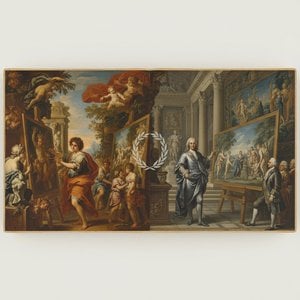
Rutilio di Lorenzo Manetti: Life and Legacy
Early Life and Influences
Rutilio di Lorenzo Manetti (born Siena, Italy, 1571 – died 1639) was an Italian painter active during the transition from late Mannerism to the early Baroque period. He spent his artistic career primarily in Siena, deeply influenced by the established Sienese painting tradition.
- Manetti received formative training and guidance from prominent local artists Francesco Vanni and Ventura Salimbeni, whose styles significantly shaped his early work.
- He also collaborated with Raffaello Vanni, Francesco’s son, further solidifying his connection to the leading artistic circles in Siena.
Artistic Development and Style
Manetti's early works demonstrate a clear adherence to the Mannerist aesthetic, characterized by elongated figures, elegant compositions, and refined detail. However, over time, his style underwent a notable transformation.
- Around the beginning of the 17th century, Manetti began incorporating elements of the emerging Baroque style, particularly the dramatic use of light and shadow (tenebrism) associated with Caravaggio.
- The exact source of this stylistic shift remains debated – it could have been influenced by other Sienese and Florentine painters or through direct exposure to Roman art.
- His work is marked by a blend of gracefulness inherited from Mannerism and the heightened emotional intensity characteristic of Baroque painting.
Major Works and Achievements
Manetti created numerous paintings for churches and public buildings in Siena and surrounding towns, establishing himself as a leading artist in the region. Some of his most significant works include:
- Story of St Catherine and Pope Gregory (1597; Palazzo Pubblico, Siena) – An early example showcasing his Mannerist training.
- Baptism of Christ (1600; Church of San Giovannino in Pantaneto) – Demonstrates a growing sophistication in composition and color.
- A fresco cycle depicting the Story of St Roch (1605–1610; San Rocco alla Lupa) – A large-scale project showcasing his narrative skills.
- Rest on the Flight to Egypt (San Pietro alle Scale, Siena) - Illustrates his evolving Baroque style with dramatic lighting and emotional depth.
- His contributions to the Casino Mediceo in Siena, alongside artists like Matteo Rosselli and Giovanni Lanfranco, represent a high point in his career.
Historical Significance and Legacy
Rutilio Manetti played an important role in the artistic transition occurring in Siena during the late 16th and early 17th centuries. He successfully navigated the shift from Mannerism to Baroque, adapting his style to meet changing aesthetic preferences.
- His work reflects the religious fervor of the Counter-Reformation, with many paintings depicting scenes from the lives of saints and biblical stories.
- Manetti’s influence extended to a younger generation of artists, including his pupil Stefano Volpi.
- While not as widely recognized internationally as some of his contemporaries, Manetti remains an important figure in the history of Sienese painting and a valuable example of artistic adaptation during a period of significant change.
Pytania i odpowiedzi
Gdzie mogę znaleźć statystyki dotyczące dzieł Rutilio di Lorenzo Manetti?
Statystyki dotyczące dzieł artysty Rutilio di Lorenzo Manetti można znaleźć na jego stronie Statystyki odwiedzin.
Czy mogę przeglądać dzieła Rutilio di Lorenzo Manetti według techniki wykonania?
Aby znaleźć wszystkie dzieła artysty Rutilio di Lorenzo Manetti wykonane w danej technice, odwiedź stronę Wszystkie techniki.
Na jakie okresy dzieli się kariera Rutilio di Lorenzo Manetti?
Kariera Rutilio di Lorenzo Manetti rozwija się etap po etapie na stronie Osiągnięcia artystyczne: jako pozioma oś czasu dzieł, pogrupowanych w rozdziały odpowiadające poszczególnym okresom twórczości.