Robert McInnes: A Painter of Victorian Life
Robert McInnes (1801-1886) emerges from the rich tapestry of 19th-century Scottish art as a skilled and observant painter, best known for his evocative genre scenes, meticulously rendered portraits, and captivating glimpses into Italian landscapes. His work offers a valuable window into Victorian society – its rituals, social dynamics, and everyday moments – presented with a polished style that reflects both technical mastery and a keen understanding of human psychology. While not as widely celebrated as some of his contemporaries, McInnes’s contribution to the visual record of his era is significant, particularly through pieces like ‘The Sunday School,’ which provides a poignant snapshot of Victorian morality and community life.
Born in Scotland, the precise details of McInnes' early life remain somewhat elusive. His artistic training likely began within established Scottish traditions, absorbing influences from the prevailing academic style prevalent at the time. However, he quickly developed his own distinctive approach – a careful balance between realism and a subtle romanticism. His paintings aren’t merely depictions; they are carefully constructed narratives, imbued with atmosphere and a sensitivity to light and shadow. He demonstrated an ability to capture not just appearances but also the emotional tenor of his subjects, evident in the expressions of quiet contemplation or gentle amusement that frequently grace his portraits.
Genre Scenes and Social Realism
McInnes’s most enduring legacy lies in his genre paintings. These scenes – often depicting domestic life, social gatherings, or moments of leisure – offer a remarkably detailed portrayal of Victorian society. ‘The Sunday School,’ perhaps his most famous work, exemplifies this talent. It's not simply a record of a religious gathering; it’s a study of class distinctions, the roles of women and children, and the prevailing moral values of the era. The composition is meticulously arranged, with each figure carefully positioned to convey a specific social role or relationship. His ability to capture these nuances – the attentive gaze of the teacher, the shy glances of the students, the quiet dignity of the elderly – speaks volumes about his observational skills and artistic insight.
Beyond ‘The Sunday School,’ McInnes produced numerous genre scenes that provide a valuable social commentary. He frequently depicted rural life, capturing the rhythms of farming communities and the simple pleasures of country living. His portraits, too, are not merely likenesses; they reveal something about the sitter’s character and status. He skillfully employed lighting and pose to create an impression of personality – whether it be the stern authority of a landowner or the gentle grace of a young woman.
Italian Landscapes and Artistic Development
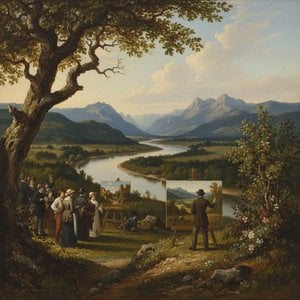
While McInnes is primarily remembered for his domestic scenes, he also possessed considerable skill in painting Italian landscapes. These works demonstrate a shift towards a more expressive style, influenced by the Romantic movement and perhaps informed by his travels. His Italian paintings are characterized by vibrant colors, dramatic lighting, and an emphasis on atmospheric effects – capturing the beauty of the Tuscan countryside or the rugged grandeur of the Amalfi Coast. The influence of artists like Turner is evident in his use of light and color to evoke mood and atmosphere.
It’s believed that McInnes spent considerable time in Italy during his career, immersing himself in the artistic traditions of the region. This exposure undoubtedly shaped his style and broadened his artistic horizons. His Italian landscapes represent a significant departure from his earlier, more restrained works, showcasing a newfound confidence and experimentation with technique.
Connections and Legacy
Robert McInnes was associated with the Royal Scottish Association of Artists (RSA), a prominent organization that played a crucial role in promoting artistic development in Scotland during the 19th century. Membership in the RSA provided him with opportunities to exhibit his work, network with other artists, and gain recognition for his talent. His connection to this influential group underscores his place within the broader context of Scottish art history.
Although he may not be as widely celebrated as some of his contemporaries, Robert McInnes’s paintings offer a valuable glimpse into Victorian life – its social customs, moral values, and everyday experiences. His polished style, combined with his keen observational skills and subtle emotional insights, ensures that his work continues to resonate with viewers today. The Robert McLaughlin Gallery in Oshawa, Canada, houses a significant collection of his works, offering visitors the opportunity to appreciate the enduring quality of his art.
Further research into McInnes’s life and work can be found at resources such as Art UK (https://artuk.org/discover/artists/mcinnes-robert-18011886) and the Robert McLaughlin Gallery website (https://www.robertmclaughlingallery.com/).
Pytania i odpowiedzi
Gdzie można znaleźć dzieła Robert Mcinnes pogrupowane według nurtów artystycznych?
Strona Wszystkie nurty artystyczne grupuje dzieła Robert Mcinnes według nurtów artystycznych.
Gdzie mogę zobaczyć dzieła Robert Mcinnes w wirtualnej galerii 3D?
Dzieła Robert Mcinnes można podziwiać w galerii 3D na stronie Wirtualna Galeria 3D artysty.
Jak mogę znaleźć dzieła artysty Robert Mcinnes w konkretnej palecie barw?
Prace artysty Robert Mcinnes można przeglądać według palety kolorystycznej na stronie Według palet kolorystycznych artysty.