Robert Julian Onderdonk: The Texas Landscape Illuminated – A Life in Light and Color
Robert Julian Onderdonk, affectionately known as “the father of Texas painting,” wasn’t simply a recorder of the Lone Star State's beauty; he was its passionate interpreter, translating the spirit of the land onto canvas with an unparalleled sensitivity. Born in San Antonio on July 30, 1882, into an artistic lineage – his father, Robert Jenkins Onderdonk, being a respected painter himself – Julian’s life unfolded as a deeply personal and profoundly creative exploration of light, color, and the captivating essence of his native land. His early years were steeped in this artistic atmosphere, nurtured by a family that valued both intellectual pursuits and the expressive power of art; this foundation proved crucial, shaping a career dedicated to capturing the soul of Texas on canvas. The Onderdonk heritage also extended to education through his grandfather, Henry Onderdonk, who served as headmaster of Saint James School in Maryland, instilling a sense of refinement alongside artistic fervor. From these roots blossomed a talent that would come to define a distinctly Texan voice within the broader American Impressionist movement.From New York Studies to a Texan Vision
Onderdonk’s formal artistic journey began at West Texas Military Academy, where he simultaneously honed his skills and supported his education by teaching art. A pivotal moment arrived in 1901 when, through the generosity of a neighbor, he traveled to New York City. There, he immersed himself completely in the teachings of William Merritt Chase at Shinnecock Hills Summer School of Art on Long Island. This experience proved transformative, instilling within him a deep appreciation for *en plein air* painting – the practice of creating art directly from nature – and an unwavering focus on capturing those fleeting, ephemeral moments of light and atmosphere. He continued his studies with Chase for several years, absorbing not just techniques but also the philosophy behind them, learning to see the world through an artist’s eye. Despite initial attempts to establish himself in New York’s bustling art scene, where he married Gertrude Shipman and began a family, Onderdonk found an undeniable pull back towards the landscapes of his youth – the familiar hues and expansive vistas of Texas called to him with a powerful resonance. The vibrant colors and seemingly endless horizons of the Texan countryside promised a unique artistic inspiration that the urban environment simply couldn’t match.A Homecoming and the Bloom of Inspiration
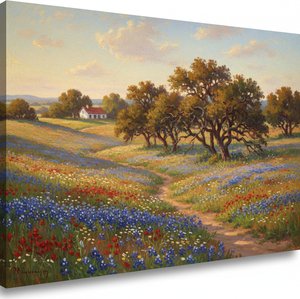
The year 1909 marked a significant turning point as Onderdonk returned to San Antonio, bringing with him his family. This relocation ushered in what would become the most productive and celebrated period of his career. He wholeheartedly dedicated himself to portraying the beauty of the Texan countryside, quickly becoming renowned for his vibrant depictions of bluebonnet fields – scenes that would soon become inextricably linked with his artistic identity. Onderdonk’s paintings are characterized by a distinctive style: loose brushstrokes that seemed to dance across the canvas, a rich palette of colors drawn directly from the landscape itself, and an unwavering focus on capturing the fleeting qualities of light and atmosphere. He wasn't merely painting landscapes; he was conveying a feeling, an experience – the very soul of Texas. His paintings are imbued with a sense of warmth, nostalgia, and a deep connection to the land. Works like “Blue Bonnet Field, Early Morning, San Antonio Texas” (1914), “Road to the Hills” (1918), "Early Spring—Bluebonnets and Mesquite" (1919), “Coreopsis, near San Antonio, Texas” (1919), and “Dawn in the Hills” (1922) exemplify his mastery of Impressionistic techniques and his profound understanding of how to translate the essence of a Texan landscape onto canvas. He sought not just to represent what he saw, but *how* it felt to be immersed in that landscape – bathed in its light and air.Key Influences and Artistic Style
Onderdonk’s artistic development was shaped by several key influences. William Merritt Chase's emphasis on *en plein air* painting—working directly from nature—was particularly formative, instilling a deep respect for the immediacy of observation and the importance of capturing fleeting moments of light. The teachings of James Carroll Beckwith also played a role in shaping his approach to color and composition. However, it was his own unique connection to Texas that truly defined his style. He developed a distinctive palette—often dominated by blues, greens, and yellows—that perfectly captured the colors of the Texan landscape. His brushwork was loose and expressive, creating a sense of movement and vitality in his paintings. He wasn’t interested in photographic realism; instead, he aimed to evoke an emotional response in the viewer through color, light, and composition. He skillfully blended Impressionistic techniques with a distinctly Texan sensibility, resulting in works that are both beautiful and deeply evocative.Historical Significance and Legacy
Robert Julian Onderdonk's untimely death in 1922 at the age of forty tragically cut short a promising career, yet his legacy continues to resonate profoundly within Texan artistic circles and beyond. He is widely regarded as “the father of Texas painting,” a title earned through his unwavering dedication to portraying the unique beauty of the Texan landscape and establishing a distinctly Texan voice within American Impressionism. His influence extended far beyond his own creations, inspiring generations of artists to embrace regional subjects and develop their own distinctive styles rooted in the spirit of the Southwest. Recognition of his importance grew steadily over time, culminating in national acclaim – three of his paintings were even proudly displayed in the Oval Office during President George W. Bush’s administration. The Dallas Museum of Art houses a significant collection of his work, dedicating several rooms to showcase his artistic achievements and the evolution of his style. Furthermore, the preservation of his former art studio on the grounds of the Witte Museum in San Antonio serves as a tangible reminder of his enduring legacy – a place where visitors can step back in time and experience the world through the eyes of one of Texas’s most beloved artists. His work remains a powerful testament to the beauty and spirit of Texas, continuing to captivate audiences with its vibrant colors and evocative depictions of the natural world. His art is not merely a visual representation; it's an invitation to feel the warmth of the Texas sun and breathe in the scent of its wildflowers.Pytania i odpowiedzi
Jakie pseudonimy lub inne nazwy posiada Robert Julian Onderdonk?
Robert Julian Onderdonk występuje również pod innymi nazwiskami: Julian Onderdonk, Robert Jenkins Onderdonk.
Gdzie mogę zobaczyć profil kolorystyczny twórczości Robert Julian Onderdonk?
Profil kolorystyczny twórczości Robert Julian Onderdonk można zobaczyć na stronie Genom Palety artysty.
W jakim mieście i kraju urodził(a) się Robert Julian Onderdonk?
Robert Julian Onderdonk urodził się w San Antonio w Stany Zjednoczone.