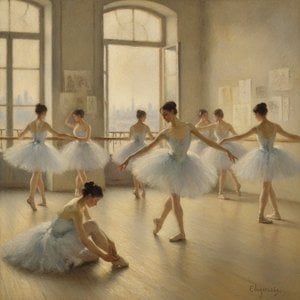
A Legacy of Light: The Life and Art of Richard Emil Miller
Richard Emil Miller was a master of the fleeting moment, an artist who possessed the rare ability to capture the soft, shimmering essence of light as it danced across skin and silk. Born in St. Louis, Missouri, in 1875, his journey from the American Midwest to the heart of the French avant-garde is a quintessential tale of artistic discovery. His early training at the St. Louis School of Fine Arts provided him with a robust academic foundation, yet it was his move to Paris in 1898 that would irrevocably alter the course of his career. Studying under the esteemed Benjamin Constant and Jean-Paul Laurens at the Académie Julian, Miller honed a technical precision that would later serve as the structural backbone for his more experimental, impressionistic endeavors. During his transformative years in France, Miller became an integral part of the Giverny Colony, a vibrant community of American expatriates seeking to capture the ephemeral beauty of the French countryside. Here, amidst the sun-drenched gardens and tranquil landscapes, he forged deep connections with luminaries such as Claude Monet, Camille Pissarro, and Frederick Frieseke. This period was marked by a profound stylistic evolution; while his early works occasionally echoed the darker, more structured influences of Edgar Degas and Édouard Manet, his immersion in Giverny pushed him toward a luminous palette and a more decorative, atmospheric approach to painting.The Art of Intimacy and Impression
Miller’s mature style is celebrated for its exquisite balance between academic rigor and impressionistic freedom. He was primarily a figurative painter, renowned for his ability to depict women with a sense of gentle sensuality and quiet introspection. His canvases often feature figures lounging in sun-flecked interiors or wandering through lush, verdant gardens, where the boundaries between the subject and their environment seem to dissolve into a tapestry of broken brushstrokes and vibrant colors. There is a rhythmic quality to his compositions, often utilizing repeated diagonals of furniture or floral elements to guide the viewer's eye through a scene of domestic tranquility. His technical mastery allowed him to achieve what he called a "pleasant optical sensation," prioritizing the decorative beauty of light and color over heavy-handed narrative. This approach was not merely about aesthetics; it was an intentional effort to create art that resonated with the intimacy of everyday life. Whether painting a quiet moment of tea-time or the dappled shadows of a summer afternoon, Miller’s work evokes a sense of nostalgia and peace, inviting the observer into a world where time seems to slow down.Achievements and Enduring Influence
The recognition bestowed upon Miller during his lifetime was both widespread and prestigious. His talent earned him significant accolades in the European art circuit, including gold medals at the Salon des Artistes Français in 1900 and 1904, as well as the highly coveted Légion d'Honneur in 1906. These honors solidified his status as a leading figure of the second-generation American Impressionists. Upon returning to the United States due to the onset of the Great War, he continued to influence the burgeoning art scenes in California and eventually settled in the historic colony of Provincetown, Massachusetts, where he remained until his death in 1943. The historical significance of Richard Emil Miller lies in his role as a bridge between the rigorous traditions of academic painting and the emotive freedom of Impressionism. His ability to marry defined contours with a luminous, airy atmosphere created a unique aesthetic that remains deeply captivating to modern audiences. Today, his works serve as a testament to an era of profound artistic experimentation, reminding us of the enduring power of light, color, and the simple beauty found in life's most quiet moments.- Key Artistic Milestones:
- Recipient of the Légion d'Honneur (1906)
- Gold Medalist at the Paris Salon (1900, 1904)
- Prominent member of the Giverny Colony
- Influential teacher at the Académie Colarossi and in California
Pytania i odpowiedzi
Czy istnieje zestawienie wszystkich tematów, które malował Richard Emil Miller?
Strona Atlas tematów prezentuje dzieła Richard Emil Miller pogrupowane według tematów.
Gdzie można znaleźć dzieła Richard Emil Miller pogrupowane według palety barw?
Strona Według palet kolorystycznych grupuje dzieła Richard Emil Miller według ich palet kolorystycznych.
Czy istnieje oś czasu prac Richard Emil Miller?
Oś czasu prac Richard Emil Miller jest dostępna na stronie Chronologia dzieł, gdzie dzieła zostały uporządkowane według daty ich powstania.