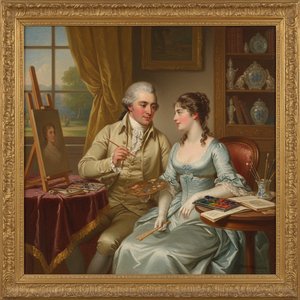
Richard Cosway (1742–1821) – A Life in Miniature: The World of Richard Cosway
Richard Cosway, born in the quiet Devon town of Tiverton in 1742, ascended to become one of the most celebrated portrait miniaturists of his age. His journey began with a precocious talent recognized early on; at twelve years old, he was already demonstrating artistic promise significant enough to warrant a move to London for formal training. He studied under Thomas Hudson and William Shipley, foundational figures who instilled in him not only technical skill but also an entrepreneurial spirit that would define his career. Even before establishing his own business by 1760, Cosway had secured recognition from the Society of Arts, foreshadowing the acclaim he would soon garner within London’s vibrant artistic circles. This early success wasn't merely about talent; it was a testament to ambition and a keen understanding of the burgeoning market for portraiture during the Georgian era.Early Years and Artistic Foundations
Richard Cosway’s formative years were marked by an exceptional education, beginning with instruction at Blundell’s School in Tiverton—a prestigious institution where his father served as master—before relocating to London at twelve to pursue formal artistic training under Thomas Hudson and William Shipley. These mentors imparted not only mastery of oil painting but also a crucial element: the drive for success that would propel Cosway into prominence. His early engagement with the Society of Arts demonstrated an astute grasp of prevailing tastes and established him as a rising star within London’s burgeoning artistic milieu. He quickly honed his technique, absorbing influences from Hudson's meticulous realism and Shipley's dedication to fostering a supportive environment for aspiring artists—a partnership that proved instrumental in shaping Cosway’s distinctive style.The Regency Miniature Style
Cosway swiftly distinguished himself through his exquisite miniatures, a particularly popular art form during the Regency era – an age captivated by elegance and personal representation. Unlike grand canvases, these diminutive portraits demanded unparalleled precision and subtlety; Cosway achieved this remarkable feat with a refined attention to detail, utilizing delicate watercolor washes alongside meticulous oil glazing techniques. He wasn’t merely replicating appearances; he was crafting intimate glimpses into character and social standing—a skill that resonated deeply with the aristocratic clientele of his time. His style embodied the prevailing aesthetic sensibilities of the period: restrained color palettes, luminous highlights, and an uncanny ability to convey emotion through subtle expressions – qualities that cemented his reputation as *the* miniaturist of the Regency era.Notable Commissions and Artistic Recognition
Cosway’s talent quickly garnered considerable acclaim, culminating in his election as Associate Member of the Royal Academy in 1770—a pivotal moment signifying his acceptance into London’s elite artistic community. This honor was swiftly followed by full membership in 1771, placing him amongst the foremost artists of his day and securing his place alongside luminaries like Joshua Reynolds and Francis Hayman. His inclusion in Johan Zoffany’s group portrait of Royal Academy members—a collaborative effort showcasing the collective spirit of artistic endeavor—served as a tangible testament to his peers’ respect and admiration. However, Cosway's career reached its zenith with his appointment as Painter to the Prince of Wales in 1785 – an unprecedented gesture of royal patronage that elevated him to the highest echelon of British society. This prestigious role afforded him access to influential circles and solidified his legacy as a champion of artistic excellence.A Legacy Enduring Through Time
Richard Cosway’s influence extended far beyond his own lifetime, shaping subsequent generations of miniature artists and establishing him as a cornerstone of British art history. His meticulous technique—characterized by layering watercolor washes over oil glazes—continues to inspire admiration among connoisseurs today. Works such as *Mrs Siddons Reading In A Grotto* exemplify Cosway’s ability to capture dramatic emotion with remarkable accuracy, while *Portrait Of Lady Almeria Carpenter* showcases his mastery of tonal gradation and subtle color harmonies. Furthermore, Cosway's contribution to the broader artistic landscape—particularly his involvement in fostering a vibrant salon culture alongside fellow artists like William Blake and Chevalier d’Éon—underscores his role as not merely a painter but also as a humanist engaged in intellectual discourse and creative collaboration. His enduring legacy serves as a poignant reminder of an era defined by sophistication, refinement, and the transformative power of art to illuminate human experience.Pytania i odpowiedzi
Czy mogę przeglądać dzieła Richard Cosway według tematyki?
Dzieła artysty Richard Cosway można przeglądać według tematów na stronie Atlas tematów poświęconej temu artyście.
Gdzie i w którym roku urodził(a) się Richard Cosway?
Richard Cosway urodził się w Tiverton w 1742.
Ile dzieł Richard Cosway można przejrzeć w katalogu?
Możesz przeglądać 85 dzieł sztuki dzieł autorstwa Richard Cosway na stronie Wszystkie dzieła sztuki.
Gdzie mogę zobaczyć wszystkie dzieła artysty Richard Cosway?
Każde dzieło Richard Cosway dostępne w ta strona można przeglądać na stronie Wszystkie dzieła sztuki artysty.
W jakiej epoce historycznej tworzył/a Richard Cosway?
Richard Cosway tworzył w okresie – Wczesna nowożytność. Epoka ta osadza twórczość artysty w kontekście historycznym.
W jakim mieście i kraju urodził(a) się Richard Cosway?
Richard Cosway urodził się w Tiverton w Wielka Brytania.
Czy istnieje chronologiczny opis twórczości Richard Cosway?
Kariera Richard Cosway rozwija się etap po etapie na stronie Kronika: jako pozioma oś czasu dzieł, pogrupowanych w rozdziały odpowiadające poszczególnym okresom twórczości.
Czy dostępna jest wirtualna wycieczka 3D po dziełach Richard Cosway?
Możliwa jest wirtualna wizyta: strona Muzeum 3D artysty Richard Cosway prezentuje dzieła twórcy w galerii trójwymiarowej.