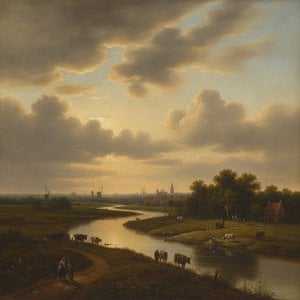
The Shadow and Light of the Dutch Golden Age
In the vibrant, bustling landscape of the seventeenth-century Netherlands, few artists captured the quiet drama of existence as poignantly as Reyer Jacobsz van Blommendael. Born in Amsterdam in 1628, a period when the Dutch Republic was ascending to unparalleled heights of cultural and economic power, Blommendael’s life was woven into the very fabric of this Golden Age. While much of his personal history remains veiled by the passage of centuries, the fragments left behind—notarial deeds, guild records, and the tender mentions in his sister Risje’s will—paint a picture of a man deeply embedded in the artistic pulse of Haarlem and The Hague. He was a painter who did not merely observe the world but sought to translate its most mundane and profound moments into a visual language of striking realism.
His journey through the ranks of the Haarlem Guild of St. Luke, which he joined in 1662, signifies his formal recognition as a master of his craft. Though the specific identity of his mentor remains a subject of scholarly debate, the echoes of great masters resonate through every brushstroke. There is an undeniable presence of chiaroscuro in his work, a technique that suggests a profound engagement with the dramatic light-and-shadow play popularized by Rembrandt. This mastery allowed him to breathe life into skin tones and create a psychological depth that transformed simple compositions into windows of human emotion.
A Visionary Realism: From Domesticity to Myth
Blommendael’s artistic repertoire was remarkably diverse, ranging from the whimsical to the epic. He possessed a rare ability to navigate between the intimate and the monumental. In his more playful works, such as The Smoking Room, he ventured into the realm of anthropomorphic storytelling, populating cozy, atmospheric settings with animals engaged in human-like leisure. These scenes, while charming, are executed with a meticulous attention to texture and light that prevents them from descending into mere caricature, instead offering a delightful commentary on social habits and domestic warmth.
Yet, the artist was equally capable of tackling the weight of classical and biblical narratives. His canvases often explored the complexities of human relationships and historical legends, as seen in works like Paris and Oenone or the dramatic Xantippe Dousing Socrates. In these pieces, Blommendael utilized his skill in rendering realistic figures to ground mythological subjects in a tangible, almost visceral reality. He did not shy away from the "warts and all" approach; his commitment to presenting subjects as they truly appeared—unidealized and raw—gave his historical and biblical scenes an unexpected intimacy and a sense of immediate, lived experience.
Legacy and Historical Significance
The significance of Reyer van Blommendael lies in his role as a bridge between the high drama of the early Golden Age and the more observational, genre-focused styles that would follow. His ability to infuse everyday life—the smoke of a tavern, the bustle of a marketplace, or the quietude of a domestic interior—with a sense of profound atmosphere ensured that his work remained deeply resonant. He captured the essence of an era defined by its fascination with the tangible world and the human condition.
Though he passed away in 1675, leaving behind a legacy preserved in the halls of great institutions like the Musée des Beaux-Arts de Strasbourg and the Grote Kerk in Haarlem, his influence persists. He remains a vital figure for anyone seeking to understand the nuances of Dutch realism—a master who found the extraordinary within the ordinary and the eternal within the ephemeral.