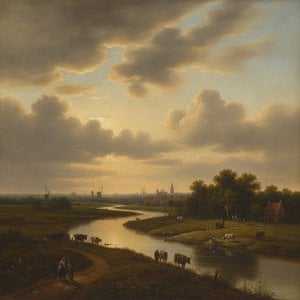
A Refined Vision of the Dutch Golden Age: Pieter van der Werff
Pieter van der Werff, a name perhaps less immediately recognized than those of Rembrandt or Vermeer, nevertheless occupies a significant and fascinating niche within the pantheon of Dutch Golden Age painters. Born in The Hague in 1665 and passing away in Rotterdam in 1722, his career unfolded during a period of immense artistic flourishing in the Netherlands, yet he carved out a distinctive style characterized by elegance, meticulous detail, and an early embrace of innovative pigments. His life was deeply intertwined with that of his older brother, Adriaen van der Werff, who served as both mentor and foundational influence, shaping Pieter’s trajectory from its earliest stages. While Adriaen achieved considerable renown – even securing a prestigious position at the court of the Elector Palatine – Pieter established himself primarily in Rotterdam, becoming the favored portraitist of the city's affluent citizenry and leaving behind a legacy that offers invaluable insights into the social fabric and aesthetic sensibilities of his time.Early Life and Artistic Training
Pieter’s formative years were profoundly shaped by familial connections. Adriaen van der Werff, already an established painter with considerable experience in portraiture and genre painting, instilled in Pieter a dedication to artistic excellence from a young age. This mentorship extended beyond mere technical instruction; it encompassed a crucial introduction to the prevailing artistic currents of the Baroque era – specifically the dramatic compositions, rich color palettes, and emotional intensity championed by artists like Rubens and Caravaggio. Recognizing Pieter’s innate talent, Adriaen encouraged him to pursue his artistic ambitions with unwavering determination, fostering a style that would become synonymous with Dutch Baroque painting. The influence of Flemish masters was palpable in Pieter's early works, demonstrating the breadth of his artistic education and establishing the groundwork for his future stylistic development.Style and Technique: Precision and Psychological Depth
Pieter van der Werff’s artistic signature is defined by remarkable precision combined with a profound understanding of human psychology. Unlike many of his contemporaries who prioritized spectacle over subtlety, he cultivated a style characterized by meticulous observation and painstaking detail—a hallmark that distinguishes him from artists like Rembrandt. His portraits weren't merely representations of physical appearance; they were carefully constructed portrayals designed to convey not only likeness but also character, status, and inner emotions. He achieved this feat through masterful brushwork, utilizing chiaroscuro – the dramatic interplay of light and shadow—to sculpt form and imbue his subjects with palpable presence. This technique allowed him to capture fleeting expressions and subtle nuances of personality, elevating portraiture beyond mere likeness into a powerful medium for psychological exploration. Furthermore, Pieter’s pioneering use of Prussian blue—a pigment newly synthesized in Europe—added depth and luminosity to his canvases, reflecting the artistic spirit of his time and establishing him as one of the foremost innovators of his generation.Notable Works and Artistic Achievements
Pieter van der Werff produced a substantial body of work spanning portraiture, mythological scenes, historical narratives, and genre paintings. Among his most celebrated achievements are “Expulsion of Adam and Eve,” a monumental depiction of biblical drama imbued with dramatic emotion; “Granida and Diafilo,” a poignant portrayal of classical mythology conveying profound pathos; and “Johan de Vries portrait,” a masterful likeness capturing the dignified countenance of Rotterdam’s prominent citizen. These paintings exemplify Van der Werff's ability to synthesize technical virtuosity with artistic vision, demonstrating his mastery of composition, color theory, and psychological rendering. His works are housed in museums across Europe, testifying to their enduring aesthetic appeal and historical significance.Legacy and Influence
Pieter van der Werff’s contribution to Dutch Baroque painting extends beyond the individual masterpieces he created. He served as a pivotal figure within Rotterdam's artistic community, fostering a tradition of refined portraiture and elevating the standards of artistic excellence. His influence can be discerned in the works of subsequent generations of painters who admired his meticulous technique and psychological insight. More broadly, Van der Werff’s legacy embodies the spirit of the Dutch Golden Age—a period characterized by intellectual curiosity, artistic innovation, and a commitment to capturing the complexities of human experience. He remains an artist whose work continues to inspire admiration for its beauty, precision, and profound understanding of the human condition.- His meticulous attention to detail and masterful use of Prussian blue cemented his reputation as one of the most innovative painters of his era.
- The enduring fascination with biblical narratives and classical mythology reflects Van der Werff’s engagement with the intellectual currents of his time.
Pytania i odpowiedzi
Gdzie mogę zobaczyć dzieła Pieter van der Werff w porządku chronologicznym?
Istnieje oś czasu prac Pieter van der Werff: strona Oś czasu dzieł sortuje dzieła według daty ich powstania.
Jak znaleźć dzieła Pieter van der Werff o konkretnej tematyce?
Dzieła artysty Pieter van der Werff można przeglądać według słów kluczowych na stronie Według słów kluczowych. Każde słowo kluczowe grupuje powiązane ze sobą dzieła.
Ile dzieł Pieter van der Werff można przejrzeć w katalogu?
Możesz przeglądać 64 dzieł sztuki dzieł autorstwa Pieter van der Werff na stronie Wszystkie dzieła sztuki.