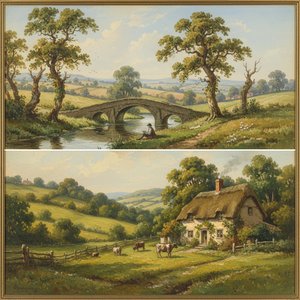
Paul Sandby RA: The Father of Modern Landscape Painting
Paul Sandby (1731 – 7 listopada 1809) stanowi kluczową postać w historii malarstwa krajobrazowego brytyjskiego, rozpoznawalnego nie tylko ze względu na jego artystyczne umiejętności, ale również za wprowadzenie nowej tradycji estetycznej, która głęboko wpłynęła na kolejne pokolenia. Urodzony w Nottingham u Thomasa Sandby’ego, tkacza, młodość Paula była naznaczona samodzielną edukacją i naturalnym zamiłowaniem do obserwacji – cechy, które okazały się kluczowe dla kształtowania się jego niezwykiej kariery jako mapomawcy i malarza. W odróżnieniu od wielu artystów jego czasu, którzy dążyli do formalnego szkolenia, Sandby doskonalił swoje umiejętności niezależnie, zanurzając się w świat natury i precyzyjnie dokumentując jej piękno za pomocą akwareli.- Wczesne lata i edukacja: Formujące lata Paula wykształciły w nim głębokie zrozumienie szczegółów i dokładności – umiejętności, które później bezproblemowo przełożyły się na jego działalność kartograficzną. Jego brat Thomas, również rysownik, wspierał tę artystyczną skłonność, zachęcając do eksperymentowania i budowania współpracy.
- Usługi wojskowe i badania krajobrazu szkockiego: Zaangażowanie Sandby’ego w dział departamentu rysunków wojskowych w Pałacu Lwowskim wpłynęło na niego, otwierając drogę do poznania potęgi Szkocji podczas rebelii jacobitów. Misja ta powierzyła mu tworzenie map topograficznych i szkiców krajobrazów Wysp Szkockich – projektu, który umocnił jego reputację jako wizualnego rejestratora historii i uczynił jednym z czołowych malarzy krajobrazowych tamtej epoki.
- Współpraca i styl artystyczny: Współpraca Sandby’ego z Thomasem była kluczowa dla jego rozwoju artystycznego. Razem założyli oni akademię w Nottingham, przyciągając ambitnych artystów pragnących uczyć się od ich doświadczenia. Ich charakterystyczny styl – charakteryzujący się lśniącymi warstwami koloru i mistrzowskim oddaniem atmosferycznej perspektywy – natychmiast stał się rozpoznawalny i głęboko wpływowy.
- Patronat królewski i wkład architektoniczny: Pozycja Sandby’ego, dzięki wsparciu George'a III, podniosła jego status w środowisku artystycznym, zapewniając mu stanowiska w Akademii Wojskowej w Woolwich oraz w Parku Wielkim Windsor. Jego projekty architektoniczne, takie jak Pałac Cumberlanda, świadczyły o jego wszechstronności i umocniły jego dziedzictwo jako wizjonera budującego harmonię między sztuką a naturą.
- Dziedzictwo i wpływ: Precyzyjne obserwacje Sandby’ego Szkocji – uchwycone w ikonicznych akwarelach, takich jak „The Light Steps” i „West View of the City of Edinburgh” – uczyniły go pionierem malarstwa romantycznego krajobrazu. Jego dzieła promują moc ekspresji koloru i światła, inspirując artystów we wszystkich krajach Wielkiej Brytanii do przyjęcia nowego poczucia estetyki, które stawiało na emocjonalne oddanie ponad dokładność wizualną.
The Early Years and Military Service
Born in Nottingham, Paul Sandby's early life was marked by a strong connection to the natural world. His father, Thomas Sandby, was a textile worker, and Paul’s education was largely self-directed, fueled by an innate curiosity and a keen eye for detail. This foundation proved crucial to his later success as both a mapmaker and a landscape painter. In 1743, at the age of 12, Sandby joined the military drawing department at the Tower of London, where he was tasked with creating topographical maps and sketches of various locations in England and Scotland. This experience exposed him to the techniques of cartography and provided him with valuable training in observation and representation. During his time at the Tower, Sandby also began to develop his artistic skills, experimenting with watercolor and learning from other artists working in the department. He quickly demonstrated a talent for capturing the nuances of light and shadow, as well as an understanding of perspective and composition. The Jacobite Rebellion and Highland Surveys Sandby’s military service coincided with the Jacobite Rebellion (1745-1746), a period of intense political upheaval in Scotland. The British government commissioned Sandby to document the events of the rebellion, including the Battle of Culloden, one of the most decisive battles in Scottish history. As part of his duties, Sandby traveled extensively throughout the Highlands, sketching and painting landscapes, buildings, and people. He meticulously recorded the devastation caused by the rebellion, as well as the beauty and resilience of the Highland culture. His work during this period is considered to be some of his finest, capturing a sense of drama and emotion that was rare for landscape painters at the time. The Importance of Observation Sandby’s military service instilled in him a deep appreciation for observation and detail – skills that would later prove invaluable in his work as a mapmaker and painter. He learned to see the world with a critical eye, paying attention to every aspect of the landscape, from the smallest details to the grandest vistas. This meticulous approach is evident in all of his paintings, which are characterized by their realism and accuracy.Collaboration and Artistic Style
Sandby’s artistic style was shaped by his close collaboration with his brother, Thomas Sandby, a renowned architect and draughtsman. Together, they established an academy in Nottingham, attracting aspiring artists eager to learn from their expertise. Their distinctive style—characterized by luminous washes of color and a masterful depiction of atmospheric perspective—became instantly recognizable and profoundly influential. The Influence of the Royal Academy Sandby’s partnership with Thomas was crucial to his artistic development. Together, they established an academy in Nottingham, attracting aspiring artists eager to learn from their expertise. Their distinctive style—characterized by luminous washes of color and a masterful depiction of atmospheric perspective—became instantly recognizable and profoundly influential. In 1768, Sandby and Thomas became founding members of the Royal Academy, a prestigious institution that would become a center for artistic innovation in Britain. A Pioneer of Watercolor Sandby’s work helped to popularize watercolor as a medium for landscape painting. He was one of the first artists to publish his watercolors in print, making them accessible to a wider audience. His innovative use of color and technique inspired other painters to experiment with watercolor, contributing to its growing popularity throughout the 18th century.Legacy and Influence
Paul Sandby’s legacy as “the father of English watercolor” is secure. His meticulous observations of Scotland—captured in iconic watercolors like “The Light Steps” and “West View of the City of Edinburgh”—established him as a pioneer of Romantic landscape painting. His work championed the expressive power of color and light, inspiring artists throughout Britain and beyond to embrace a new aesthetic sensibility that prioritized emotional resonance alongside visual accuracy. Sandby’s influence can be seen in the works of subsequent generations of landscape painters, who adopted his stylistic principles and embraced his commitment to portraying nature with uncompromising honesty. Sandby remains regarded as “the father of modern landscape painting,” a title justly earned for his pioneering role in shaping British artistic culture and establishing a visual language that continues to resonate with audiences today.Pytania i odpowiedzi
W jakim mieście i kraju urodził(a) się Paul Sandby?
Paul Sandby urodził się w Nottingham w Wielka Brytania.
Skąd pochodzi Paul Sandby?
Paul Sandby urodził się w Wielka Brytania.
Gdzie i w którym roku urodził(a) się Paul Sandby?
Paul Sandby urodził się w Nottingham w 1798.
W jakich nurtach tworzył Paul Sandby?
Nurty, w których tworzył/a Paul Sandby, można zobaczyć na stronie Wszystkie nurty artysty, która grupuje dzieła według nurtów.
W jaki sposób kariera Paul Sandby jest podzielona na okresy?
Chronologiczne zestawienie twórczości Paul Sandby można znaleźć na stronie Kronika, gdzie dzieła prezentowane są w kolejności ich powstania, podzielone na poszczególne etapy kariery.
Czy mogę sortować dzieła Paul Sandby według koloru?
Prace Paul Sandby można przeglądać według kolorów na stronie Indeks barwny artysty.
Czy mogę przeglądać dzieła Paul Sandby według słów kluczowych?
Aby znaleźć dzieła artysty Paul Sandby o konkretnej tematyce, skorzystaj ze strony Według słów kluczowych, która grupuje prace według słów kluczowych.