Omar Carreño Rodríguez: A Venezuelan Pioneer of Abstract and Transformable Art
Omar Carreño Rodríguez (1927-2013) stands as a monumental figure in Venezuelan art, recognized for his distinctive fusion of figurative elements with dynamic abstract compositions. Born in Caracas on February 7, 1927, and passing away in 2013, Carreño’s career spanned seven decades, during which he profoundly influenced the development of modern Venezuelan art and left an indelible mark on international artistic circles. His work is characterized by bold colors, geometric precision, and a revolutionary approach to engaging the viewer – particularly through his pioneering exploration of transformable art.
Early Life and Artistic Formation
Carreño’s early life was marked by a deep engagement with art. He began studying at the Escuela de Artes Plásticas y Aplicadas in Caracas in 1948, laying the groundwork for his future artistic vision. This period wasn't merely about technical skill; it was a crucial time of intellectual and stylistic development. Crucially, he became involved with *Los Disidentes*, a collective of Venezuelan artists who actively sought to challenge established artistic conventions and forge their own path. This group’s spirit of rebellion and experimentation profoundly shaped Carreño’s approach to art-making, encouraging him to question traditional forms and explore new possibilities. His early work demonstrated an interest in both figurative representation and the burgeoning world of abstraction, a duality that would become a defining characteristic of his oeuvre.
The Rise of Abstract Geometric Art & International Recognition
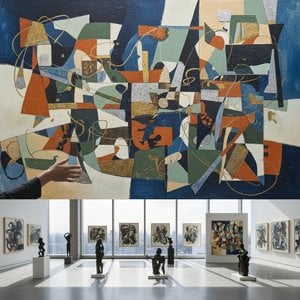
Carreño's artistic career truly took flight in the 1950s, coinciding with the emergence of abstract geometric art in Venezuela. He quickly distinguished himself through works like *La Mesa de Rancagua* (a screenprint now housed at the Inter-American Development Bank), a vibrant Cubist still life that showcased his mastery of color and form. This piece, along with others from this period, established his signature style – a bold interplay between recognizable imagery and dynamic geometric abstraction. His innovative approach to art led him to Paris in 1950, where he joined *Los Disidentes* and began experimenting with transformable artworks. He exhibited these groundbreaking pieces at the Galerie Arnaud in 1952, gaining international recognition for his radical departure from traditional artistic practices. This exhibition marked a pivotal moment, establishing Carreño as a leading figure in the burgeoning movement of kinetic art.
Transformable Art & The Movimiento Expansionista
Carreño’s most significant contribution to the art world lies in his pioneering work with transformable art – pieces designed to be manipulated and reconfigured by the viewer. This concept, central to his artistic philosophy, was formalized as *Movimiento Expansionista* (Expansionist Movement) in 1965. This movement sought to redefine the role of the audience within the artwork, shifting it from passive observer to active participant. Carreño’s transformable works – often intricate geometric structures incorporating hinged elements and sometimes illuminated components – were presented at exhibitions like *Imágenes Transformables* (1971) in Caracas and a monumental installation for the 36th Venice Biennale (1972). These installations demonstrated his ability to create immersive, dynamic environments that challenged conventional notions of art. His work was deeply influenced by artists such as Yaacov Agam, but Carreño’s approach focused on creating interactive experiences rather than purely optical illusions.
Legacy and Continuing Influence
Omar Carreño Rodríguez's legacy extends far beyond his own lifetime. He is considered one of the most important figures in Venezuelan art, a true pioneer who helped to shape the country’s artistic identity. His bold use of color, geometric forms, and innovative approach to viewer engagement continues to inspire artists today. His work has been exhibited extensively throughout Latin America, Europe, and North America, solidifying his place as a globally recognized artist. The Museo de Bellas Artes in Caracas holds a significant collection of his works, ensuring that his artistic vision will continue to be appreciated for generations to come. Carreño’s exploration of transformable art remains remarkably prescient, anticipating contemporary developments in interactive media and digital art. His influence can be seen in the work of numerous Venezuelan artists who followed in his footsteps, carrying forward his legacy of experimentation and innovation.