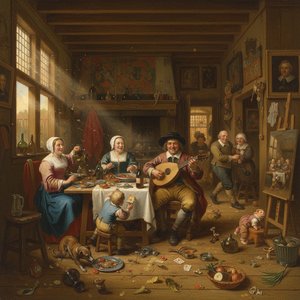
Nicolaas Hogenberg: Pioneer of Dutch Landscape Printmaking
Nicolaas Hogenberg (c. 1500 – 1539) stands as a pivotal figure in the burgeoning artistic landscape of the Dutch Golden Age, recognized primarily for his groundbreaking contributions to landscape printmaking and his meticulous depictions of biblical scenes. Though overshadowed by contemporaries like Rembrandt and Rubens during his lifetime, Hogenberg’s innovative techniques and stylistic choices cemented his legacy as one of the foremost Flemish printmakers of his era, shaping the visual vocabulary of Northern Renaissance art.
Early Life and Training
Born in Munich, Germany, around 1500, Hogenberg's formative years were steeped in the artistic traditions of Bavaria’s imperial court. Precise biographical details remain elusive, largely due to the scarcity of surviving documentation; however, evidence suggests he apprenticed under Pieter Bruegel the Elder, arguably the most celebrated landscape painter of his time. This influential mentorship instilled within Hogenberg a profound understanding of atmospheric perspective and compositional principles—skills that would become hallmarks of his artistic output. Bruegel’s emphasis on capturing the grandeur and complexity of nature undoubtedly fueled Hogenberg's ambition to translate these visual sensations onto paper with unprecedented accuracy.
Technique and Artistic Style
Hogenberg distinguished himself from many of his peers through a revolutionary approach to printmaking—specifically, the development of *aluve*, or "open air" etching techniques. Unlike conventional methods that relied on masking off areas of the plate, aluve allowed for direct incision into the metal surface, creating intricate lines and textures that faithfully reproduced the contours of natural landscapes and architectural structures. This technique demanded exceptional precision and patience, reflecting Hogenberg’s meticulous attention to detail—a characteristic that permeated his entire oeuvre. His prints possessed a remarkable realism, achieved through painstaking observation and skillful manipulation of tonal gradations, capturing subtle nuances of light and shadow with breathtaking subtlety.
Notable Works and Influences
Hogenberg's artistic output spanned a diverse range of subjects, primarily focusing on religious iconography—particularly depictions of the Virgin Mary and Child—and landscapes inspired by Flemish countryside vistas. Among his most celebrated achievements are monumental prints illustrating scenes from Genesis and Exodus, showcasing his mastery of perspective and dramatic composition. These works exemplify the humanist spirit of the Renaissance, blending biblical narratives with idealized representations of human experience. Furthermore, Hogenberg’s artistic style drew inspiration from both Bruegel's landscapes and Flemish Mannerism—a stylistic movement characterized by elongated figures, stylized drapery, and a heightened sense of emotion. He skillfully synthesized these influences into a distinctive visual language that resonated powerfully with audiences across Europe.
Legacy and Historical Significance
Despite his relatively short life – he died in Antwerp in 1539 – Nicolaas Hogenberg exerted an enduring influence on subsequent generations of printmakers. His aluve technique became widely adopted, establishing it as the dominant method for landscape printing throughout the Netherlands and beyond. More importantly, Hogenberg’s prints served as crucial conduits for disseminating humanist ideas and artistic innovations across Europe, contributing significantly to the development of Northern Renaissance art history. Today, his masterpieces continue to captivate viewers with their unparalleled beauty and technical virtuosity—testaments to a singular artist's unwavering dedication to capturing the sublime grandeur of the natural world and conveying profound spiritual truths through visual artistry.