A Dissection of the Everyday: The World of Nazgol Ansarinia
Born in Tehran in 1979, Nazgol Ansarinia’s artistic journey is deeply interwoven with the fabric of her city—a metropolis undergoing constant transformation. Her work isn't simply *about* Tehran; it’s born from its rhythms, its anxieties, and its hidden layers. Ansarinia doesn’t present a picturesque view of Iran, but rather an intricate examination of the systems that govern daily life within it. She approaches her art as a form of meticulous investigation, dissecting the mundane to reveal the complex networks of power, memory, and social control at play. This analytical approach stems from her educational background—a Bachelor’s degree from the London College of Communication in 2001 followed by an MFA from the California College of the Arts in San Francisco in 2003—which instilled a strong foundation in design principles and critical theory. It's this unique blend that allows her to move beyond surface appearances, probing beneath the veneer of routine to expose the underlying structures shaping Iranian society.
From Domestic Spaces to Urban Landscapes
Early in her career, Ansarinia’s focus centered on the intimacy of domestic settings. She wasn't interested in portraying idealized homes but rather in exploring how these spaces reflect broader societal concerns. Her work began as a deconstruction of objects and experiences found within the home—patterns on carpets, the arrangement of furniture, the rituals of daily life—reconfigured to reveal hidden meanings and unspoken narratives. This initial exploration gradually expanded outwards, mirroring her growing fascination with the rapidly changing urban landscape of Tehran. The relentless pace of construction and demolition became a central theme, prompting her to investigate the loss of collective memory and the impact of development on individual lives. This shift wasn’t abrupt; it was a natural progression from examining the microcosm of the home to understanding its place within the larger macrocosm of the city. She began to see Tehran itself as a layered text, ripe for interpretation.
Technique and Materials: A Language of Reconstruction
Ansarinia’s artistic practice is remarkably diverse in terms of media. She seamlessly integrates video, 3D printed models, sculpture, drawing, and even municipal murals into her installations. However, a common thread unites these varied approaches—a commitment to research-driven processes and a meticulous attention to detail. Her work often involves the painstaking reconstruction of fragmented objects or environments, creating layered compositions that invite viewers to question their own perceptions. The use of materials is equally significant. Glazed ceramics, for example, appear frequently in her sculptures, referencing traditional Persian craftsmanship while simultaneously embodying fragility and impermanence. The geometric forms she employs are often derived from Islamic architectural designs, acting as both formal elements and conceptual anchors. This deliberate choice of materials and techniques isn’t merely aesthetic; it's a conscious effort to engage with Iranian cultural heritage while also challenging conventional notions of representation.
Recognition and Historical Significance
Ansarinia’s work has garnered significant recognition within the international art world, culminating in awards such as the Abraaj Capital Art Prize in 2009. More importantly, her pieces have found a home in prestigious collections including the Queensland Art Gallery, the Los Angeles County Museum of Art, the Tate Collection, and the British Museum—a testament to their enduring artistic merit and cultural significance. Her inclusion in major exhibitions like the Venice Biennale and the Istanbul Biennial further solidified her position as a leading contemporary artist from Iran. What sets Ansarinia apart is not simply *what* she depicts but *how* she depicts it. She offers a nuanced perspective on Iranian society, moving beyond stereotypes to reveal the complexities of everyday life. Her work challenges viewers to confront their own assumptions and engage with the socio-political realities shaping the contemporary world. She isn’t merely documenting change; she's actively interrogating it.
A Continuing Dialogue
Today, Nazgol Ansarinia continues to live and work in Tehran, remaining deeply connected to the city that inspires her art. Her ongoing exploration of urban development, memory, and social systems demonstrates a commitment to artistic inquiry and a desire to foster dialogue about the challenges facing contemporary Iranian society. Her work is not simply an aesthetic statement; it’s a powerful act of resistance—a refusal to accept easy answers and a relentless pursuit of truth. She invites us to look closer, to question everything we think we know, and to recognize the hidden layers that shape our own realities.
Zespół Redakcyjny WahooArt.com
Quiz wiedzy o sztuce
Do każdego pytania dotyczy tylko jedna poprawna odpowiedź.
Pytanie 1:
In what city was Nazgol Ansarinia born?
Pytanie 2:
What type of art is Nazgol Ansarinia primarily known for?
Pytanie 3:
Which prize did Nazgol Ansarinia receive in March 2009?
Pytanie 4:
Which of the following institutions does *not* include Nazgol Ansarinia's work in its collection?
Pytanie 5:
Where did Nazgol Ansarinia obtain her Master of Fine Arts degree?
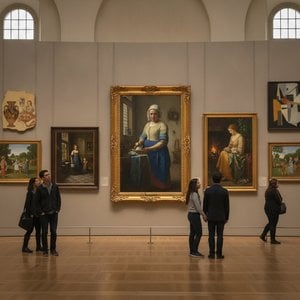
Discover the profound beauty of domestic scene art. Explore how masterworks of genre painting capture intimacy and history, offering timeless elegance for the discerning collector seeking to infuse their home with soul and sophistication.
Explore the profound beauty of domestic life through art history. From Dutch Golden Age realism to Post-Impressionist intimacy, discover how masterworks capture the heart of the home and learn to bring timeless elegance into your personal collection with expert guidance.