Early Life and Training
Mori Tetsuzan (森徹山), born Yoshino in Japan around 1775, emerged from a family steeped in artistic tradition. His father, Syuhou Mori (森周峰), was himself a painter—a lineage that profoundly shaped Tetsuzan’s formative years. Recognizing his son's talent, Syuhou diligently nurtured his artistic inclinations, providing him with invaluable instruction and fostering a deep appreciation for the visual arts. Crucially, Tetsuzan studied under the guidance of Mori Tetsuzan (q.v.), another prominent Osaka artist who served as a pivotal mentor. This relationship instilled in him the foundational principles of Maruyama Shijō style—a distinctive approach characterized by bold colors and assertive outlines that would become hallmarks of his oeuvre.Artistic Style and Contributions
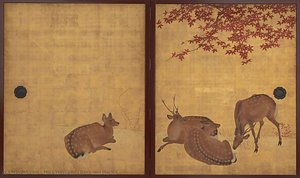
Tetsuzan’s artistic vision was firmly rooted in Chinese painting traditions, which held sway during the late Qing Dynasty and influenced Japanese art extensively. However, he skillfully adapted these influences to forge a uniquely Japanese aesthetic—one imbued with dynamism and emotional resonance. His canvases pulsated with vibrant hues—particularly crimson and gold—contrasting sharply against darker tones, creating dramatic visual effects. Furthermore, Tetsuzan’s meticulous attention to detail ensured that every brushstroke conveyed precise observation and artistic intention. He excelled in depicting animals—especially deer—capturing their grace and vitality with remarkable accuracy. His depictions weren't merely representations; they were imbued with symbolic meaning, reflecting Confucian ideals of harmony and reverence for nature.Notable Artwork
Although definitive records concerning Tetsuzan’s specific artworks remain scarce, his legacy persists through reproductions and scholarly analyses. One particularly noteworthy piece is “Deer and Maples,” a quintessential example of Maruyama Shijō style—a landscape composition featuring deer amidst maple trees bathed in ethereal moonlight. The painting embodies the spirit of its time, reflecting both artistic innovation and philosophical contemplation. It’s considered to be among the most celebrated works of his era.Influences and Connections
Tetsuzan's artistic trajectory was inextricably linked with the broader cultural landscape of Edo Japan. He benefited from the patronage of influential figures—including Mori Sosen (his father-in-law)—who championed artistic excellence. More significantly, he collaborated closely with Maruyama Ōkyo (森沖), a towering figure in Kyoto Shijō style—a relationship that solidified Tetsuzan’s position within the artistic elite and ensured the transmission of stylistic refinements across geographical boundaries. This exchange fostered a vibrant dialogue between Kyoto and Edo art traditions, enriching Japanese visual culture as a whole.Historical Significance
Mori Tetsuzan stands as a testament to Japan's enduring commitment to artistic craftsmanship during the Edo Period. His unwavering devotion to traditional techniques—particularly woodblock printing—contributed significantly to preserving cultural heritage and disseminating aesthetic ideals throughout society. Today, his paintings continue to inspire admiration for their beauty and sophistication—serving as enduring symbols of Japanese artistic achievement and embodying the spirit of a bygone era.Pytania i odpowiedzi
Gdzie można znaleźć dzieła Mori Tetsuzan pogrupowane według słów kluczowych?
Dzieła artysty Mori Tetsuzan można przeglądać według słów kluczowych na stronie Według słów kluczowych. Każde słowo kluczowe grupuje powiązane ze sobą dzieła.
Gdzie mogę zobaczyć dzieła Mori Tetsuzan w porządku chronologicznym?
Oś czasu prac Mori Tetsuzan jest dostępna na stronie Chronologia dzieł, gdzie dzieła zostały uporządkowane według daty ich powstania.
Gdzie można znaleźć dzieła Mori Tetsuzan pogrupowane według nurtów artystycznych?
Nurty, w których tworzył/a Mori Tetsuzan, można zobaczyć na stronie Wszystkie nurty artystyczne artysty, gdzie dzieła są pogrupowane według nurtów.