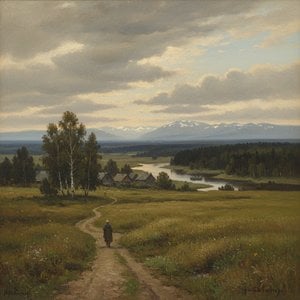
Mikhail Markianovich Germashev (also found as Hermashev or Garmashev), born in 1867 in Kharkov, Russian Empire (now Kharkiv, Ukraine), and passing in Paris in 1930, stands as a significant, if sometimes overlooked, figure in the rich tapestry of Russian landscape painting. His life and career bridged the flourishing of late 19th-century Realism and the tumultuous changes of the early 20th century, including the Russian Revolution and subsequent emigration. Germashev's art is characterized by its profound lyricism, its subtle yet masterful depiction of the Russian countryside, particularly its ephemeral winter and spring moods, and a technical finesse that earned him accolades both in his homeland and later in France.
The environment at MUZHVZ undoubtedly shaped his artistic vision. The school emphasized direct observation and a truthful representation of Russian life and nature, principles that would become central to Germashev's oeuvre. He would have been immersed in an atmosphere where artists like Isaac Levitan, a contemporary who also studied at MUZHVZ and became a towering figure in Russian landscape art, were redefining the genre with their “mood landscapes.” Germashev absorbed these influences, developing his own distinct voice that captured the quiet poetry of the Russian land.
Emergence and Association with Artistic Societies
Germashev began to make his mark on the Russian art scene in the 1890s. From 1894, he became an active participant in exhibitions, showcasing his burgeoning talent. He was associated with several important artistic societies, which were crucial for an artist's development and recognition at the time. These included the Moscow Society of Artists (MTKh) and the Moscow Society of Art Lovers (MOLKh). His involvement with these groups placed him in the mainstream of Moscow’s vibrant artistic life, allowing him to exhibit alongside established and emerging artists.
A pivotal moment in Germashev's early career came in 1897. His painting, “Snow Fell” (Снег выпал), sometimes translated as “The Snow Melts” or “Winter’s Embrace,” garnered considerable acclaim at the Society for Itinerant Art Exhibitions—the Peredvizhniki—where he showcased alongside luminaries like Vasily Polenov and Vladimir Makovsky. The Peredvizhniki championed Realism, rejecting academic conventions in favor of portraying Russian life with unflinching honesty and capturing the emotional resonance of the natural world. Germashev’s participation aligned him with their core tenets, solidifying his position within Moscow's artistic vanguard.
The Influence of Levitan and the Peredvizhniki Movement
Isaac Levitan’s profound impact on Germashev’s artistic sensibilities cannot be overstated. Like Germashev, Levitan honed his skills at MUZHVZ and embraced the Peredvizhniki ethos—a dedication to capturing the soul of Russia through landscape painting imbued with lyrical emotion. Levitan's masterful depictions of Russian forests and marshes, characterized by atmospheric haze and subtle tonal gradations, served as a model for Germashev’s own explorations of winter landscapes. The Peredvizhniki’s insistence on depicting scenes from everyday life—peasants working in the fields, fishermen casting nets, solitary figures contemplating the beauty of nature—provided Germashev with inspiration for his genre paintings and instilled in him a commitment to portraying Russian culture authentically.
Notable Works and Artistic Style
Germashev’s oeuvre comprises approximately 100 paintings, predominantly landscapes rendered in oil on canvas. His distinctive style is marked by meticulous attention to detail—particularly in capturing the textures of snowdrifts, birch bark, and frozen ponds—combined with a masterful command of color and light. He skillfully employed atmospheric perspective, creating depth and luminosity that conveyed the mood and atmosphere of his subjects. Recurring motifs include winter landscapes—often bathed in soft sunlight—and depictions of Russian forests—characterized by dense foliage and muted hues—reflecting Levitan’s influence and embodying the Peredvizhniki's aesthetic vision. Among his most celebrated works are “Beginning of Winter,” acquired by Sergei Sheremetev, and “Winter Landscape,” housed at the Russian Museum in St Petersburg.
Legacy and Recognition
Mikhail Germashev’s artistic legacy extends beyond his individual paintings—though those alone constitute a testament to his talent and dedication. He represents an important link between Realism and Symbolism, embodying the spirit of Russia at the turn of the century. His work continues to resonate with viewers today, offering insights into the psychological complexities of human experience within the context of the Russian landscape. Germashev’s contribution to Russian art history is recognized by scholars and curators alike, ensuring that his artistic vision—characterized by lyrical beauty and unwavering fidelity to nature—remains accessible to future generations.
Odkryj 25 arcydzieł Johna Constable'a – mistrza angielskiego krajobrazu! Poznaj romantyczne pejzaże, technikę malarską i inspiracje z Dedham Vale. Reprodukcje obrazów najwyższej jakości na WahooArt.com. Eksploruj pełną kolekcję online!
Explore the captivating world of Mikhail Nesterov, a pioneer of Russian Symbolism. Discover his spiritual themes, iconic paintings like 'The Hermit,' and lasting influence on Russian art history. Learn more at WahooArt.
Explore the captivating world of Fyodor Vasilyev, a pioneering Russian landscape painter. Discover his lyrical style, influential works like 'Clouds' & lasting legacy. Learn about his life, artistic journey & impact on Russian art history.