Matthijs Maris: Bridging Romanticism and Dreamlike Vision
Matthijs Maris (1838-1917) stands as a singular figure in Dutch art history, an artist who stubbornly resisted categorization yet undeniably captivated audiences with his haunting landscapes and exquisitely rendered portraits. Born in The Hague, Maris’s early artistic ambitions were met with the sting of rejection from the Hague Academy of Art—a setback that ironically propelled him toward a distinctive style rooted in both Romantic idealism and Pre-Raphaelite sensibilities. This unique blend would become the hallmark of his oeuvre, establishing him as one of the most evocative painters of his era, capable of moving beyond mere realism into the realm of the subconscious.
His formative years were marked by a diligent pursuit of mastery despite institutional hurdles. Following his initial failure to pass the academy's entrance exam, he sought instruction from Isaac Cornelis Elink Sterk, the secretary of the institution, honing his foundational skills in private. However, it was the mentorship of the marine painter Louis Meijer that truly steered him toward a professional path. This relationship proved pivotal, as Meijer helped him secure a royal grant from Queen Sophie, an opportunity that allowed Matthijs to follow his brother, Jacob, to Antwerp. In this vibrant Belgian hub, the brothers shared a studio and immersed themselves in a landscape of intense artistic experimentation.
A Journey Through Light and Symbolism
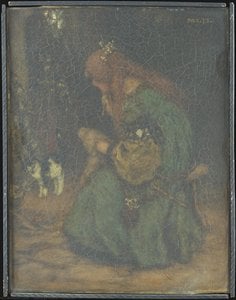
The Antwerp period was instrumental in shaping the mature Maris style. Working alongside his brother Jacob, Matthijs was exposed to a diverse intellectual landscape that included the influence of German Romanticism during travels through Cologne. This exposure sparked a lifelong fascination with expressive power and atmospheric depth. As he moved away from the more conventional, grounded aesthetic of the Hague School, his work began to reflect a profound engagement with folklore, fairy tales, and symbolic detail. His canvases became windows into dreamlike worlds, where the subtle nuances of light and shifting weather conditions served not just to document nature, but to evoke a sense of mystery and longing.
His artistic evolution was further enriched by collaborations and travels that expanded his visual vocabulary:
- The Oosterbeek Circle: In the artist colony of Oosterbeek, Maris connected with notable painters such as Gerard Bilders and Anton Mauve, which helped refine his ability to capture the ephemeral qualities of the Dutch landscape.
- European Travels: His journeys through Switzerland, France, and Germany allowed him to absorb the broader European currents of Symbolism and Impressionism, integrating these into his uniquely Dutch perspective.
- Technical Versatility: Beyond the brush, Maris was a skilled etcher and lithographer, mediums that allowed him to explore more intimate, linear expressions of his visionary themes.
Legacy and Historical Significance
While often grouped with his brothers Jacob and Willem under the umbrella of the Hague School, Matthijs Maris’s legacy is defined by his departure from their shared Realism. He was an artist who looked inward as much as he looked at the horizon. By infusing his landscapes with a sense of the supernatural and the poetic, he bridged the gap between the naturalistic traditions of the Netherlands and the burgeoning Symbolist movement that would sweep through Europe. His ability to capture the unseen—the mood, the myth, and the memory—ensures his place as a vital link in the evolution of modern Dutch painting, leaving behind a body of work that continues to haunt and inspire the contemporary imagination.
Pytania i odpowiedzi
Do jakiej epoki należał/a Matthijs Maris?
Matthijs Maris tworzył w okresie 19th Century. Epoka ta osadza twórczość artysty w kontekście historycznym.
Gdzie i w którym roku urodził(a) się Matthijs Maris?
Matthijs Maris urodził się w The Hague w 1838 roku.
Gdzie można znaleźć dzieła Matthijs Maris pogrupowane według tematów?
Strona Atlas tematów prezentuje dzieła Matthijs Maris pogrupowane według tematów.